
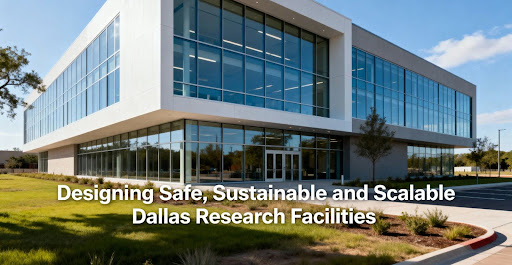
- You can create research facilities that contribute to cutting edge research and long term sustainability, as long as you consider safety, energy consumption, and scalability to be linked priorities.
- Laboratory spaces which apply smarter HVAC, lighting and ventilation strategies can save 30 to 50 percent energy according to recent case studies.
- A flexible facility layout ensures that your team can adjust as equipment changes, research and development grows or new user groups arrive on site.
- Scalable electrical and mechanical design reduces future capital expenditures when the time comes to upgrade, expand or reconfigure.
I have been through many research facilities over the years but I still remember the day I entered a new laboratory on a university campus in Dallas for the first time in my life. The space was impressive, bright, modern, almost too polished for the kind of experimental work that goes on inside. However, the first thing I noticed was that the ventilation system ran loudly. The amount of air that was passing through each fume hood did make me believe the building was spending significantly more on energy use than it should. It was a small thing, but it reminded me that a well engineered building is not only a well engineered building is well equipped with good equipment, it’s well equipped with good design choices that ensure there is a minimum of waste and people are protected.
You may be planning a new research facility, or you may be considering upgrades from an existing building. Either way, you will be faced with the same challenge. How do you design a laboratory that is safe, feels efficient, limits operational overhead and still affords you room to grow? Dallas continues to tighten its stance in the research and development market so the expectation for a higher performance is an increasing year by year expectancy.
Let me take you step by step through some of the major factors in creating a strong laboratory space, and how each one affects the next.
Why Safe and Sustainable Facilities are Important in Dallas
A laboratory is not simply another building. It is a facility that is built around equipment that operates round-the-clock, chemical storage that requires strict oversight and ventilation requirements that are far in excess of a typical office. Many labs also use three to five times as much energy as most commercial buildings, because the air change rate remains high during the entire day. That is not surprising, but it does represent a real burden to the building system if the design does not optimize air flow.
Dallas research facilities also have a blend of university, biopharma, clinical, engineering and computational research. Different specialties make different demands on the space. Some labs require more freezer units, some have high temperature equipment, some have dangerous chemical materials, and others require open lab space for collaboration. All these demands impact on the footprint, function and the impact on the environment.
I once visited a lab where the experimental area was perfectly organised, but behind it the utility room was a maze. Coils, chillers, an old HVAC system, and a jumble of ductwork indicated that the facility expanded faster than was originally engineered. There was no scalable strategy. This is what we don’t want to happen when planning a new facility.
Code, guideline and safety considerations
Dallas is governed by the International Building Code and its mechanical counterparts and these codes provide a baseline for occupant safety. A laboratory must meet requirements for ventilation, fume hood exhaust, lighting, temperature, chemical storage and hazardous materials handling. A research facility can’t take these as optional features. They are essential functions for determining how safe you can be.
You also will need to measure key performance criteria.
- Air change rate
- Fume hood face velocity
- Temperature controls for each laboratory area
- Freezer backup power
- Pressure levels between laboratory and office areas
Think about how these are tied into sustainability. For example, a high rate of ventilation leads to increased energy use. If the system ramps up in vain, your energy consumption quickly goes up a notch. Some academic facilities have been able to reduce this load by installing occupancy sensors which reduce ventilation when a space is vacant. A tiny change makes a big change for the better.
The design of laboratory safety
Safety is the core of any research facility. A lab is full of potential hazard points ranging from chemical handling to equipment heat loads. Good lab design begins with the separation of clean areas from experiment areas. Clear pathways help the user to navigate safely. Strong lighting is conducive to researchers keeping things in their sight when they work with small pieces of material.
You also want a ventilation system that knows what is needed and what is a waste. A fume hood decreasing to a low volume during the night wastes energy. Some labs are now using automated sash closing systems to reduce energy consumption. It feels like a simple solution but the savings each year are potentially significant.
Another factor is storage. You want chemical storage which allows you to keep incompatible materials apart. You want freezer storage that includes reliable back-up, which is not just handy when you’ve lost a few research samples. It has the potential of setting an entire particular project back months. I once talked to a researcher who lost a whole battery of temperature sensitive samples because the outage came unexpectedly. A better emergency plan would have been all the better for the experimental work.
Designing for sustainable building performance
Sustainability is More than a Trend A laboratory uses a lot of power, water and conditioned air. A sustainable building lets you to minimise the operation costs and enhance the long term performance.
There are a number of components you can look at.
- Ventilation and heating driven HVAC loads
- Lighting that Aids in Lab Work Without Being a Waste
- Equipment using less power, computational devices and machine tools
- Layout decisions that minimize the footprint and optimize utility routing
When you eliminate unnecessary heat load, you also eliminate work for the chiller and coil systems. Reducing energy is not only about saving money. It is also enhancing sustainable performance and reducing the environmental impact of the facility.
According to the U.S. Environmental Protection Agency’s Sustainable Design Requirements, facilities that manage ventilation, lighting loads, and material choices early in the process see measurable improvements in long term performance.
I often encourage owners to go through life cycle cost data. A solution that you think costs you a lot during installation could save you more each year due to the reduction of energy consumption. When a freezer, fume hood or HVAC unit is operating efficiently you will feel the savings in the long run.
Flexible architecture and MEP planning
Scalability is important in Dallas more than most people are aware. The nature of research facilities changes rapidly. A new experimental device, new engineering project or change in the research focus can lead to a change in the way the space must operate.
A flexible layout helps you to respond.
- Service corridors for changes in overhead utilities
- Modular furniture systems
- Open laboratory space that is easily convertible
- Electrical infrastructure designed for future growth
This is where it is important to work with the right partner. Bringing in a team that has experienced working with these setups like an FSG Dallas electrical contractor helps prepare you for future load increases, specialty equipment or new ventilation systems. I have seen spaces where the electrical backbone was too small, making updates in the future very costly. Good planning avoids that.
Pay attention to the nature of the infrastructure. You want sufficient overhead room to allow for ductwork. You want a lot of utility distribution. You want a mechanical system that is able to cope with more volume in the event of facility growth. The U.S. Department of Energy points out that high performance buildings rely on integrated planning, continuous monitoring, and long term scalability. Planning for the present only generates budgetary problems in the future.
Operational performance and maintenance in the long term
A research facility is in constant use. Even when a lab is unoccupied, freezers, machines, ventilation systems and devices are running. The operation of the building needs to be consistently monitored.
Commissioning gives you your best hope of spotting the issues before a researcher does.
- Are the air flows up to standard?
- Are the temperature controls stable?
- Does the HVAC System respond to changes
- Is the lighting suitable for the setting?
Once the building is being used, the facility team needs a plan for maintenance. Where regular practice is implemented to minimize downtime. Monitoring software can be used to track equipment behaviour, energy usage and user feedback. A computational model of the building can help to predict problems before they become expensive.
In a University setting I have seen entire labs closed for a short while due to a failure in one infrastructure. When the mechanical rooms are easy to get into and the systems are designed to be replaceable, these shutdowns last a matter of minutes and not days.
Case studies and practical advice
Several academic and commercial labs have published data on the impact of thoughtful design to reduce energy use. Some facilities have found as much as a 40 per cent reduction in annual energy consumption just by better controlling ventilation. Others found that freezer upgrades alone reduced energy consumption enough to make the investment worthwhile.
You can take these outcomes as your guidance.
- Always look at the long term operation of your research facility
- Always Review the function of each piece of Equipment
- Always Verify How the Design Affects User Productivity
- Always make safety the focus of any strategy
Even a small change in the configuration or the HVS approach can have measurable benefits.
Checklist to plan your Dallas research facility
Here is a basic list to help you get organized.
- Define the function of each laboratory space
- Identify specialty areas, such as chemical storage or hazardous materials
- Specify the ventilation rate and the performance of an HV system that you need
- Focus on lighting, temperature stability and equipment layout
- Plan freezer, machine and device locations early
- Evaluate the utility infrastructure and overheads
- Develop a strategy for collaboration zones
- Track the footprint impact of significant design choices
- Proceed in mapping the operation and maintenance process
- Preparing for future expansion through scalability in building and electrical planning
If you consider each of these as a building block you will end up with a facility that will have a long life.
To wrap things up
Designing research facilities in Dallas requires careful planning, constant mindfulness of safety, and a genuine appreciation of how a laboratory will work in the long run. When you build with sustainability in mind, you decrease day-to-day strain and help enhance the use. When you create a layout that will expand, you will be preparing for new equipment, new users, and new discoveries.
Your facility is now an adaptable resource, rather than a limitation. With the right design choices, thoughtful infrastructure and commitment to sustainable performance, you can create a laboratory that facilitates every researcher that walks through the door.
Meta Title:
Designing Safe, Sustainable and Scalable Dallas Research Facilities
Meta Description:
Design safe, sustainable, and scalable research facilities in Dallas with smart laboratory design, optimized HVAC systems, strong safety planning, and future ready infrastructure to support growth, efficiency, and long term performance.

