
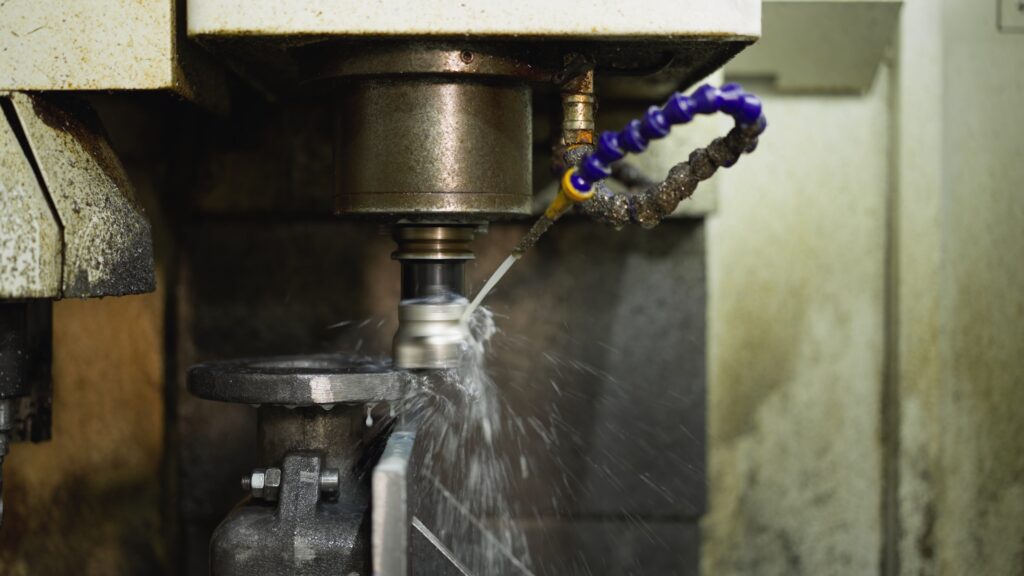
Many businesses create prototypes using manufacturing methods and materials that differ from those intended for production, leading to delays and cost overruns. Prototype-to-production services use computer numerical control (CNC) machining from the very beginning, enabling them to move into high-volume production without redesigns or retooling.
Industrial professionals supplying defense-related components must look for companies registered under the International Traffic in Arms Regulations (ITAR). ITAR CNC machining provides precision parts that meet stringent security and reporting protocols.
Prototype-to-Production Services Close the NPI Gap
When taking a product from design to full-scale manufacturing, many industrial professionals encounter the new product introduction (NPI) gap. This costly disconnect occurs between the prototyping phase and mass production.
Say a drone company uses three-dimensional (3D) printing to create a plastic prototype of a propeller blade. Although their design might look and function as intended, plastic isn’t a production-grade material. They will have to switch from 3D printing to CNC machining, which can create unexpected production, performance or durability issues.
The tooling and processes needed for mass production are often far more complex than those required for prototyping. If the team discovers a design flaw after approving the sample, they may have to delay assembly line manufacturing by weeks or months.
If the design is unoptimized or a communication breakdown occurs between the teams handling prototyping and production, clients may face unexpectedly high costs and slow lead times. The prototype-to-production model solves this problem by keeping critical services in one place. By ensuring designs can be manufactured at scale, it mitigates common causes of delays.
The Value of Documenting Knowledge in CNC Machining
When a facility makes a part for the first time, it learns vital information regarding setup, tooling, and material selection. For instance, a machinist may find they can shave the cycle time by 15% with a slightly different tool path.
When clients switch shops for their production run, all of that knowledge is lost because the new team has to start from scratch. They have the technical drawing but no hands-on experience. Preserving collective yet undocumented knowledge can help companies achieve faster time-to-market and higher-quality parts.
When a single manufacturer handles both prototyping and production, communication is much better. The knowledge gained from the initial design and prototyping stages is directly applied to the production run, eliminating information loss.
Relying on the same machine shop for prototyping and production is especially important for industrial professionals who need to comply with ITAR. The more vendors they rely on, the more complicated the documentation and recordkeeping get. Minimizing the risk of noncompliance is crucial since the associated penalties are steep.
5 Top-Rated ITAR-Compliant CNC Machine Shops
Find the top five ITAR-compliant CNC machining suppliers offering prototype-to-production services in the United States.
1. Fisher Barton — Best in Wisconsin
With over 100 years of metallurgical and machining experience, Fisher Barton has established itself as an industry leader. With advanced CNC machining technologies, it specializes in prototype-to-production services. It can handle tight tolerances, small parts, complex geometries and strict surface finish requirements.
Its range of advanced Swiss machining technology makes precision engineering easy. The Star SR20 Type A can perform turning, drilling and milling operations in a single setup, decreasing production time and minimizing the need for secondary operations. Its range of tooling options allows clients to customize machining processes to meet project-specific requirements.
Fisher Barton offers ITAR-compliant CNC machining. All quality systems in all nine of its facilities meet ISO 9001:2015 standards. In addition to complying with stringent regulations, it brings expertise in material science, surface engineering and heat treating to the table.
2. Ensinger — Best in North Carolina
The Ensinger team provides CNC machining, injection molding and post-molding services for aerospace and defense applications. It can complete milling, turning and routing operations to very tight tolerances, ensuring repeatability. Each service is backed by decades of experience and state-of-the-art technologies.
Ensinger specializes in high-performance plastic parts. It selects raw materials for strength, fatigue resistance, impact toughness, dimensional stability, chemical resistance and temperature resistance. It primarily works with PEEK tubes, engineering resins, plastic stock shapes, general industrial polymers, high-performance resins, near-net shapes and proprietary composites.
The technicians recently installed a new coordinate measuring machine (CMM) at its Huntersville, NC, location. This Hexagon unit can scan, measure and validate parts, enabling rapid in-house documentation. It has already certified parts for critical applications.
2. Protolabs — Best in Minnesota
Since its founding in 1999, Protolabs has manufactured 700 million parts. Today, it serves 95% of Fortune 100 companies. It has become one of the leading CNC machining shops by providing prototype-to-production services. Its manufacturing services comprise injection molding, 3D printing, sheet metal fabrication and CNC machining.
The team of manufacturing experts provides end-to-end project management to optimize costs, quality, and time-to-market. Protolabs uses in-house CMM technology and digital Design For Manufacturability review to streamline documentation.
This facility can machine prototypes or production parts in as little as 24 hours. It accepts low-volume runs of up to 100,000 parts. Since Protolabs stocks over 30 engineering-grade metals and plastics, it can iterate rapidly. For less time-sensitive projects, the supplier works with over 100 plastic, elastomeric, metal and silicone rubber materials.
4. Zetwerk — Best in California
Global manufacturer Zetwerk has locations in America, India, Singapore and the United Arab Emirates. Its CNC machining factory is fully equipped with advanced equipment, allowing it to provide comprehensive in-house engineering from its U.S.-based manufacturing facility in San Francisco, California.
The facility offers various low and high-volume manufacturing processes, so businesses don’t need to find other suppliers to scale. Zetwerk can double production capacity overnight, regardless of specifications. The team even provides project management with weekly updates to ensure prototypes are optimized for full-scale production.
With vendor-managed inventory, local warehousing and just-in-time delivery, Zetwerk can reduce lead times by up to 50%. Customers don’t have to worry about complex documentation processes because the team covers everything from sourcing to mass production. For inspections, Zetwerk employs CMM, gauging, contour profiling and scanning technologies.
5. Criterion — Best in Ohio
Ohio-based Criterion provides production-intent prototyping services nationwide. With advanced Swiss turning and five-axis milling technologies, it offers precision manufacturing. The supplier can work with intricate components, whether flat, cylindrical or oddly shaped.
Criterion specializes in small-diameter, ITAR-controlled and multiaxis components, meeting tolerances as tight as 0.0002 inches. Prototypes production meets the same quality and compliance standards as full production orders. This approach ensures a seamless transition to high-volume runs without requalification or reprogramming.
As an ITAR-registered manufacturer, Criterion cares as much about technical data as it does physical parts. Its certified quality assurance program, which features CMM and optical inspections, generates significant data. Criterion takes restricted access protocols and full export compliance documentation seriously.
How The Best CNC Machine Shops Were Selected
CNC machine shops were ranked based on their expertise, precision manufacturing capabilities and post-processing services. Because their prototypes are machined using the same methods and production-grade materials, they eliminate the NPI gap. Rather than producing a low-cost 3D printed part, they go the extra mile to ensure repeatability.
The manufacturing experts working at these facilities have extensive hands-on experience with five-axis and Swiss machining technologies, enabling them to consistently produce high-quality parts, regardless of volume or complexity.
These CNC machine shops also outrank their competitors by offering value-added services, such as surface finishing, plating, CMM inspections and assembly. More importantly, their production processes align with ITAR and international quality standards. Whether they work with medical, aerospace or defense companies, they prioritize compliance.
Comparing These Prototype-to-Production Services
Since precision-machining technology enables high-quality, scalable manufacturing, CNC machine shops offer superior prototype-to-production services. Whether businesses request a single prototype or thousands of parts, they benefit from short lead times, high repeatability and low production costs.
While decision-makers can’t go wrong with one of the top five machine shops, they shouldn’t rush into the decision. Carefully comparing each company’s capabilities and compliance levels will help them make a sensible choice.
|
CNC Machine Shop |
Available Materials |
Compliant With |
Machining Capabilities |
Minimum Order Quantity |
|
Fisher Barton |
Stainless steel, specialty metals and alloys |
ISO 9001 and ITAR |
From 0.125 inches to 72 inches |
Contact for MOQ |
|
Ensinger |
Plastics |
ISO 9001, ITAR and AS9100D |
Unspecified |
Contact for MOQ |
|
Protolabs |
Plastics, metals, elastomeric and silicone rubber |
ISO 9001, ISO 13485, ITAR and AS9100D |
From 0.039 inches to 25.5 inches |
No minimum order quantity |
|
Zetwerk |
Metals, plastics and composites |
ISO 9001, ISO 13485, AS9100 and IATF 16949 |
Unspecified |
No minimum order quantity |
|
Criterion |
Plastics, metals and composites |
ISO 9001, ISO 13485 and ITAR |
From 0.04 inches to 22 inches |
No minimum order quantity |
Frequently Asked Questions About Machine Shops
Here are some of the most common questions about CNC machine shops.
What does it mean to be an ITAR-registered shop?
Although “ITAR-certified” is a common phrase, there is no formal certification process, as ITAR is a set of guidelines. Machine shops must register with the Directorate of Defense Trade Controls and comply with its rules to offer ITAR-compliant CNC machining.
This distinction signifies that the government authorizes them to manufacture defense-related parts. For national security reasons, they must comply with strict regulations to prevent sensitive technical data from falling into a foreign entity’s hands.
Do I need to supply my own raw materials?
Most turnkey providers source materials for clients. However, their approaches vary. For instance, Fisher Barton requires materials to be sourced from the U.S. unless customers supply them, whereas Ensinger does not sell any raw materials. Businesses should clarify whether they need to purchase materials themselves before making their final selection.
How do rush orders affect pricing and lead times?
A fee typically accompanies expedited orders. It is usually paid as a percentage but may be a flat rate. However, paying extra doesn’t guarantee fast production and delivery, since not all shops can put a rush on orders.
Can these shops handle secondary operations?
All of the top-rated companies can handle secondary operations, such as heat treatment, plating and coating. Their end-to-end offerings ensure clients don’t have to look elsewhere for a finished component. Some even offer assembly and packaging services.
Choosing Between the Best CNC Machine Shops
Prototype-to-production service providers ensure designs are manufacturable. They can create prototypes from plastic, metal or composites using the same methods as for full-blown production. By offering inspections and quality assurance processes, they ensure each part precisely aligns with the specifications.
Since they create production-intent prototypes, they validate the design for function and manufacturability simultaneously. This dramatically reduces the risk of late-stage redesigns and retooling, ensuring projects stay on track. Best of all, their ITAR CNC machining processes ensure industrial and defense clients comply with stringent regulations.

