
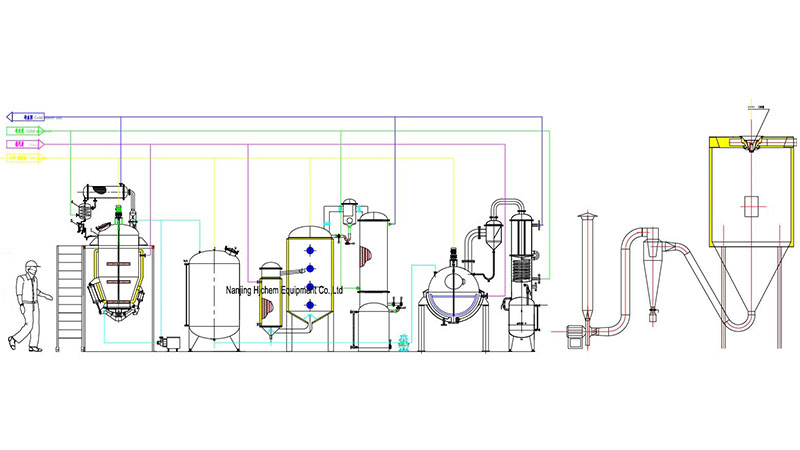
In industrial herbal extraction, poor results are not usually caused by vessel size alone. More often, performance problems come from mismatches between the material, the solvent, the mixing method, the filtration setup, and the downstream recovery process.
A system may look reasonable on paper and still become difficult to run in practice. Long batch times, unstable yield, difficult discharge, excessive solvent consumption, and cleaning delays often trace back to design decisions made too early and reviewed too lightly.
That is why an effective herbal extraction system should be evaluated as a complete process solution rather than as a single extraction tank. The extractor matters, but so do filtration, concentration, solvent recovery, cleaning, and control strategy.
Below are ten practical design factors engineers and buyers should review before selecting an industrial herbal extraction system.
1. Start with the Raw Material, Not the Tank Size
One of the most common mistakes in extraction projects is starting with target batch volume before understanding the botanical itself.
Different materials behave very differently during extraction. Leaves and flowers may float and trap air. Roots and bark may require more contact time and stronger circulation. Fine powders can create downstream filtration problems. Resin-rich or gummy materials may stick to internal surfaces and increase cleaning time.
Before reviewing vessel size, the supplier should understand at least the following:
- raw material form
- particle size range
- bulk density
- solids loading per batch
- whether the material tends to float, settle, or swell
- temperature sensitivity of the target compounds
These are not minor details. They directly affect equipment sizing, agitator design, heating performance, filtration behavior, and batch repeatability.
2. Solvent Choice Changes the Whole System Design
Solvent selection is not just a process question. It changes the engineering requirements of the entire line.
Water extraction may reduce safety complexity, but it often increases concentration load later in the process. Ethanol and hydroalcoholic systems may improve extraction selectivity for certain compounds, but they also bring additional requirements for sealing, vapor control, solvent recovery, ventilation, and electrical protection.
When flammable solvents are involved, the extraction section cannot be evaluated in isolation. Buyers should review:
- whether the system is fully sealed
- whether gasket and seal materials are compatible
- how vapors are condensed and recovered
- how solvent losses are controlled
- what electrical and safety protections are required
In many projects, the real cost difference between two systems is not the tank itself, but how well the supplier has designed the ethanol extraction process around safety, recovery efficiency, and practical operation.
3. Solid-to-Liquid Ratio Affects More Than Yield
At lab scale, the solid-to-liquid ratio is often treated mainly as an extraction parameter. At industrial scale, it becomes both a process issue and a mechanical design issue.
A high solvent ratio may improve wetting and mass transfer, but it also increases tank volume, heating duty, solvent inventory, evaporation load, and recovery time. A lower ratio may reduce downstream concentration time, but if taken too far it can create poor mixing, local overheating, slurry handling problems, or uneven extraction.
The right ratio should therefore be judged not only by extraction performance, but by whether the batch can still be mixed, heated, filtered, and discharged efficiently.
4. Agitation Is Often Underrated
Many extraction systems are specified with too much attention on motor power and not enough attention on what the agitator actually needs to do.
In practice, mixing problems do not always appear as obvious mechanical failures. They show up as floating solids, uneven wetting, slow extraction, temperature inconsistency, solids settling, and unstable batch-to-batch performance.
Agitator selection should be based on:
- slurry behavior
- solids content
- viscosity during extraction
- vessel geometry
- whether circulation or suspension is the main goal
For light botanical materials, moderate axial flow may be enough. For heavier or higher-solids slurries, the system may need stronger circulation and a more carefully selected impeller design. Buyers should ask not only for speed range and motor size, but also why that agitator type was chosen for the intended material.
5. Heating Performance Matters as Much as Heating Method
Two herbal extraction systems with the same nominal capacity can perform very differently depending on how heat is delivered and controlled.
What matters in practice is not simply whether the system uses steam, hot water, or thermal oil. The real questions are:
- how quickly the batch reaches operating temperature
- how uniformly heat is distributed
- how stable the extraction temperature remains
- whether there is risk of local overheating
- whether the jacket design suits the operating conditions
For many herbal products, gentle and uniform heating is more important than aggressive heating. Heat-sensitive compounds, aroma components, pigments, and certain active ingredients may be damaged by poor temperature control even if the nominal setpoint looks acceptable.
6. Filtration Is Often the Real Bottleneck
In many herbal extraction projects, extraction itself is not the slowest step. Filtration and solid-liquid separation are.
A system may finish extraction in acceptable time but still suffer from poor overall productivity if filtrate clarification is slow, filter media blind too quickly, or spent solids are difficult to discharge. This is especially common with fine plant powders, fibrous biomass, sticky extracts, and slurries with high suspended solids.
The separation section should be reviewed with the same seriousness as the extraction vessel. Key factors include:
- particle size after extraction
- slurry viscosity at filtration temperature
- expected filtration rate
- filter media selection
- solids discharge method
- cleaning difficulty between batches
A surprising number of projects underperform because the extraction stage was sized correctly but the separation stage was treated as secondary.
7. Solvent Recovery and Concentration Should Not Be Added as an Afterthought
If the process uses recoverable solvent, concentration and solvent recovery are core parts of the system design.
Weak recovery design usually shows up quickly in operation. The plant consumes more solvent than expected, batch cycles become longer, evaporation costs rise, and product consistency may suffer. Emissions control can also become more difficult.
Vacuum concentration is commonly used to lower evaporation temperature and reduce thermal stress on heat-sensitive compounds. But vacuum performance alone is not enough. The concentration and recovery section must be matched to the extraction throughput, solvent load, and product characteristics.
For that reason, many buyers make better decisions when they evaluate the full line as an integrated process including extraction, separation, concentration, and solvent recovery rather than treating the extractor as a standalone purchase.
8. Cleaning Time Has a Direct Effect on Output
Cleaning is often underestimated during equipment selection because it does not appear in extraction yield calculations. But in real production, cleaning time directly affects how many batches a plant can complete.
This becomes even more important when processors handle multiple herbs, seasonal materials, dark-colored extracts, or sticky botanical products that leave residue on internal surfaces and piping.
A practical cleaning review should include:
- internal dead zones
- drainability
- valve and piping arrangement
- accessibility for inspection
- cleanability of filters, sight glasses, and transfer lines
- whether CIP is needed
A system that extracts well but takes too long to clean may still perform poorly from a production planning standpoint.
9. Automation Should Match the Process Risk and Consistency Target
The right level of automation depends on system size, solvent type, operator workload, and the consistency requirements of the final product.
Small trial systems may tolerate more manual operation. Pilot and production systems usually benefit from tighter control over temperature, agitation, liquid transfer, vacuum level, alarms, and interlocks. If flammable solvents are involved, control logic becomes even more important from both a safety and operating standpoint.
Useful control points often include:
- extraction temperature
- agitator speed
- liquid level
- vacuum level
- solvent transfer sequence
- alarms and safety interlocks
- data recording where required
Good automation does not just improve convenience. It reduces operating variability and helps the system run more predictably from batch to batch.
10. Scale-Up Changes the Process More Than Many Buyers Expect
A process that works well at lab scale does not automatically remain efficient at pilot or production scale.
As batch size increases, the system may face changes in mixing behavior, heating response, filtration load, solids discharge, and total cycle time. What worked in a small glass vessel may require a different agitator profile, different heating approach, or different separation arrangement in industrial equipment.
That is why scale-up should be discussed early rather than after the equipment layout has already been fixed. Buyers should not only ask whether a supplier can build the current size, but whether the design logic will still make sense when production increases later.
Conclusion
An industrial herbal extraction system should not be judged by extraction vessel capacity alone. Reliable performance comes from how well the full process is matched to the botanical material, solvent system, mixing requirements, filtration behavior, recovery strategy, cleaning needs, and production scale.
For buyers, the better question is not simply “How large should the extractor be?” It is “How should the process be designed so the system can run efficiently, consistently, and economically in real production?”
That distinction is what often separates a workable extraction line from one that only looks good in a quotation.

