
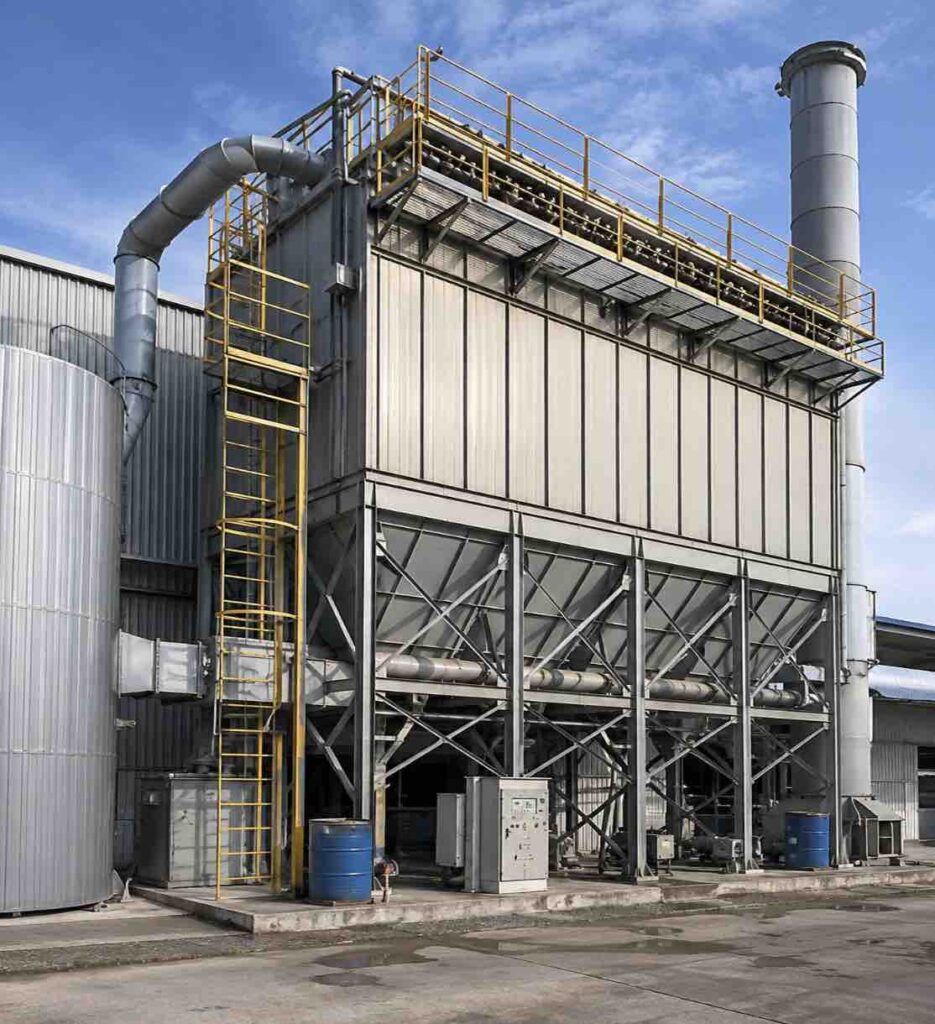
Industrial Baghouse Dust Collector Supplier & Factory in China | Senotay
An industrial baghouse dust collector is a filtration system that captures airborne particulate from industrial processes by forcing dust-laden air through fabric filter bags, trapping particles on the bag surface while clean air passes through. It is the most widely used dust control technology in heavy industry because it consistently achieves filtration efficiencies above 99%, even on fine and sub-micron particulates. For manufacturers sourcing this equipment, the choice of supplier matters as much as the choice of technology — bag material, cleaning method, and airflow engineering all determine whether a system performs reliably for years or fails within months.
This guide breaks down how baghouse dust collectors work, the main types available, how to size and select one, and what separates a reliable manufacturer from a risky one — with a detailed reference table for engineers and procurement teams comparing baghouse configurations side by side.
Quick Facts: Baghouse Dust Collector at a Glance
| Attribute | Detail |
| What it is | Fabric filtration system that removes dust particles from industrial exhaust air |
| Typical filtration efficiency | 99–99.9%+, down to sub-micron particle sizes |
| Common cleaning methods | Pulse jet, shaker, reverse air |
| Typical air-to-cloth ratio | 3:1 to 6:1 (application dependent) |
| Common filter media | Polyester, PTFE-membrane, aramid, fiberglass |
| Best suited for | High dust load, fine particulate, continuous industrial processes |
What Is a Baghouse Dust Collector?
A baghouse dust collector, also called a fabric filter dust collector, is an air pollution control device that removes particulate matter from industrial process air using long fabric filter bags housed inside a sealed enclosure. Dust-laden air enters the housing, passes through the fabric, and deposits particles on the bag surface (or inside the media, depending on filtration direction) while filtered air exits through a clean-air plenum. Over time, the collected dust cake actually improves filtration efficiency by acting as an additional filtration layer — a characteristic unique to fabric filtration compared to other dust control methods.
Baghouses are used across cement production, metal processing, mining and mineral handling, woodworking, chemical manufacturing, food processing, and power generation — essentially any operation that generates airborne particulates and needs to meet workplace safety or environmental emission standards.
Key Components of a Baghouse Dust Collector
- Housing/casing — the sealed structure containing the filter bags and separating dirty-air and clean-air chambers
- Filter bags — the fabric media that captures particulate; material choice depends on dust type, temperature, and moisture
- Cage/bag support — internal frames that hold bag shape and prevent collapse under airflow pressure
- Cleaning system — mechanism (pulse jet, shaker, or reverse air) that dislodges accumulated dust cake
- Hopper — collects dislodged dust for discharge, typically via rotary airlock or screw conveyor
- Fan/blower — generates the airflow (negative or positive pressure) that draws dust-laden air through the system
- Controller — manages cleaning cycle timing, often based on differential pressure across the filter bags
How Does a Baghouse Dust Collector Work?
The working process follows a repeatable cycle:
- Air intake — dust-laden air is drawn into the collector housing through inlet ductwork, typically from a source hood, process enclosure, or conveying line.
- Filtration — air passes through the fabric filter bags; particulate is captured on the bag surface as a “dust cake,” while filtered air continues toward the clean-air side.
- Pressure monitoring — as dust cake builds up, resistance to airflow (differential pressure) increases; the control system continuously monitors this pressure drop.
- Cleaning cycle — once pressure drop reaches a set threshold, the cleaning mechanism activates to dislodge the dust cake from the bags.
- Dust discharge — dislodged dust falls into the hopper and is removed via rotary valve, screw conveyor, or manual discharge for disposal or reuse.
- Clean air exhaust — filtered air exits through the clean-air plenum, either recirculated into the facility or exhausted to the atmosphere, depending on system design and regulatory requirements.
Pulse Jet Cleaning Mechanism
In a pulse jet baghouse dust collector — the most common configuration in modern industrial applications — short, high-pressure bursts of compressed air are fired down the inside of each bag through a venturi nozzle. This reverses the airflow momentarily, flexing the bag and shattering the dust cake off the fabric surface without stopping the filtration process. Because cleaning happens online, pulse jet systems support continuous operation, which is why they dominate high-throughput industrial applications over older shaker or reverse-air designs.
Types of Baghouse Dust Collectors
Pulse Jet Baghouse Dust Collector
Cleans bags with compressed air pulses while the system remains in continuous operation. Handles high dust loads, supports online cleaning, and is the standard choice for most modern industrial facilities due to its compact footprint and lower bag wear compared to mechanical shaking.
Shaker-Type Baghouse Dust Collector
Uses a mechanical shaking mechanism to dislodge dust cake from bags, typically requiring the affected compartment to be taken offline during cleaning. Lower capital cost but generally less efficient for high-volume, continuous processes.
Reverse-Air Baghouse Dust Collector
Cleans bags by reversing airflow direction through a compartment, gently collapsing the bags to release dust. Common in applications with fragile or expensive filter media where minimizing mechanical stress on bags extends filter life.
Detailed Baghouse Dust Collector Comparison
The table below compares the three main baghouse configurations across the specifications that matter most for industrial buyers — filtration performance, operating characteristics, and best-fit applications. Use it as a starting reference when narrowing down which configuration suits your process, then confirm final sizing with an equipment engineer based on your specific dust load, particle size, and airflow requirements.
| Specification | Pulse Jet | Shaker-Type | Reverse-Air |
| Cleaning method | Compressed air pulse | Mechanical shaking | Reversed airflow |
| Operation during cleaning | Continuous (online) | Compartment offline | Compartment offline |
| Typical air-to-cloth ratio | 4:1 to 6:1 | 2:1 to 3:1 | 2:1 to 3:1 |
| Bag wear from cleaning | Low to moderate | Higher (mechanical stress) | Low (gentle collapse) |
| Footprint | Compact | Larger | Larger |
| Best for | High-volume continuous processes, fine dust | Coarser dust, lower budgets | Fragile/expensive filter media, high-temp processes |
| Maintenance complexity | Moderate (compressed air system) | Low to moderate | Moderate |
Pulse jet systems generally offer the best balance of footprint, continuous uptime, and filtration performance for most modern industrial operations, which is why they represent the majority of new baghouse installations today — though reverse-air and shaker designs remain valid choices for specific process conditions.
Key Benefits of Baghouse Dust Collectors
- High filtration efficiency — consistently captures 99%+ of particulate, including fine and sub-micron dust that other collection methods struggle with
- Handles high dust loads — well-suited to processes generating heavy or continuous particulate output
- Broad material compatibility — filter media can be matched to specific dust characteristics, temperatures, and moisture conditions
- Regulatory compliance support — helps facilities meet workplace exposure limits and environmental emission standards
- Dust recovery potential — in some processes, captured material can be reclaimed and reused rather than discarded
- Scalable design — modular compartments allow systems to be sized from small workshop applications to massive industrial installations
- Long operational life — with correct bag selection and maintenance, baghouse systems can run reliably for many years
Industries and Applications
Cement and Building Materials
Baghouses control fine cement, limestone, and clinker dust generated during grinding, blending, and material handling, supporting both workplace safety and stack emission compliance.
Metal Processing and Metallurgy
Used to capture metal fume, grinding dust, and particulate from furnaces, welding operations, and metal cutting/finishing lines.
Mining and Mineral Processing
Handles heavy dust loads from crushing, screening, and material transfer points common in mineral processing operations.
Woodworking
Captures wood dust from sawing, sanding, and shaping operations — critical for both air quality and fire/explosion risk management given the combustible nature of wood dust.
Chemical and Pharmaceutical Manufacturing
Supports powder handling processes where fine particulate control and, in some cases, product recovery are both operational priorities.
Food Processing
Applied in grain handling, milling, and powder ingredient processing where dust control also intersects with product yield recovery.
How to Choose the Right Baghouse Dust Collector
- Characterize your dust — particle size, moisture content, temperature, and abrasiveness all influence filter media and system design.
- Calculate required airflow (CFM/m³h) — based on the number and size of capture points, hood design, and duct velocity requirements.
- Select an appropriate air-to-cloth ratio — lower ratios generally mean better performance but larger equipment footprint.
- Match filter media to conditions — polyester for general use, PTFE-membrane for fine/sticky dust, aramid or fiberglass for high-temperature applications.
- Consider combustible dust risk — processes handling combustible dust (wood, certain metals, organic powders) may require explosion venting, isolation, or suppression systems.
- Evaluate space and structural constraints — footprint, height clearance, and structural support requirements at the installation site.
- Factor in total cost of ownership — not just equipment price, but energy consumption, filter replacement frequency, and maintenance labor over the system’s operating life.
Installation, Maintenance & Common Issues
Maintenance Schedule
Routine maintenance typically includes monitoring differential pressure trends, inspecting bags for wear or tears during scheduled shutdowns, checking compressed air system pressure and solenoid valve function (for pulse jet systems), verifying hopper discharge mechanisms operate correctly, and replacing filter bags on a planned interval based on operating hours and dust characteristics rather than waiting for failure.
Common Problems & Troubleshooting
- Rising differential pressure — often indicates bag blinding, insufficient cleaning cycle frequency, or incorrect filter media for the application.
- Dust leakage from clean-air side — usually points to torn bags, poor bag seating, or damaged cages.
- Excessive bag wear — can result from abrasive dust, incorrect cleaning pressure, or poor airflow distribution within the housing.
- Hopper bridging/plugging — common with fine, cohesive, or moist dust; may require hopper design changes or discharge equipment upgrades.
- Compressed air system failures (pulse jet) — inadequate air pressure or volume reduces cleaning effectiveness and accelerates bag blinding.
Why Choose Senotay for Baghouse Dust Collectors
Senotay has manufactured industrial dust collection and air filtration equipment since 2005, operating under ISO 9001, ISO 14001, and ISO 45001 certified quality and environmental management systems. As a baghouse dust collector manufacturer with in-house engineering and production, Senotay designs pulse jet and other baghouse configurations tailored to specific dust characteristics, airflow requirements, and industry regulations, rather than offering only fixed off-the-shelf sizes. This full-service approach — spanning system design, manufacturing, installation support, and commissioning — is particularly valuable for buyers sourcing custom baghouse dust collector systems for cement, metallurgy, mining, woodworking, chemical, and food processing applications, where matching the system to the exact process conditions has a direct impact on filtration performance and long-term operating cost.
Frequently Asked Questions
What is the difference between a pulse jet baghouse dust collector and other types? A pulse jet baghouse dust collector cleans filter bags using short bursts of compressed air while the system remains in continuous operation, whereas shaker and reverse-air systems typically require taking a compartment offline to clean. This makes pulse jet systems better suited to high-throughput, continuous industrial processes.
What filtration efficiency can a baghouse dust collector achieve? Properly sized and maintained baghouse dust collectors typically achieve filtration efficiencies of 99% to over 99.9%, including capture of fine and sub-micron particulate, making them one of the most effective dust control technologies available.
How do I know what size baghouse dust collector I need? Sizing depends on required airflow volume (CFM or m³/h), the number and type of dust capture points, dust characteristics, and the target air-to-cloth ratio for your application — this calculation is typically performed by the equipment manufacturer’s engineering team based on your process data.
How often do baghouse filter bags need to be replaced? Filter bag life varies by dust type, temperature, and operating conditions, but is generally tracked through differential pressure trends and planned replacement intervals rather than run-to-failure, to avoid unplanned downtime and filtration performance loss.
Can a baghouse dust collector handle combustible dust? Yes, but combustible dust applications require additional safety engineering such as explosion venting, spark detection, or isolation devices, and should be assessed against applicable combustible dust safety standards during system design.
Is a baghouse dust collector better than a cyclone separator? Baghouses generally achieve significantly higher filtration efficiency than cyclone separators, especially for fine particulate, though cyclones are sometimes used as a cost-effective pre-separation stage ahead of a baghouse in high dust-load applications.
Conclusion
A baghouse dust collector remains the benchmark technology for industrial particulate control, offering high filtration efficiency, scalability, and compatibility across a wide range of dust types and industries. Choosing the right configuration — and the right manufacturing partner — depends on accurately characterizing your dust, calculating correct airflow and air-to-cloth ratios, and working with a supplier capable of engineering the system around your actual process conditions rather than a generic template. Senotay’s experience manufacturing custom pulse jet and baghouse dust collection systems since 2005 supports exactly this kind of application-specific approach for industrial buyers evaluating dust control equipment.
Related Resources / Internal Links
▪ Industrial Baghouse Series
▪ LDMC baghouse dust collector | PPC baghouse dust collector | DMC Pulse Jet Baghouse Dust Collector | Baghouse Dust Collector

