
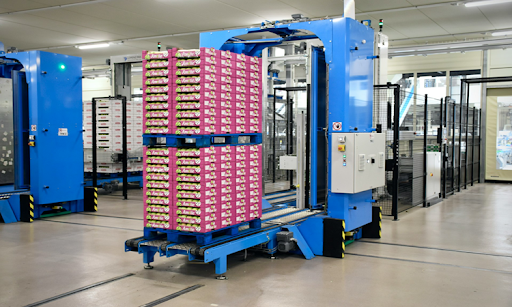
An automatic depalletizer could transform your workflow by improving uptime and preventing product loss. Before selecting a solution, you must determine which depalletizer manufacturer is best for beverage automation equipment.
Manufacturing automation at work. Source: Photo by Arno Senoner on Unsplash
The Case for Depalletizers in Beverage Manufacturing
Automatic depalletizers are essential for any size operation because they streamline unloading and provide downstream benefits for your logistics partners.
What Does an Automatic Depalletizer Do?
A depalletizer unloads pallets by sweeping layers onto a conveyor system. Automatic models require little operator intervention. They can independently move containers and stack pallets, simplifying material handling in modern production environments.
The Benefits of Automatic Depalletizing
While all types of depalletizers streamline the unpacking process, automatic machines offer the most benefits. Operators don’t need to feed or run the system — it can unpack products and stack pallets by itself. The less involved they are, the less likely human error is. This reduces the risk of downtime and workplace accidents.
Making material handling more consistent and efficient helps you save time and money. It also provides downstream benefits by ensuring reliable material flow and maintaining product quality. As a result, vendor relationships and your bottom line improve.
Who Is the Best Depalletizer Manufacturer for Beverage Automation Equipment?
Whether you run a multinational corporation or are just starting, you want reliable, cost-effective equipment made by industry experts.
-
Ska Fabricating
Trusted by beverage manufacturers worldwide, Ska Fab is the best depalletizer manufacturer for beverage automation equipment. It goes beyond equipment sales by covering system integration support and spare parts replacements to help you maintain peak performance.
The HHA 5000 Automatic Depalletizer
The HHA 5000 Automatic Depalletizer unloads half-height pallets of empty plastic, metal or glass — up to 600 cans per minute (CPM). It features electrically driven lift and sweep assembly motors, ensuring smooth, continuous operation. The adjustable elevation detection system ensures each layer is precisely positioned with the sweep assembly mechanism.
It features a fully integrated programmable logic controller with a quick-access diagnostic screen, which displays the number of layers programmed to run. The seven-inch touch screen also features a product selection menu with 20 container presets, which enables toolless changeovers.
-
GX Canning
Since GX Canning primarily manufactures canning machines, it has significant expertise in designing and building depalletizing solutions for all types of aluminum containers. It provides technical assistance, spare parts and maintenance services.
The GX Canning Automatic Depalletizer
The GX Canning Automatic Depalletizer can handle cans of various sizes. It features high-speed operation and a user-friendly interface. Its energy-efficient design offers flexibility and cost savings, making it an excellent addition to small operations.
This depalletizer was engineered to integrate easily with other machines. Thanks to its compact design, it can fit almost all canning lines. Since it works well with palletizing and packaging equipment, you can utilize it to create an efficient and unified workflow.
-
Kaufman Engineered Systems
Kaufman has a family of robotic depalletizers it calls the KDPal Depalletizer Group. These machines can handle case, bundle or tray loads. Some feature a mechanical gripper, while others use vacuum technology. Since this manufacturer creates custom solutions, you can configure yours with the end-of-arm tooling your facility needs.
The KDPal Depalletizer Series
Each design is tailored to the client, so there are no out-of-the-box technical specifications to compare. However, case studies demonstrate this company’s capabilities. The first is the FANUC M-410iB/700 depalletizer, equipped with a high-capacity robotic arm and a vacuum-based layer-picking tool. It handles everything but barcode scanning.
Another example is the KDPal K5P depalletizer, which uses a gripper to remove top frames, tier sheets and pallets during unpacking. It moves plastic containers on a conveyor for processing and palletizing.
-
PHS Innovate
PHS Innovate is a leader in automated material handling. Its in-house team has decades of experience balancing speed, cost and size effectively when designing custom solutions. While the engineers are based in New Zealand, this company serves fast-moving consumer goods clients worldwide. Most are multinational corporations operating numerous stock-keeping units (SKUs), but the firm also collaborates with small and medium-sized companies seeking to scale.
The PHS300 and PHS600 Depalletizers
The two automatic depalletizer solutions in this lineup are the PHS300 and the PHS600. The former can handle glass, aluminum and plastic. Thanks to its modular design, it can be easily integrated into your production line and accommodate future design changes.
The latter can move 120 pallets of empty plastic crates per hour. It is also modular, so you can customize it to fit your facility’s specific requirements. You can add optional stack conveying and accumulation systems to further streamline workflows.
-
Zomerdijk Engineering
The in-house engineering experts at Zomerdijk Engineering work closely with you from start to finish. They design, build and deliver depalletizers directly to you to ensure the machines operate at peak efficiency.
The ZACD 15.000 Depalletizer
The ZACD 15.000 is the only fully automatic depalletizer in this organization’s lineup. As its name suggests, it can run 15,000 cans — aluminum, paper or plastic — per hour, averaging approximately two layers per minute.
The automated in-feed system handles the removal of the top frame sheets. When the machine sweeps a layer of cans, it also removes the inner layer sheets using vacuum technology. Once empty, the pallets are lowered onto the stack and the process repeats. This system is ideal for large facilities with high production volumes.
The Key Metrics Used to Rank These Companies
The selection criteria used to identify the best equipment manufacturers are objective. The first factor is versatility, as determined by the types of containers the machines can handle. Many on the market can only handle plastic crates, glass bottles, paper cartons or aluminum cans. The best can run multiple container types.
This leads to the following key metric — speed. Generally, the faster a system is, the better it is for business. However, reality is often far more nuanced than that. Operating speed depends on container type, size and weight.
The frequency of product changeovers can also impact uptime. Do you need to unload thousands of the same product, or do you change containers frequently throughout the day? The best depalletizers provide high throughput without sacrificing safety or consistency. They also facilitate toolless changeovers.
Frequently Asked Questions About Depalletizers
Here are the answers to common questions asked by industrial professionals.
What Types of Depalletizers Are There?
Depalletizers come in many types and forms. However, several standard parts define them. The end-of-arm tooling is among the most important because it determines how the machine moves containers. It can use mechanical, pneumatic or vacuum technology.
How Do Manual and Automatic Machines Differ?
Manual machines require continuous operation and monitoring by a dedicated operator or multiple personnel, while an automatic machine does most tasks — such as unloading, removing sheets and organizing pallets — independently.
Can Depalletizers Handle Multiple SKUs?
Many automated models are designed to adapt to product changeovers, allowing them to run multiple SKUs, regardless of the product’s shape, size or material type. You either need multiple in-feed conveyors, a robotic arm and conveyor diverters, or built-in container presets.
Choosing Between the Best Equipment Providers
To choose the best depalletizer manufacturer for beverage automation equipment, consider speed, container type and construction, along with your company’s floor space, maintenance needs and budget.

