
Nearly half of all enterprise resource planning (ERP) projects fail on the first attempt—bleeding time, budget, and production capacity. Forbes (January 29, 2024) reports that manufacturers face that risk more than any other sector, accounting for 47 percent of new ERP evaluations heading into 2026. To keep your rollout off the failure list, we sifted through 2025–2026 analyst reports, fresh case studies, and verified client reviews. The result: four implementation partners that repeatedly deliver measurable plant-floor wins. Read on to find the team whose methods, reach, and technical depth fit your growth plans.
Our research methodology and criteria
We asked one question: Which partners take manufacturing ERP programs live on time and on budget in 2026?
- SERP scan. In November 2025 we reviewed the first 100 Google results for *hire ERP implementation partner for manufacturing*. We captured every People Also Ask prompt, then grouped 24 recurring pain points—sector expertise, proven success rates, and AI-ready factory workflows topped the list.
- List audit. We studied 15 “top ERP partner” round-ups published from January 2024 to October 2025. More than half reused 2023 data or mixed all industries, so we removed vendors without fresh manufacturing proof.
- Scoring grid. The remaining firms earned points across five pillars (20 each, 100-point max):
Only four partners cleared 80 points. Each fits a different need, from boutique depth to global rollout power, cross-platform range, or independent oversight.
When we scored recent case studies, we focused on hard plant-floor outcomes rather than generic satisfaction scores. According to a case study from MCA Connect, one global technology manufacturer that adopted Dynamics 365 and a fixed interval scheduling model cut replenishment windows from more than 48 hours to about six and reduced non-value-added activity by more than 60 percent, freeing millions in working capital.
The next sections show how those strengths align with real manufacturing scenarios, so you can choose the team that keeps machines running and ROI climbing.
Find your fit before you pick a name
Manufacturers usually fall into four project profiles, and each calls for a different type of partner.
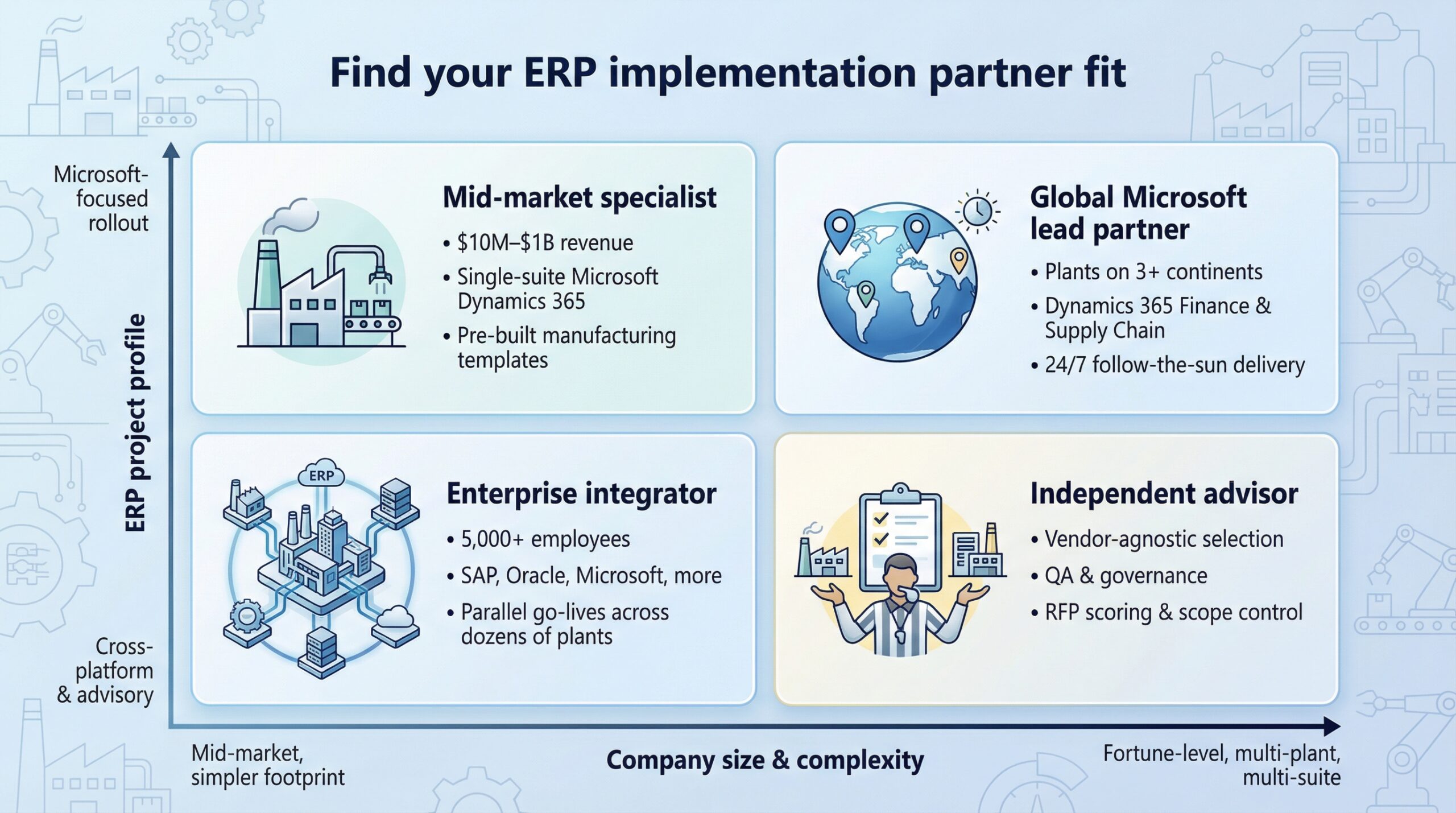
Use this four-quadrant matrix to quickly match your manufacturing ERP project to the right type of implementation partner.
- Mid-market specialist. If your annual revenue sits between $10 million and $1 billion, the range IndustryWeek calls the manufacturing “middle market” (IndustryWeek analysis), a boutique Microsoft firm often delivers the fastest ROI because its consultants speak plant-floor shorthand and roll out pre-built Dynamics 365 templates.
- Global Microsoft lead partner. Multisite producers with facilities on three or more continents need a team that blends on-shore and off-shore talent while keeping a 24-hour project rhythm. That scale matters when you’re syncing demand signals across time zones.
- Enterprise integrator. Fortune-size manufacturers, some with 5,000 plus employees spread over dozens of plants, benefit from a cross-platform systems integrator (SI) that links SAP finance to Oracle PLM and manages hundreds of change-controlled enhancements. Fortune Global 500 companies together run plants employing 70 million people, proof that complexity rises quickly at the top end, according to Fortune.
- Independent advisor. When you’re still weighing software options or want a referee to keep vendors honest, an advisory firm adds governance, guides RFP scoring, and protects budget and scope no matter which suite you choose.
Match your situation to one of these lanes, then jump to the corresponding partner profile that follows. You’ll cut research hours and focus on the provider built for your footprint, risk tolerance, and growth goals.
1. MCA Connect: boutique muscle for Microsoft-first manufacturers
Spend five minutes in an MCA Connect workshop and you’ll hear shop-floor terms such as takt time, Kanban loops, first-pass yield instead of bland “best practice” clichés. That fluency comes from one focus for more than 20 years: implementing Microsoft Dynamics 365 for manufacturers and distributors.
MCA Connect focuses on Microsoft Dynamics 365 for manufacturers and distributors, bringing deep shop-floor expertise to mid-market ERP projects.
Each project feeds a library of pre-configured templates called ManufacturingCONNECT. Core processes (order to cash, procure to pay, shop-floor control) arrive prebuilt, and MCA’s Spectrum playbook delivers them in agile sprints with hard tollgates. A recent oil and gas engagement went live in under nine months, beating the 15.5-month industry average cited in Panorama’s 2025 ERP Report.
That speed matters because unplanned downtime burns cash. One automotive-parts client trimmed weeks from production scheduling by configuring Dynamics advanced warehousing with no custom code.
Microsoft backs the approach. MCA has landed on the Microsoft Business Applications Inner Circle for 14 consecutive years (17 total), a distinction reserved for the top one percent of partners worldwide. Early access to features such as artificial intelligence (AI) Copilot for supply-chain planning means your team benefits the moment Microsoft ships an update.
Reality check: MCA works only with Microsoft technologies. If you’re locked into SAP or Oracle, choose another partner. And while the firm fields seasoned consultants, global rollouts across dozens of plants may still require a Big Four integrator.
For manufacturers with 200 to 5,000 employees who want measurable ROI and senior experts on the factory floor, MCA Connect delivers results you can trace in inventory turns, not just project dashboards.
2. Hitachi Solutions: global reach, Dynamics firepower
When your board has already green-lit Microsoft Dynamics 365 and your plants span borders, Hitachi Solutions brings the talent to match. Sitting inside the wider Hitachi industrial family, the firm ships accelerators for discrete, process, and aftermarket service with built-in know-how, including barcode-ready quality checks, Kanban loops, and asset-centric maintenance dashboards that plug straight into Dynamics Finance and Supply Chain.
Hitachi Solutions pairs global delivery centers with Microsoft Dynamics 365 accelerators to support multi-site manufacturing ERP rollouts.
Scale matters. Hitachi fields about 2,400 Dynamics consultants in 30 countries, supported by delivery hubs in Portugal and Costa Rica. That footprint lets a new warehouse in Poland go live the same week a U.S. plant cuts over.
Proof shows up in the numbers. Hitachi Construction Truck Manufacturing replaced 80 legacy systems with one Dynamics instance in ten months across 25 warehouses and cut spare-parts fulfillment time by double digits. Everest Group echoed the discipline, naming Hitachi a Leader in its 2025 Microsoft Business Applications Services PEAK Matrix for “superior service delivery” and “strength in manufacturing.” The study covered 31 global providers and placed only ten in the Leader tier.
Fit still matters. Hitachi targets mid- to large-enterprise programs. Smaller scopes may pay for capacity they will not use, and non-Microsoft stacks belong elsewhere. If you need a Dynamics partner that keeps multi-site rollouts on time and can add digital twin simulations to standard ERP flows, Hitachi Solutions deserves a spot on your shortlist.
3. Accenture: enterprise horsepower for complex, cross-platform programs
When your roadmap covers SAP, Oracle, and Dynamics—and dozens of plants must go live on the same clock—Accenture brings the bench to match. The Industry X group pairs software engineers with production-line specialists so manufacturing execution systems (MES), digital twins, and predictive scheduling land in one plan.
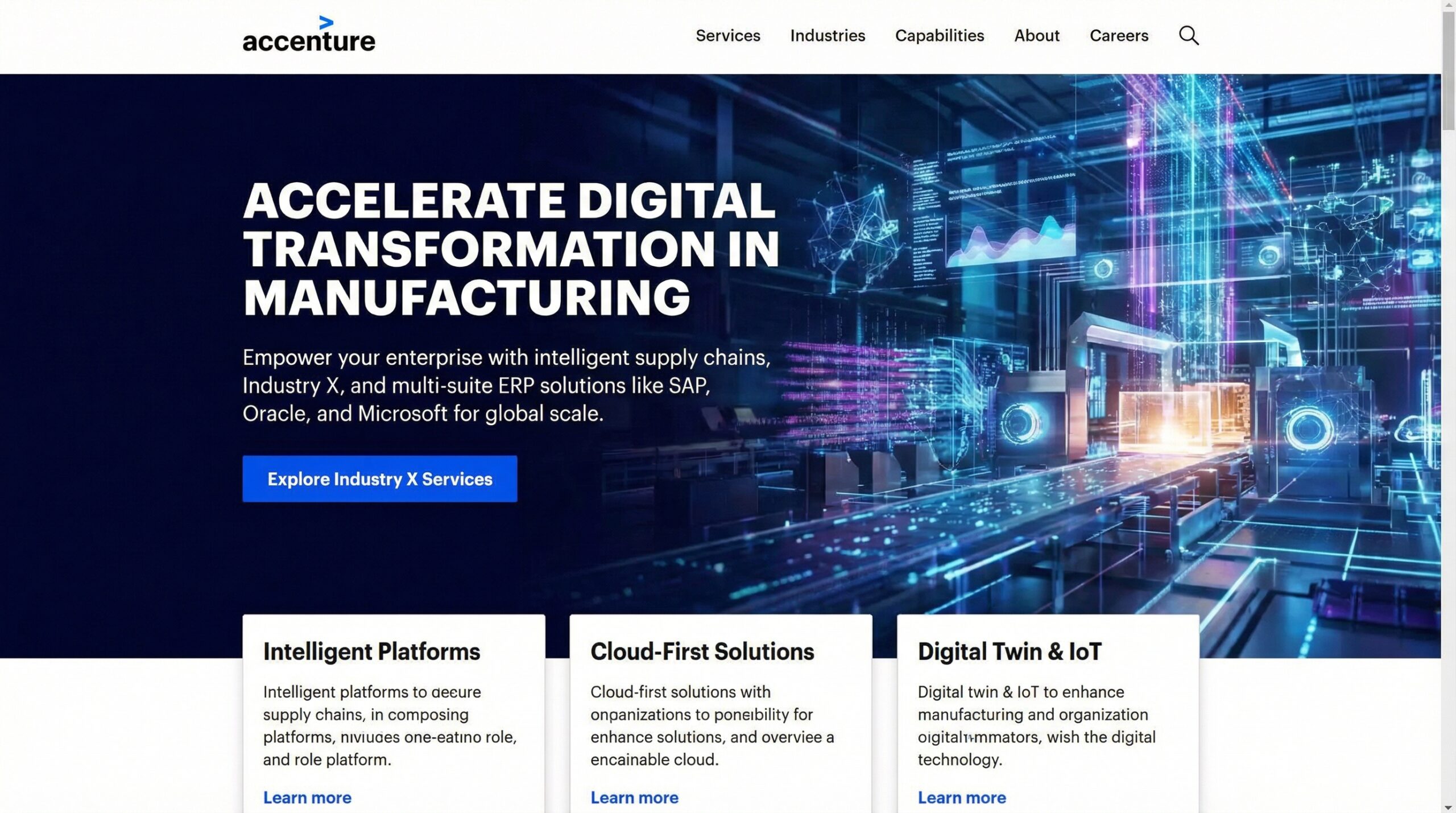
Accenture’s Industry X and ERP services give Fortune-level manufacturers the horsepower for complex, multi-suite rollouts.
Scale is real. Accenture employs nearly 570,000 people worldwide, with more than 40,000 focused on ERP and digital manufacturing. Follow-the-sun delivery hubs on five continents let a thousand operators train in five languages before cut-over weekend.
Results back the muscle. A global automotive supplier deployed SAP S/4HANA to 15 plants across three regions in 24 months, meeting every milestone under Accenture’s parallel-deployment model. Gartner placed Accenture in the Leader quadrant of its 2022 Magic Quadrant for SAP S/4HANA Application Services for the fourth straight year.
Breadth is the bonus. Elite partnerships with SAP, Oracle, Microsoft, Infor, and IFS let Accenture connect whichever mix you choose—merging SAP finance with Oracle product lifecycle management (PLM) or adding predictive-maintenance analytics to Dynamics.
Digital twins are not an afterthought. The 2025 launch of Accenture’s Physical AI Orchestrator shows how teams model entire factories in NVIDIA Omniverse, then feed live data back to production. Early pilots delivered up to 20 percent throughput gains.
Reality check: Accenture’s size comes with higher fees and strict governance. Mid-market manufacturers may struggle for senior attention unless they negotiate oversight in the contract. For Fortune-level enterprises that want schedule certainty and deep technical range, Accenture trades higher cost for proven results.
4. Panorama Consulting Group: your independent project watchdog
Sometimes the safest way to land an ERP is to hire a referee, not another player. Panorama Consulting Group sells no software and collects no reseller commissions, so its only bias is toward your outcome.
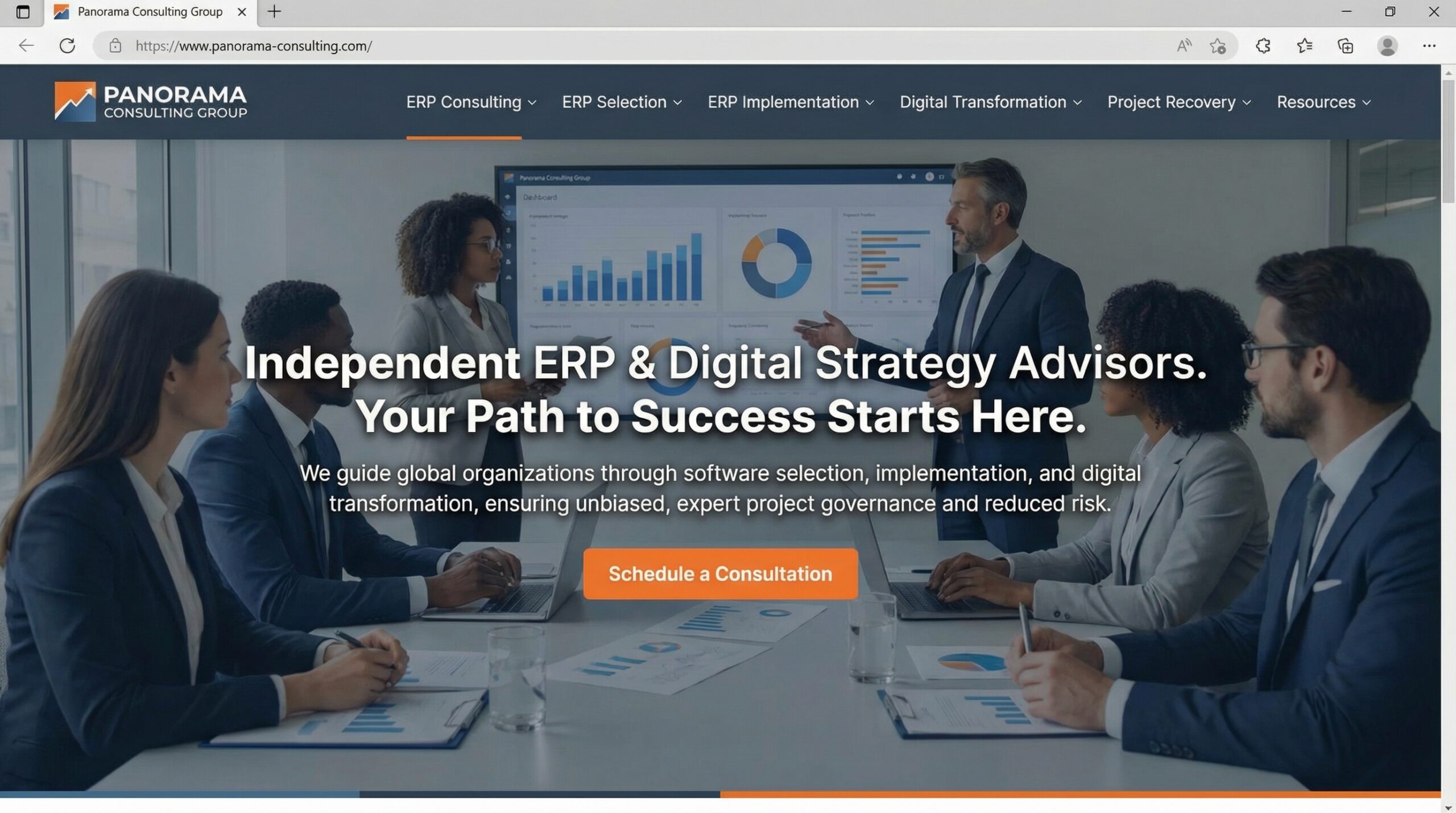
Panorama Consulting Group serves as an independent ERP advisor, guiding software selection, RFPs, and project governance for manufacturers.
Panorama’s consultants start with requirements-mapping workshops, then score each vendor against those needs and run the request for proposal (RFP). After you pick a platform and systems integrator, they move into governance mode, tracking milestones, validating test scripts, and flagging scope creep before it drains overtime.
The oversight pays off. Panorama’s 2025 ERP Report shows projects with independent quality assurance averaged nine months to go-live versus 15 months for self-managed efforts, and success rates climbed to 85 percent across 167 manufacturing and distribution projects. Client reviews on Clutch highlight transparent communication and the ability to translate consultant-speak into shop-floor English, earning Panorama a 4.6-star rating from more than 40 reviews.
Panorama is not a one-stop shop; you still need a technical integrator, and the advisory fee sits on top. For manufacturers short on internal bandwidth or recovering from a failed rollout, that extra layer of governance often pays for itself long before cut-over weekend.
Engage Panorama when you want a watchdog who calls fouls, keeps the playbook tight, and makes sure your new ERP delivers the throughput, traceability, and cost savings the board expects.
Compare the contenders at a glance
Need a fast shortlist? Start with the grid below. Match your company’s scale and tech stack to the partner profile, then dive back into each deep-dive section for nuance.
| Partner | Manufacturing focus | Certified ERP platforms | Recent recognition* | Ideal customer size | Global coverage |
| MCA Connect | 100 percent manufacturing and distribution | Microsoft Dynamics 365 | Microsoft Business Apps Inner Circle (14 years), 2025 U.S. Supply Chain Partner of the Year | 200–5,000 employees | North America–centric; remote global support |
| Hitachi Solutions | Discrete, process, aftermarket accelerators | Microsoft Dynamics 365 | Everest Group 2025 Leader for Microsoft Biz Apps Services | 1,000-plus employees, multi-site | 30 countries, 2,400 Dynamics consultants |
| Accenture | Industry X smart-factory practice | SAP, Oracle, Microsoft, Infor, IFS | Gartner Magic Quadrant Leader for SAP S/4HANA Services 2022 | Fortune-level, 5,000-plus employees | 50-plus countries, 24/7 delivery hubs |
| Panorama Consulting | Vendor-agnostic selection and QA | All major suites (advisory only) | 4.6/5 average on Clutch (40-plus reviews, Dec 2025) | 500-plus employees, first-time or recovery projects | North America HQ, global client base |
*See individual sections for full award details and case-study metrics.
Remember: the “best” partner is the one whose strengths overlap with your footprint, platform choice, and risk tolerance, not simply the firm with the longest trophy shelf. Use the table as a compass; the deep dives explain what each headline really means on the factory floor.
Your 10-point partner-selection checklist
A sound decision follows a structured playbook. Capture honest answers to the prompts below, assign each one a 1–5 score, and the front-runner usually emerges before pricing talks begin.
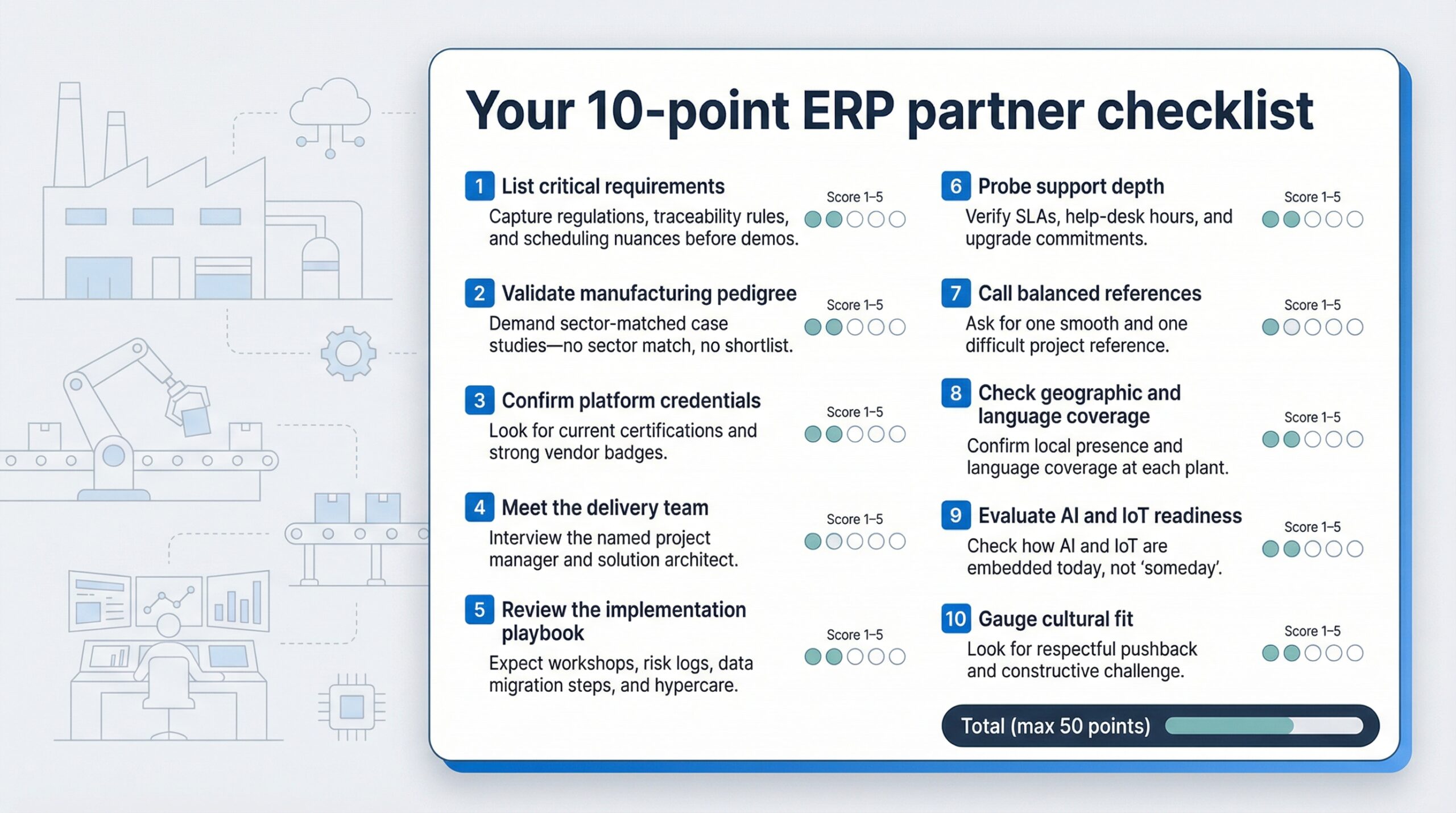
Use this 10-point checklist to score ERP implementation partners on requirements, manufacturing pedigree, platform credentials, support, AI readiness, and cultural fit.
- List critical requirements.
- Record every regulation, traceability rule, and scheduling nuance *before* demos. Partners who probe these details score higher.
- Validate manufacturing pedigree.
- Ask for case studies in your sub-sector—food safety, metal fabrication, aerospace. No sector match, no shortlist.
- Confirm platform credentials.
- Look for current certifications and Inner Circle or Gold-level badges. A lack of formal endorsements slows escalation when issues surface.
- Meet the delivery team.
- Interview the named project manager and solution architect, not just salespeople.
- Review the implementation playbook.
- A solid plan shows discovery workshops, risk logs, data-migration steps, and at least four weeks of hypercare. Vague timelines hide cost.
- Probe support depth.
- Check service level agreements (SLAs), help-desk hours, and upgrade paths to make sure the partner stays after go-live.
- Call balanced references.
- Ask for one smooth project and one that hit roadblocks. Lessons learned reveal more than highlight reels.
- Check geographic and language coverage.
- Global rollouts need local consultants who can visit the plant floor and translate training without delay.
- Evaluate artificial intelligence (AI) and [Internet of Things (IoT)](https://www.linquip.com/blog/the-future-of-industrial-automation-key-trends-to-watch-in-2025-introduction/) readiness.
- Ask how the team embeds these capabilities today, not “in the future.” Future-proofing starts on day one.
- Gauge cultural fit.
- Notice how the team handles tough questions. Respectful pushback signals a partner who challenges bad decisions early.
Total the scores (maximum 50 points) to rank your contenders on evidence, not charisma.
Frequently asked questions
What does an ERP implementation partner do?
They configure, test, and launch the software, then train your team so the system boosts throughput and traceability. For manufacturers, that means mapping bills of material, integrating machines, and enforcing lot genealogy from raw material to shipment.
How should I weigh cost versus expertise?
Look past day-one quotes. Panorama’s 2025 ERP Report shows projects that hire specialist partners finish 6.5 months faster on average than do-it-yourself efforts—even after consulting fees. Faster go-live means less downtime and a quicker payback.
Big firm or boutique: what’s safer?
Match scope to DNA. Global, multi-suite rollouts often need a heavyweight like Accenture, while a single-site Dynamics upgrade may thrive with MCA Connect. Unsure? Bring in an independent advisor such as Panorama to score both bids.
How long does a manufacturing ERP project take?
Cloud ERP programs at mid-market plants average nine months when accelerators are used, according to Panorama’s 2025 data set of 167 projects. Multi-country transformations can still run 18–24 months, but disciplined governance delivers value in phases.
Is AI in ERP hype or real?
Real—and speeding up. Gartner predicts 40 percent of enterprise apps will include task-specific artificial intelligence (AI) agents by 2026, up from less than 5 percent in 2025. Leading partners already deploy machine-learning models to forecast spare-parts demand and flag quality drift, provided your plant data is clean from day one.
Conclusion
Have a question we missed? Send it to our editors, and we’ll update this guide in the next release.

