
Procurement experts and industrial professionals often experience disruptions from all corners of the warehouse and production line, which may come from downtime or maintenance. Others attribute delays to congestion and poor blueprints. Building a new warehouse and adding thousands of square feet sounds like the ideal solution to improve flow, especially when considering scaling. However, more square footage may exacerbate existing flow issues.
Poor Process Flow
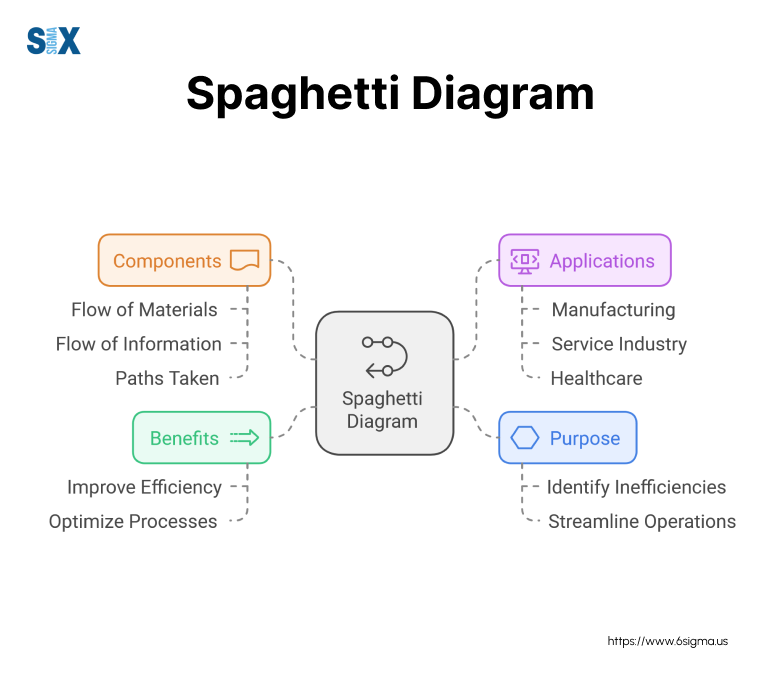
If industrial processes are inherently inefficient, adding more square footage will only extend the time it takes for each phase to occur. Many manufacturers have unintentionally adopted a Spaghetti Diagram, which represents a workflow that has become unnecessarily chaotic. These paradigms may incorporate up to eight different types of waste, including transportation, waiting and defects.
The trend may occur as companies experiment with new products and verticals or hire more contractors. The influences are many, but travel distances, times and routes only become more convoluted without intentional streamlining. Stakeholders should evaluate these pathways using value stream mapping and adopt lean manufacturing principles, such as Six Sigma. This will reveal insights for adjustments, such as remapping the floor for a straight-line flow.
Excess Inventory
More floor space may allow workers to fill the area with more product, but this may cause additional problems. Assuming more inventory may be perceived as a strategy of preparedness, stocking additional parts for maintenance or hoarding more materials in the event of a supply chain disruption. However, smart inventory management and curbing excess are crucial for designing a flow prioritizing efficiency. Otherwise, facilities adopt a work-in-progress (WIP) mindset, housing too many materials that lead to workflow inefficiencies and additional costs.
In 2023, U.S. retailers were holding onto $740 billion in backlogged inventory, collecting dust on shelves. Adding more square footage invites more to accumulate. Instead, adopting a just-in-time framework will result in stricter inventory limits. Additionally, automating stock management with technologies such as sensors and RFID tagging will notify technicians of outdated stock and suggest actions for managing it. Kanban racks and bins, or any setup with smaller staging areas, are another way to save space.
Disorganized Workstations
Clutter and poor organization strategies will inevitably lead to misplaced tools, spare parts and excess materials. Eventually, they become a dumping ground and require more time to plan and clean than if they had been accessible for workers to place items in their designated places. The 5S framework is a widely applied organizational method in manufacturing for minimizing search and response times, representing five steps:
- Sort
- Set in order
- Shine
- Standardize
- Sustain
This is adaptable to workplaces of any size. Workers may feel inspired to create inserts for drawers, label shelving or set up a shadow board so tools are laid flat and visible.
Production Bottlenecks
Stakeholders should initiate process discovery regularly to discover the bottlenecks, whether it be the travel distance to final product delivery or tangled throughput. According to the Theory of Constraints, identifying the limiting factor of a facility is the only way to affect the rest of the chains in the system. Improving other aspects of the business without remedying the bottleneck may result in few or no results.
Companies may discover that an outdated machine causes frequent downtime, necessitating an upgrade. It could also be due to contractor management or overly complex maintenance schedules. Implementing strategies like drum-buffer-rope scheduling can reduce the chokehold of the bottleneck on the floor. Putting these assets in larger spaces does not alter their efficiency.
Inefficient Batching
Scaling square footage may encourage businesses to take on larger-batch orders. Manufacturing with batches that are too large for operators to handle can create logistical challenges and lost productivity. Inventories store boxes with extra materials that technicians must retrieve, and loading or offloading inventory to different locations within the building is a time-consuming process.
While large-batch production may make sense for some product orders, smaller orders may be more advantageous. They can cut waste from movement. Workers access and manipulate inventory less, removing WIP from the workflow equation. Implementing smaller forklifts and pallets will also make the product easier to handle and transport.
Poor Ergonomics
Most warehouses have racking systems that are too tall and tight, straining employees and putting them in hazardous situations. Injuries and illnesses are common to develop while working in these environments, with five in every 100 full-time workers developing them annually. While square footage may seem to make warehouses easier to navigate and safer for staff, workspaces of all sizes can benefit from investing in ergonomic equipment.
Facilities of all scales can gain these advantages by implementing more ergonomic tools, such as sliding shelves, scissor lift tables and more:
- Cost-benefit ratio of 1:10
- 56% fewer musculoskeletal injuries
- 60% less absenteeism
- 20% productivity enhancement
Parkinson’s Law of Space
If more square footage is available for workers, inventory, tools and equipment, then it will become filled as everything eventually expands to fit the area. Parkinson’s Law of Space dictates this, and clutter will eventually form. It will often comprise assets that provide no value to the business, becoming visual pollution or physical barriers between the workforce and their assignments.
To prevent space from becoming overrun, managers can lay down physical barriers or markers, such as tape, to identify the functions of the floor. It can identify walkways, pathways for autonomous vehicles or pickup areas for material waste.
Underutilized Equipment
Idle machinery gets in the way. Instead of accommodating unused equipment by adding more room to the building, remove the fixture from the workfloor. This will increase overall equipment effectiveness while streamlining maintenance schedules. Workers will need to tend to fewer devices and have fewer parts lining inventory shelves as a result.
Additionally, this will highlight the most critical machines to production. Removing machinery will give teams more flexibility to place equipment based on sequence. This way, capital assets are traveling shorter distances to quality control.
Wasted Vertical Space
Verticality is a severely underutilized asset in facilities. Expanding up instead of out mitigates costly renovations. Tons of vertical space go underutilized, even though industries have the lifts and other technology to make this a reality. Automated storage and retrieval systems also make this simpler and safer for employees.
Operators can begin by analyzing storage solutions and their height requirements and weight limits. Then, they can add more racks or mezzanines to maximize the area. Resources like shelves on rails, vertical lift modules and remote inventory management systems make interacting with stock at heights manageable and even efficient.
Lack of Real-Time Data
Employees and stakeholders may be unaware of the bottlenecks and inefficiencies in their workflows because they are unable to visualize them. They may also struggle to see how a years-old method could improve with the square footage they have.
Leveraging sensors and other technologies to collect real-time data can help leaders identify the financial and lead time costs associated with neglecting routing and layout optimizations. These systems can confirm where key performance indicators, such as takt time and overall equipment effectiveness, can be improved with the available space.
The Illusion of Space
While square footage makes a facility seem more open, adaptable and scaled, it may invite more drawbacks to workflow management. Teams can be proactive with the resources and assets they currently have to create a faster-moving, data-driven process without investing in new infrastructure. Eventually, the advantages of making these changes could lead to a bigger and better facility with a lean mindset already integrated.

