
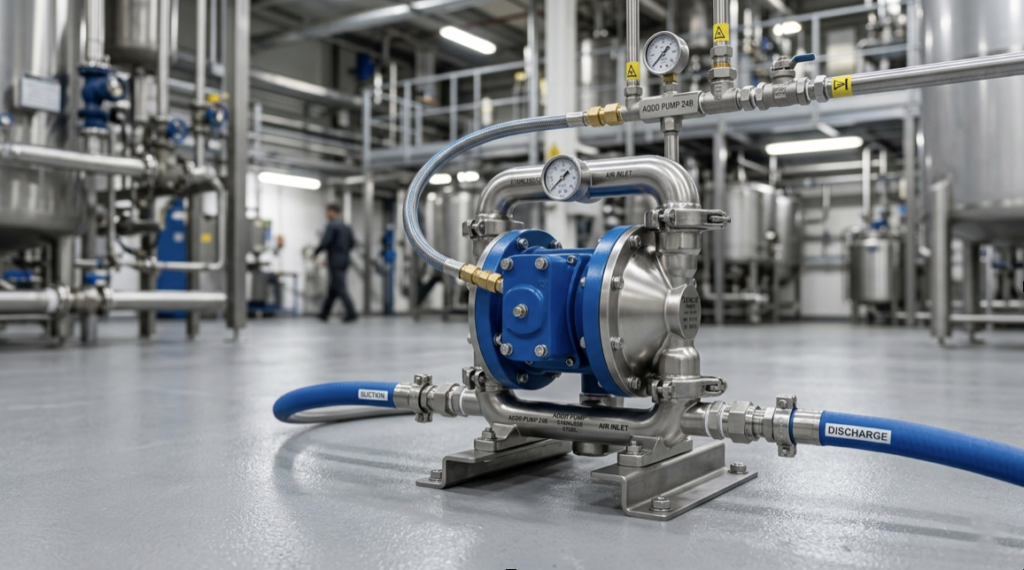
1. What Is an AODD Pump?
An Air-Operated Double Diaphragm (AODD) pump is a type of positive displacement pump powered entirely by compressed air. It uses two flexible diaphragms that work alternately — while one draws fluid in, the other pushes fluid out — resulting in a smooth, pulsed flow without the need for electricity.
AODD pumps are widely regarded as one of the most versatile pump technologies in industrial settings, capable of handling everything from thin solvents to thick slurries, and even shear-sensitive liquids. Their self-priming nature and ability to run dry without damage make them a preferred choice across numerous industries.
2. How Does an AODD Pump Work?
The operating principle of an AODD pump is elegantly simple and relies on the reciprocating action of two diaphragms connected by a central shaft:
1. Compressed air enters the air distribution valve and is directed to the back of one diaphragm (Chamber A), pushing it forward.
2. The movement of Chamber A’s diaphragm creates positive pressure, forcing fluid through the outlet check valve and into the discharge line.
3. Simultaneously, the other diaphragm (Chamber B) is pulled backward due to the shared shaft, creating negative pressure (suction) that draws fluid through the inlet check valve.
4. Once Chamber A reaches full stroke, the air valve automatically shifts, redirecting compressed air to Chamber B — reversing the cycle.
5. This alternating action produces a continuous pulsating flow that can be dampened with a pulsation dampener if a smoother output is needed.
3. Key Components of an AODD Pump
|
Component |
Material Options |
Function |
|
Diaphragms |
PTFE, Neoprene, Santoprene, EPDM, Buna-N |
Flex to create suction and discharge strokes |
|
Pump Body / Housing |
Polypropylene, PVDF, Aluminium, Cast Iron, SS316 |
Contains fluid chambers and supports all components |
|
Check Valves |
PTFE, Neoprene, SS, Ceramic |
Controls one-directional fluid flow |
|
Air Distribution Valve |
Aluminium, Acetal |
Alternates air supply between diaphragm chambers |
|
Center Section |
Aluminium, PP, PVDF |
Houses air valve and connects both fluid chambers |
|
Manifolds (Inlet/Outlet) |
Same as pump body |
Directs fluid flow in and out of pump |
4. Types of AODD Pumps
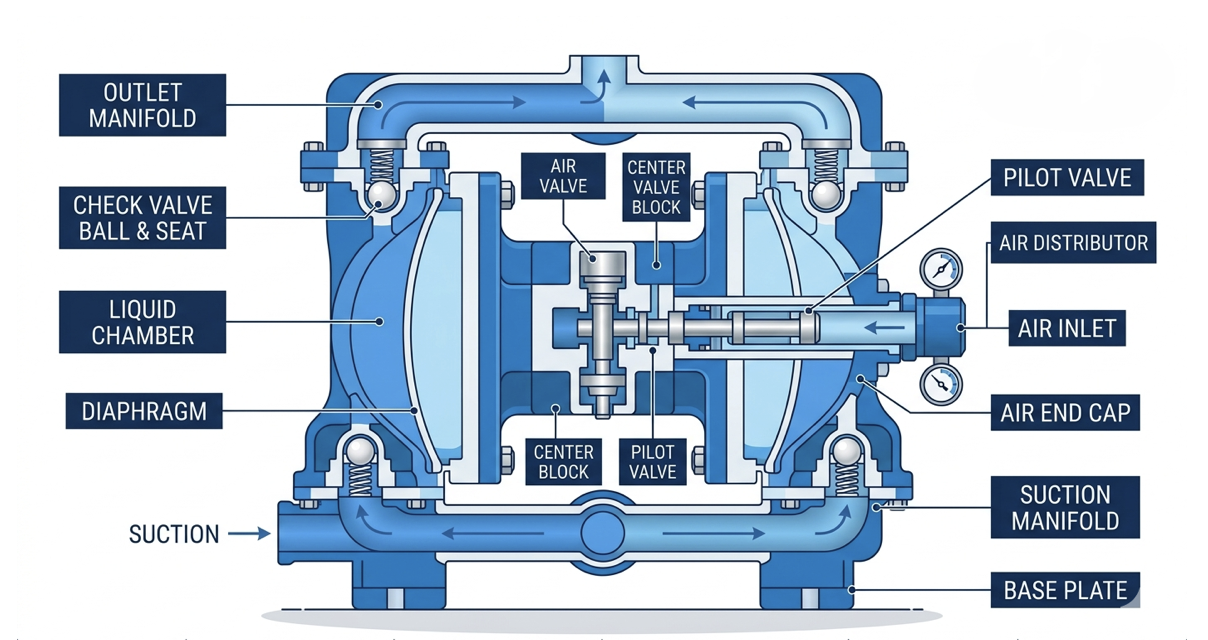
AODD pumps are classified primarily by their body material and diaphragm material, which determines chemical compatibility and suitability for different applications.
4.1 By Body Material
• Polypropylene (PP): Lightweight, chemical-resistant, cost-effective — best for acids and alkalis
• PVDF (Kynar): Excellent chemical resistance, suitable for aggressive solvents
• Aluminium: Lightweight and durable for non-corrosive fluids and general industrial use
• Stainless Steel (SS316): Hygienic, high-strength — preferred for food, pharma, and corrosive service
• Cast Iron: Economical for non-corrosive, abrasive slurries
4.2 By Diaphragm Material
• PTFE: Widest chemical resistance — used for aggressive acids and solvents
• Santoprene: Flexible, long service life — general purpose
• EPDM: Good for hot water, ozone, and steam applications
• Neoprene: Oil resistance, cost-effective general service
• Buna-N (Nitrile): Excellent for oils, fuels, and petroleum products
5. Industrial Applications of AODD Pumps
The versatility of AODD pumps makes them one of the most widely deployed pump types across global industries. Their ability to handle high-viscosity fluids, abrasive slurries, and shear-sensitive media — without mechanical seals — gives them a distinct advantage.
|
Industry |
Typical Fluid / Media |
Why AODD is Preferred |
|
Chemical Processing |
Acids, alkalis, solvents |
No sparks; handles corrosive chemicals with right materials |
|
Paint & Coatings |
Paints, pigments, resins |
Gentle on shear-sensitive materials, easy to flush |
|
Food & Beverage |
Sauces, syrups, dairy, slurries |
Hygienic SS/PTFE options, gentle handling, CIP-compatible |
|
Pharmaceuticals |
APIs, buffers, suspensions |
No contamination risk, cleanable, handles viscous fluids |
|
Wastewater Treatment |
Sludge, slurries, effluent |
Handles solids, runs dry safely, self-priming |
|
Mining |
Slurries, tailings, mine water |
Abrasion resistance, submersible options available |
|
Construction |
Cement slurry, bentonite |
Portable, runs dry, easy dewatering operations |
|
Ceramics |
Clay slips, glazes |
Handles high-viscosity suspensions without damage |
|
Printing & Inks |
UV inks, varnishes |
Precise dosing, no mechanical seals to contaminate product |
Looking for a Reliable AODD Pump Supplier?
For high-quality AODD pumps across all materials and sizes, backed by technical support and fast delivery, connect with a trusted AODD Pump Supplier that understands your industry’s specific needs.
6. Advantages & Limitations of AODD Pumps
Advantages
• Self-priming: Can prime from dry and draw fluid up to 6–7 metres vertically
• Run-dry capability: No damage if fluid supply runs out temporarily
• Explosion-proof: No electricity required — safe for ATEX/hazardous zones
• No mechanical seals: Eliminates a major failure point and reduces maintenance
• Handles abrasives & solids: Passes solid particles up to check valve diameter
• Variable flow & pressure: Simply adjust air supply to change output
• Portable & submersible: Many models can be used underwater for dewatering
• Easy maintenance: Simple construction — minimal parts, no specialist tools required
• Handles high viscosity: Effective up to 50,000+ cP depending on model
Limitations
• Pulsating flow: Requires a dampener for applications needing smooth, consistent output
• Air consumption: Requires a reliable compressed air supply — operating cost can be higher
• Lower efficiency: Typically 25–40% vs. 60–80% for centrifugal pumps on suitable fluids
• Icing: Moisture in compressed air can cause ice formation at exhaust in cold environments
• Limited pressure: Maximum discharge pressure limited by available air supply pressure
7. How to Select the Right AODD Pump
Selecting the correct AODD pump for your application involves evaluating several interconnected parameters. Rushing this step often results in premature failure, poor performance, or excessive operating costs.
7.1 Key Selection Parameters
|
Parameter |
What to Define |
|
Flow Rate (Q) |
Required litres per minute or GPM at operating conditions |
|
Discharge Pressure |
Total pressure head including pipe friction losses, elevation, back-pressure |
|
Fluid Type |
Chemical name, concentration, pH, temperature |
|
Fluid Viscosity |
cP or mPa·s — affects pump size and air consumption |
|
Specific Gravity |
Affects NPSH and pressure calculations |
|
Solids Content |
Particle size (mm) and concentration (%w/v or %v/v) |
|
Temperature |
Min and max operating temperature — determines diaphragm & seal material |
|
Available Air Supply |
Inlet air pressure (bar/psi) and volume (Nm³/hr or SCFM) |
|
Environment |
ATEX zone, outdoor, washdown, submerged — determines housing & options |
7.2 Pump Sizing Rule of Thumb
As a general guideline, the pump port size (1/4″, 1/2″, 1″, 1.5″, 2″, 3″) determines the maximum flow range. For most industrial applications, the target is to operate the pump at 50–70% of its maximum rated flow to balance efficiency, diaphragm life, and noise levels.
8. AODD Pump Maintenance Best Practices
One of the greatest benefits of AODD pumps is their low maintenance requirement. However, following a structured maintenance schedule will maximise uptime and extend pump lifespan.
Routine Checks (Weekly / Monthly)
• Check FRL bowl for water accumulation and drain as needed
• Inspect air supply line connections for leaks
• Listen for abnormal air exhaust noise (indicates valve wear)
• Check discharge and suction hose/pipe connections for weeping
• Verify outlet flow rate matches expected performance curve
Periodic Maintenance (6–12 Months)
• Inspect and replace diaphragms (primary wear component)
• Check check valve balls/seats for wear, cracking, or deformation
• Inspect O-rings and gaskets at manifold joints
• Clean air valve spool and replace if worn
Flush pump with clean water or solvent as appropriate for the fluid handled
9. Conclusion
Air-Operated Double Diaphragm pumps represent one of the most capable, versatile, and low-maintenance pump technologies available to industrial professionals today. Their ability to handle solids, run dry, operate in hazardous zones, and transfer a virtually unlimited range of fluids makes them an indispensable tool across chemical, food, pharmaceutical, wastewater, mining, and construction sectors.
The key to getting the most out of an AODD pump lies in correct material selection, proper sizing, and a clean, regulated air supply. When these three factors are addressed, AODD pumps routinely deliver years of reliable service with minimal downtime.
Whether you are replacing an existing pump or specifying a new system, partnering with an experienced AODD Pump Supplier ensures you receive both the right equipment and the application expertise to back it up. The team at Bonzer Marketeers offers a comprehensive range of AODD pumps in all materials, port sizes, and configurations, supported by full technical and after-sales service.ODD Pump: Complete Guide to Air-Operated Double Diaphragm Pumps

