
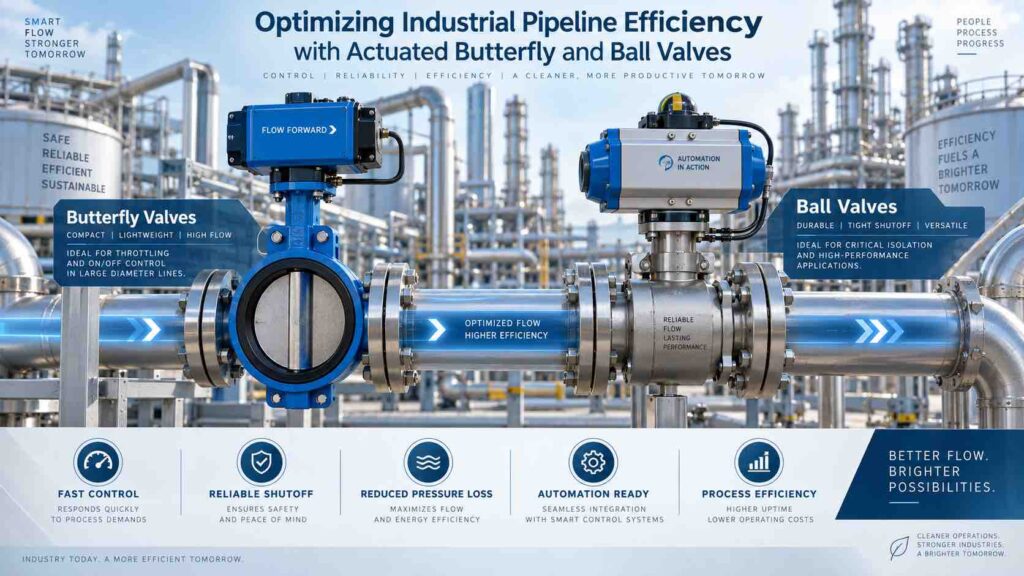
Modern factories need good flow of fluids, less energy loss, and safe systems that people can trust. Manual valves are often slow. People might make mistakes when using them. There are automatic valves, like actuated butterfly valves and actuated ball valves, that help with these problems. They use pneumatic or electric systems to move fluids.
When you put them with digital networks like SCADA and PLC systems, these automated valves help things flow better. They also use less energy. They prevent issues that can make factories stop working. You will see these in oil and gas plants. They are found in water treatment plants, chemical factories, and other businesses like these.
Knowing how to pick, install, and care for these types of valves helps people who run these systems and do these jobs make strong fluid systems that work well. When people in the industry work with big sellers like wholesale valves usa and buy the best parts, they make sure the parts are safe and follow rules like ASME, API, and ISO, even for tough jobs.
1. The Role of Actuation in Modern Process Automation
Actuation changes outside sources of power, such as air, fluid, or energy, into motion. This motion moves the valve stem. If you add automation to valve bodies with a turn, people do not have to do it by hand. It also cuts risks in the way people work and helps make the job better and more right.
Core Actuator Types
- Pneumatic Actuators: These use air that is pushed to move rack-and-pinion or scotch parts. They work well when you need to use the system often or shut it down fast for safety.
- Electric (Motorized) Actuators: These use motors and gearboxes that turn more than once. You can use them in places that are far away, when you want the valve to open or close in a certain way, or where there is no clean air line.
- Hydraulic Actuators: These give a lot of power for tough jobs like big pipes. They are often used to make oil or gas.
2. Actuated Ball Valves vs. Butterfly Valves: Technical Comparison
When you pick between an actuated ball valve and an actuated butterfly valve, you need to look at a few things. Think about how much pressure there will be. Look at what goes through the valve. Check the size of the valve opening. Think about how much it will cost to use each one over time.
| Technical Parameter | Actuated Ball Valves | Actuated Butterfly Valves |
| Sealing Capability | Zero-leakage bubble-tight shutoff (PTFE, RPTFE, Metal seats) | Dependable sealing (Resilient elastomer or Metal-seated) |
| Pressure & Temp Rating | High-pressure capacity (ANSI Class 150 to 2500+) | Moderate to high-pressure (Offset designs expand capabilities) |
| Flow Restriction (Cv) | Full-port options yield minimal pressure drop ($\Delta P \approx 0$) | Disc stays in flow path, causing slight pressure drop |
| Space & Weight | Larger footprint, heavier in diameters over 4 inches | Compact wafer/lug design, significantly lighter |
| Actuator Torque Needed | Requires higher torque to overcome seat friction | Requires lower operating torque in large-diameter pipes |
| Installed Cost Efficiency | Cost-effective in sizes up to 2 inches | Extremely cost-effective in large sizes (4 to 24+ inches) |
Key Applications for Ball Valves
- Pipelines with gas and liquid that have high pressure and need to ensure there are no leaks after the valve.
- The systems that need full pipe cleaning by using pigging for jobs where things must be cleaned in place.
- The tough flows with slurry, hydrocarbons, and strong chemicals.
Key Applications for Butterfly Valves
- The high-volume cooling water networks, HVAC systems, and raw water supply lines.
- Large-diameter ducting and low-pressure gas distribution.
- The space-constrained piping skids where the overall weight is a key factor.
3. Engineering Strategies to Maximize Pipeline Efficiency
System performance relies on parts that fit well. It is good to keep the flow steady, too. Using the right engineering steps can help to lower energy loss. This also helps the valves last longer.
Pressure Drop (Delta P$) and Energy Loss Minimization
Each valve creates some friction. This is called the loss coefficient, or $K$-factor. If the valve is too big, it can make the system hunt, and the actuator may wear out too fast. If the valve is too small, it can create too much backpressure. This will cause the pump to use more energy than it has to.
- Use full-port ball valves on key pump output lines to cut down fluid drag and lower pump power use.
- Use triple-offset butterfly valves (TOBV) for high-heat flow jobs. Their contact-free turning cuts the force needed and helps them last longer.
Implementing Smart Valve Instrumentation
Modern automated valves have digital positioners and smart sensors to check feedback.
- HART & Fieldbus Protocols: These send steady feedback about where the valve is, how hot it is, and how many times it has opened or closed. This information goes to people in the room who watch over everything.
- Partial Stroke Testing (PST): This checks how emergency shutdown valves work in a safe way, without stopping flow. It shows if the valve works well and is good to go.
- Cavitation Management: When you use valves that turn just a bit in times of high pressure, it can end up making bubbles that may do harm. To keep the valve and pipes safe, use special trim or put baffling inside. This helps take care of the pipes and valve body.
4. Maintenance Best Practices for Automated Quarter-Turn Valves
Having a good plan to take care of things before they break can stop things from changing in ways you do not expect. It also keeps the fluid system working well.
- Routine Seat & Packing Inspections: Watch the stem packing gland torque. This helps stop leaks from getting out. New ISO 5211 direct-mount pads take away side-loading on stem seals. This helps the packing last longer.
- Air Supply Quality: For these air-powered actuators, make sure the air supply goes through a 5-micron filter-regulator. The air should be oil-free. This helps keep the inside seals and solenoid valves safe.
- Actuator Calibration: Check the limit switch calibration every six months. This can stop motor burnout or valves not closing all the way.
Conclusion
Upgrading manual systems to automated valves gives quick results. It helps to save energy and improves how things flow. It also keeps the equipment safe. It’s important to pick the valve that fits what you need. Ball valves work well when you need a strong seal and want to deal with high pressure. Butterfly valves are good when there is little space, and you want to let more go through. This lets you set up a system that you can trust for your work.
If you work with people who know about flow and buy from wholesale valves usa distributors, you get what you need fast. The hardware will be checked and built to last. It will fit with your setup and work well.

