
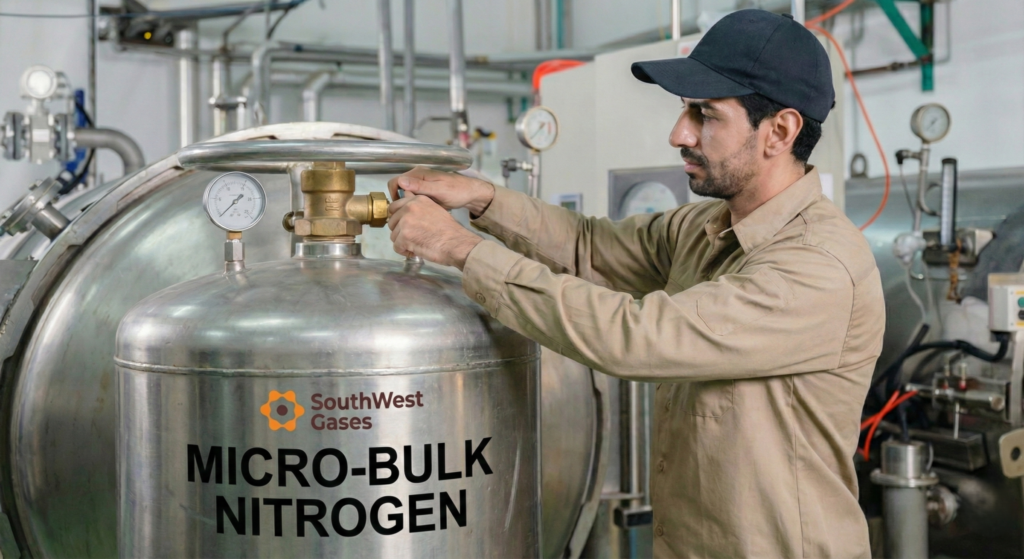
A facility can have several days of nitrogen in storage and still struggle to supply a machine during a busy shift. A regulator may be unable to maintain pressure at the required flow, or a vaporizer may be too small for the load. Storage capacity and gas delivery capacity need separate checks when choosing a supply system.
This comparison covers compressed-gas cylinders and delivered-liquid microbulk and bulk systems used to supply gaseous nitrogen. In the liquid-storage systems, a vaporizer converts nitrogen into gas before it reaches the process. Applications that consume liquid nitrogen, such as cryogenic cooling, require a separate assessment of liquid withdrawal and transfer equipment.
Start with the requirements at the equipment
Before requesting quotes, document how much nitrogen the facility uses and how demand changes during production. Include the required purity, operating pressure, and flow rate at the equipment. Southwest Gases, a nitrogen supplier in Texas, supplies compressed-gas cylinders and liquid nitrogen, including microbulk and bulk delivery systems. The company also reviews consumption and advises on system selection. Sharing equipment specifications and operating records gives the supplier a basis for comparing the available options.
How the supply formats differ
| Supply format | Storage and replenishment | Main purchasing consideration |
| Compressed gas cylinders | Nitrogen is supplied in individual cylinders or connected cylinder packs, which are replaced when depleted. | Whether cylinder capacity and handling frequency suit the workload. |
| Microbulk | A compact cryogenic tank stays at the facility and is refilled on site. | Whether reduced cylinder handling justifies the installed system and its ongoing costs. |
| Bulk liquid supply | A larger cryogenic storage installation receives liquid nitrogen deliveries and supplies the process through suitable equipment. | Whether ongoing demand and the site can support a larger installation. |
Portable liquid cylinders are another available option. They store nitrogen as a cryogenic liquid and can supply gas through a vaporizer, or provide liquid withdrawal where configured for it. They have different operating requirements from compressed-gas cylinders, so ask suppliers to identify the exact container type in their proposals.
When cylinders remain practical
Compressed-gas cylinders are worth considering for low-volume work and applications that need a movable supply. Suppliers offer individual cylinders and multi-cylinder packs, allowing facilities to increase stored gas without immediately installing a cryogenic tank.
To evaluate the existing arrangement, record the time spent receiving cylinders, moving them to the work area, making changeovers, and arranging returns. Note any production interruptions associated with those tasks. These records provide a basis for comparing the current system with an installed alternative.
Facilities that need continuous flow can also evaluate an automatic changeover system. This switches between gas sources as one supply becomes depleted, allowing the empty source to be replaced while the other remains in service. The assembly must be selected for the application’s pressure and flow requirements.
A changeover system reduces the need to stop work for every cylinder replacement. Staff still need a clear procedure for checking the reserve supply and replacing depleted cylinders.
What changes with microbulk
Microbulk replaces routine cylinder exchanges with on-site tank filling. The tank remains connected to the facility’s gas system, reducing the handling involved in moving full and empty containers. For a plant making frequent cylinder changes, that difference is worth measuring in staff time and production interruptions.
Tank selection requires more detail than the label “microbulk.” Manufacturers offer different capacities and pressure configurations, including equipment designed for high-flow applications. Ask the supplier to identify the proposed model and explain how its usable capacity fits the delivery schedule.
Periods of low consumption deserve attention. Cryogenic tanks are insulated, but heat still enters the vessel and causes some liquid to evaporate. During an extended period without sufficient gas withdrawal, pressure can rise until gas is released through the pressure-relief system. The amount lost depends on the equipment and operating conditions. Ask the supplier to account for weekends and planned shutdowns when estimating consumption and costs.
Check the whole system before choosing bulk
A bulk installation should be assessed against the facility’s current nitrogen use and any planned increase in production. Businesses evaluating bulk nitrogen supply in Texas can request a consumption review and site assessment from Southwest Gases. Its services include storage-system design and liquid-level monitoring. Ask for a written proposal that identifies the recommended equipment and explains how deliveries will be scheduled. Have the supplier separate installation costs from recurring gas, delivery, and maintenance charges so the proposal can be compared with the existing cylinder arrangement.
Compare costs over the same period
Request a first-year cost estimate and a separate estimate for subsequent years. Equipment installation can make the first year look quite different from normal operation. Gas supply proposals should identify equipment costs, the gas charge, delivery costs, and maintenance responsibilities.
For your own comparison, include any cylinder or tank rental, internal handling labor, and recurring fees stated in the contract. Ask whether minimum purchases apply and how pricing changes when consumption falls below the forecast. Have the supplier separate included services from charges that would be billed later.
Put the gas quantities on a common basis. One proposal may quote liquid nitrogen by volume or weight, while another quotes gaseous nitrogen in standard cubic feet. The conversion must use stated reference conditions. For example, Airgas’s conversion tool defines standard cubic feet at 1 atmosphere and 70°F, while its normal cubic meters use 1 atmosphere and 0°C.
A useful purchasing measure is the annual supply cost divided by the estimated usable gas delivered to the process. Document how the estimate treats residual gas returned in cylinders and any expected losses from liquid storage. Early cylinder replacement can leave usable product behind, while cryogenic storage has its own loss considerations.
Run the comparison at current consumption and at a realistic higher-use scenario. Keep any assumed savings from avoided downtime separate unless production records support them. This makes it easier to see whether a proposal remains economical when demand changes.
Confirm delivery access and reserve arrangements
Arrange a site review before accepting an installed-system proposal. Ask the supplier to confirm the tank location and delivery vehicle access, including the filling route and any restrictions during operating hours. Include the work needed to connect the installation to the equipment in the written scope.
For monitored tanks, establish who receives low-level alerts and who arranges replenishment. Remote monitoring can support delivery scheduling, but the agreement should explain how the supplier responds when consumption rises faster than expected.
Also ask what happens during a delayed delivery or equipment outage. Where production needs a reserve supply, have the supplier specify its usable capacity and the demand it can support. A backup arrangement should be assessed against the equipment that must remain running.
Safety belongs in this review. Nitrogen can displace oxygen without a warning odor, and liquid nitrogen can cause severe cold burns. Qualified personnel should assess the installation, including ventilation and the need for oxygen monitoring. Storage and transfer equipment must be suitable for nitrogen service, with appropriate pressure protection and operating procedures.
What to send with a quote request
Prepare a short operating brief with recent consumption records and the equipment’s gas specifications. Include the production schedule, expected demand peaks, and planned changes. Add a site layout showing the proposed storage area and delivery access.
Ask each supplier to explain its equipment selection and provide an itemized cost estimate using those same assumptions. The proposal should state the usable storage capacity, supported delivery pressure and flow, and the replenishment plan. These details give purchasing and engineering teams a common basis for reviewing the options.

