
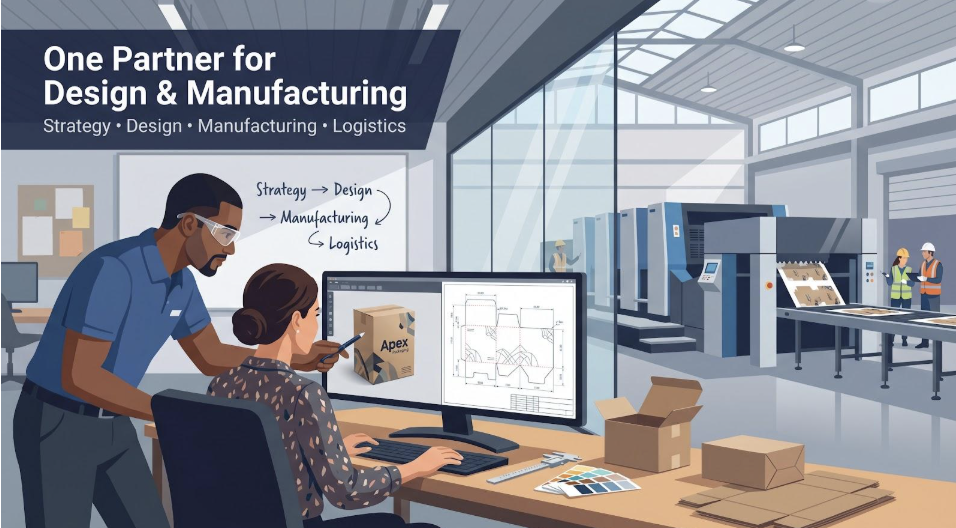
1. Partner with one team that designs and builds
Great packaging starts on a sketchpad but lives—or dies—on the factory floor. When design and manufacturing share one roof, ideas move fast, mistakes slow down, and launch dates stay firm.
Picture a structural engineer leaning over a designer’s screen to tighten a dieline and boost crush strength. That five-minute hallway chat can save 18 days in time-to-market on average, according to a 2025 Gartner survey.
The business payoff is just as real. Fewer hand-offs mean fewer mark-ups, shorter email threads, and one point of accountability. You brief once, approve once, and follow one schedule.
Full-service partners such as zenpack.us bring creatives, engineers, production managers, and logistics planners together, so every concept leaves the studio as a production-ready design rather than a pretty PDF. Their four-step path of strategy, design, manufacturing, and logistics proves how removing handoffs protects launch dates and print quality.
Before you request a quote, ask a direct question: “Will the same company that designs my box also run the presses?” A confident yes is your green light to keep talking.
2. Look for a portfolio that mirrors your world
Experience in “packaging” is too broad to be useful. You need proof that a partner has solved the same problems you face every day.
If you ship glass bottles, study projects where they lowered breakage under real distribution abuse. Launching premium skincare? Confirm they matched metallic tones and met every cosmetic-label rule. A supplier fluent in your category brings muscle memory you can bank on—regulatory shortcuts, common failure modes, and shopper expectations at shelf.
Dig past the glossy photos. Ask for the story behind each project: the challenge, the constraint, and the measurable result. Numbers speak louder than glamour shots. “We cut cube by 8 percent and saved the client six figures in freight” is music to any operations manager.
Finally, talk to peers who use them. One ten-minute call often reveals more than ten polished case studies. If references rave about on-time launches and painless audits, you’re on the right track. If they dodge the phone, keep shopping.
3. Insist on design that thinks as hard as it looks
Eye-catching graphics pull shoppers in, but thoughtful structure protects the product, ships flat, and trims freight spend. You deserve both.
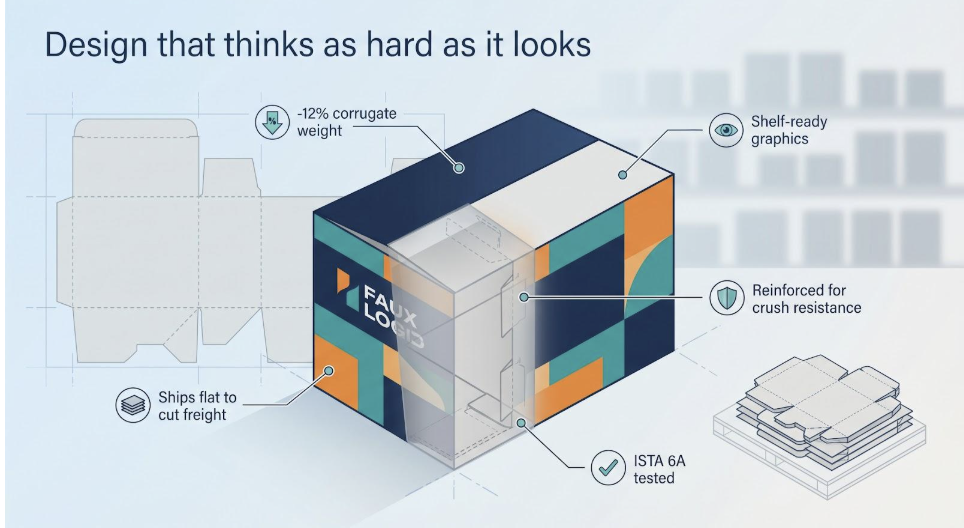
Start by reviewing the partner’s creative process. Do designers sit with engineers on day one, or hand off pretty PDFs and hope for the best? Cross-functional sessions produce packaging that snaps closed with a satisfying click, fits the line, and still turns heads on TikTok.
Ask to see proof of material savings. For instance, a client case where the team cut corrugate weight by 12 percent while holding crush resistance, confirmed by ISTA 6A testing. Real builders can show prototypes, not just glossy renders.
Toolset matters too. Partners who run color proofs through calibrated digital presses and model drop tests in CAD find faults while they are still cheap pixels. Those who rely on “print and pray” learning use your budget as the lesson.
Finally, look for a culture of experimentation. Teams exploring mushroom foam, molded pulp, or smart inks today will guard your brand against tomorrow’s material bans and consumer demands. Choose the crew that turns every brief into fresh thinking, not a rerun of last season’s dieline.
4. Demand rapid prototypes and relentless testing
Ideas on paper feel perfect. Reality argues back. A partner who can turn a CAD file into a physical sample within 48 hours lets you catch flaws while they cost pennies, not pallets.
Speed matters, and rigor wins. Insist that every prototype faces real-world abuse: ISTA 3A drop tests, ASTM D642 compression checks, and even a mock fulfillment run on your actual shipping lane. If ink scuffs, flaps pop, or bottles rattle, you learn now, not after launch day.
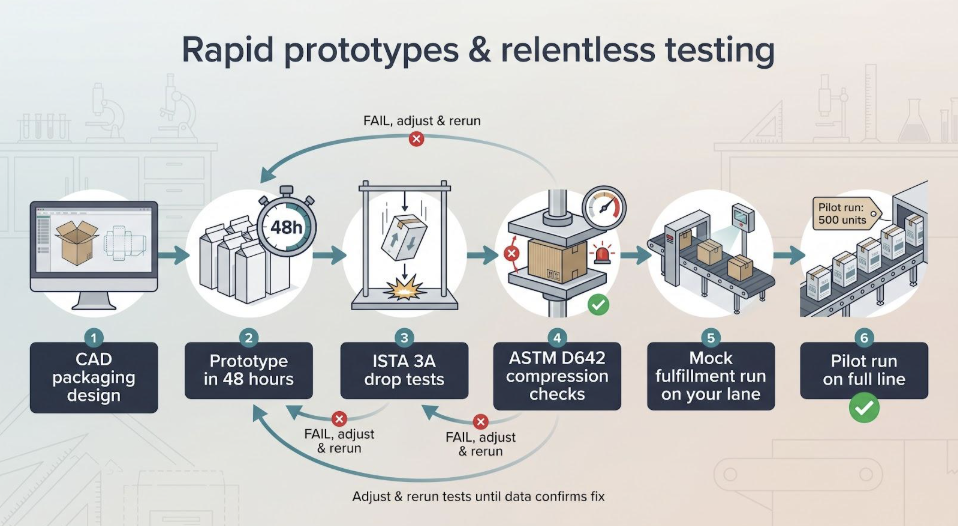
Watch how the supplier reacts to failures. Do they shrug and blame the courier, or do they adjust the structure, rerun the test, and email you the data that confirms the fix? That response tells you more about long-term reliability than any slide deck.
Finally, budget for a pilot run. A batch of 500 units on the full production line validates everything from print registration to carton-gluer settings. It is the lowest-cost insurance you will ever buy, and the partner who pushes for it is the one you want beside you.
5. Verify the quality system, not just the quality claim
Every packaging vendor promises “top-tier quality,” but the right partner proves it on paper, on the line, and in the data.
Start with the paperwork. Ask for current certificates: ISO 9001:2015 for quality management, BRCGS or HACCP for food-adjacent products, and FSC for virgin paperboard. A confident partner emails the PDFs within the hour; hesitation is a visible red flag.
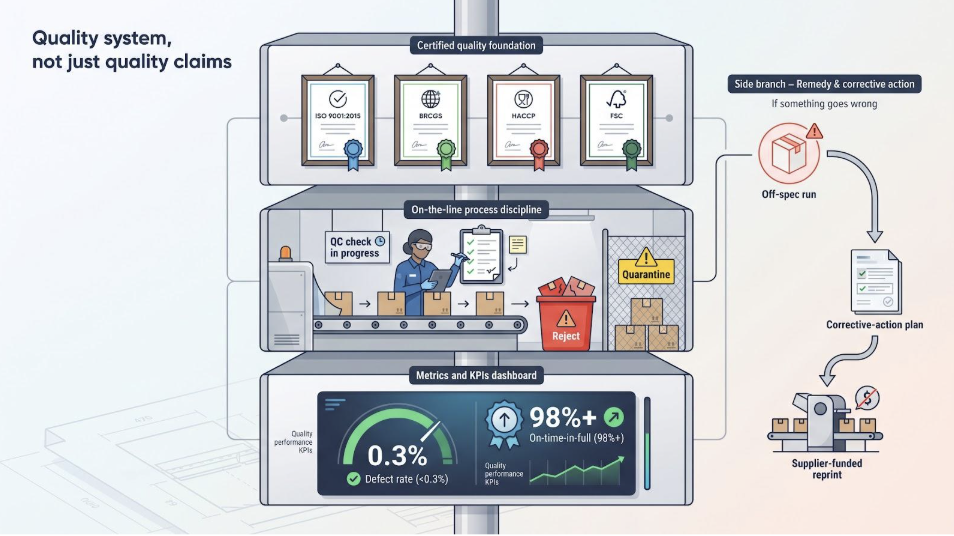
Then look at the process behind the certificate. Walk the floor or request a video tour. Do operators log every inspection? Are reject bins clearly labeled and quarantined? A disciplined system catches a mis-registered logo long before your customer sees it.
Numbers close the case. Ask for last year’s defect rate and on-time-in-full score. Leaders keep defect rates below 0.3 percent and ship on schedule 98 percent of the time, then share those metrics with pride because numbers beat marketing.
Finally, pin down the remedy. If a run ships off-spec, what happens next? The gold standard is a written corrective-action plan and a reprint at the supplier’s expense. Anything less moves the risk to you, and your launch calendar has no room for that gamble.
6. Make sustainability a built-in, not a bolt-on
Eco claims are no longer marketing sparkle; they now drive purchase orders, legislation, and consumer loyalty. Extended-producer-responsibility fees, recycled-content mandates, and plastic taxes are sweeping across key markets, and regulators show no sign of slowing.
Choose a partner who treats carbon, recyclability, and material efficiency as design inputs, not afterthoughts. In the kickoff brief they should ask, “Can we lightweight this structure?” and “Could a mono-material replace the film-plus-tray combo?” Those questions signal a team that understands the cost of missing a sustainability target, both financial and reputational.
Proof lives in paperwork and prototypes. Look for FSC on paperboard, ASTM D6400 on compostables, and ISO 14001 on the plant wall. Then ask for case studies where they replaced petroleum foam with molded pulp or cut plastic by 30 percent without raising breakage. Real wins, not vague aspirations.
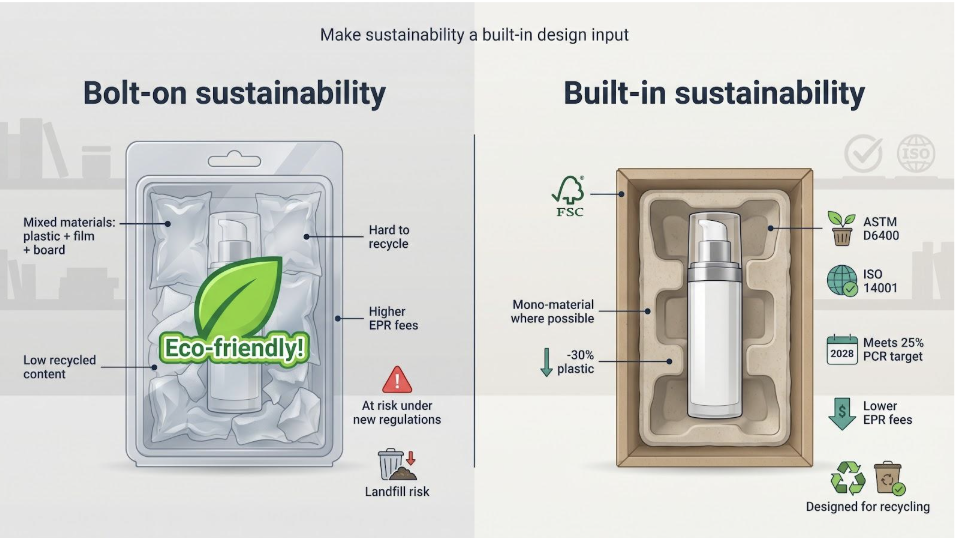
California’s SB 54, for example, will require 25 percent post-consumer recycled content in many plastic items by 2028. Partner with companies that share that urgency and you will meet tomorrow’s rules before they land on your desk.
7. Check that capacity matches your climb and survives a storm
A supplier’s pressroom can look impressive on a walkthrough, yet still choke the moment your forecast spikes. Capacity is more than square footage; it is people, machinery redundancy, and a supply chain that keeps paper, ink, and liners moving even when markets tighten.
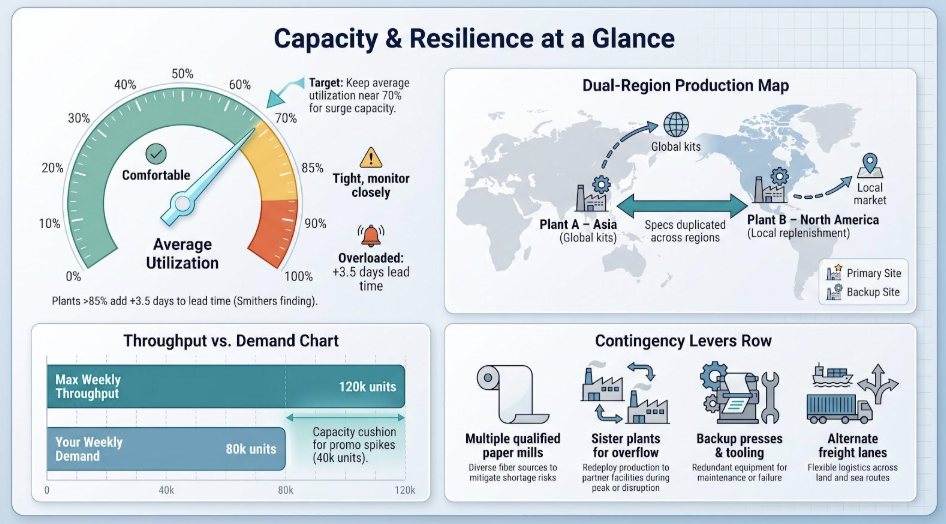
Start with the numbers. Ask for maximum weekly throughput on packaging like yours and today’s utilization rate. Plants running above 85 percent average utilization slip by 3.5 days on lead time, according to a 2024 Smithers study. A facility sitting near 70 percent leaves the cushion you need for promo surges and holiday surprises.
Next, probe lead-time discipline. Seasoned partners track on-time-in-full like a heartbeat and commit to dates in writing, penalties included. Verbal promises invite launch-day panic.
Geography counts too. A dual-region model (for example, printing in Asia for global kits and duplicating the spec stateside for replenishment) trims freight, hedges currency swings, and keeps orders moving if one lane clogs. If the vendor’s answer to disruption is “we’ll figure it out,” keep searching.
Finally, explore contingency plans. Do they qualify multiple paper mills? Can they shift work to sister plants if a press goes down? Resilient systems beat heroic emails every time. Choose the partner whose playbook is stronger than any single point of failure.
8. Judge communication the way you judge color match, with zero tolerance
Projects unravel in the inbox long before they stumble on press. A partner’s speed and clarity reveal exactly how your launch will feel.
Watch their cadence during quoting. Do questions arrive quickly, framed by your brief, and ask for missing details only once? That rhythm signals an organized workflow and a team committed to first-pass accuracy.
Ask for a single point of contact who owns timelines, artwork approvals, and freight bookings. Clear ownership trims threads and steadies nerves.
Add a response-time metric to the contract. A 2025 McKinsey survey found that suppliers who reply within four business hours score 30 percent higher in customer satisfaction. Make that your line in the sand.
Finally, test conflict resolution early. Float a hypothetical delay or spec change and note the reaction. Pros outline options, costs, and next steps within hours; amateurs dodge or deflect.
9. Follow the money, all the money
Low unit cost feels like victory until hidden fees drain your budget. Freight surcharges, storage bills, and new plate charges can each carve 5–7 percent off gross margin, according to a 2024 Deloitte packaging survey.
Treat every quote like an iceberg: the per-box price is only the visible tip. Ask for tooling, prototypes, freight class, pallet count, and payment terms in writing. A transparent partner will itemize every line, explain why it exists, and lock those numbers for a fixed window.
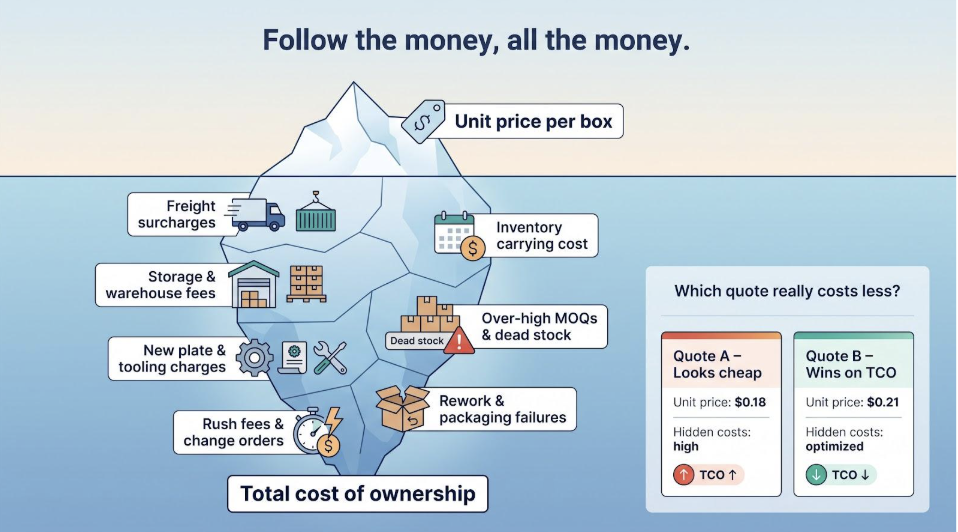
Run the math that matters—total cost of ownership. One procurement veteran puts it plainly: “Don’t compare unit prices, compare total cost of ownership.” Add inbound freight, inventory carrying cost, and the real price of a packaging failure. That bargain supplier can turn pricey fast.
MOQ is the next trap. If a vendor insists on 50,000 units when you sell 10,000 a year, the cheapest-per-piece quote inflates into dead stock and warehouse rent. Negotiate volumes that match your sell-through rate, or at least stage deliveries so cash stays liquid.
Finally, ask for value engineering. Partners who suggest a lighter flute or a faster-fold insert can trim seconds on the line or grams in the box. Savings born from design, not discounting, land in your pocket every reorder.

