
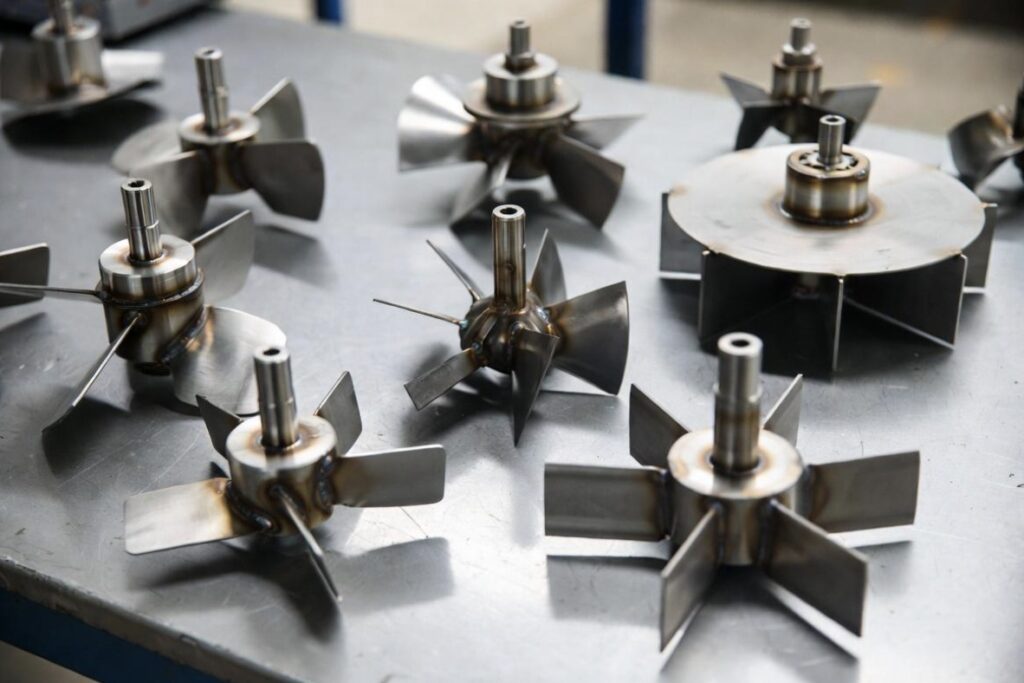
An industrial agitator impeller is the working component that transfers rotational energy from a mixer shaft into a liquid, slurry, or multiphase process. Its geometry determines how fluid moves through a vessel, how much shear is created, and how effectively the system blends, suspends solids, disperses gas, or supports heat transfer.
For B2B buyers, impeller selection should not be a catalog-only decision. Two impellers with similar diameters can create very different flow patterns and power demands. Tank geometry, viscosity, density, solids content, temperature, mixing objective, and operating schedule all influence the correct choice.
This guide explains common agitator impeller types, axial, radial, and tangential flow, and the information buyers should provide before requesting a quotation.
What Is an Industrial Agitator Impeller?
An industrial agitator impeller is a rotating blade assembly attached to a mixer shaft. The motor and gearbox rotate the shaft, while the impeller pushes or shears the surrounding fluid. The resulting circulation brings different parts of the vessel into contact and helps the process reach the required uniformity.
The impeller does not work alone. Performance also depends on shaft position, baffles, speed, bottom clearance, liquid level, and the spacing between multiple impellers. In a continuous stirred-tank reactor, agitation supports the distribution of incoming materials and temperature control. Linquip’s guide to continuous stirred-tank reactors provides useful background on this process.
How Impeller Design Influences Mixing Performance
Impeller design controls three main outcomes: bulk flow, shear, and power demand. Bulk flow moves material throughout the vessel. Shear creates velocity differences that can disperse droplets, wet powders, or break agglomerates. Power demand reflects the resistance created by the fluid and blade geometry.
A high-flow industrial mixing impeller is not automatically suitable for dispersion, and a high-shear turbine may waste energy when gentle blending is sufficient. Buyers should first define the required result, such as blending time, suspension level, temperature uniformity, gas dispersion, or protection of shear-sensitive material.
Understanding Axial, Radial, and Tangential Flow Patterns
An impeller flow pattern describes the dominant direction in which liquid leaves the blades.
Axial flow moves mainly parallel to the shaft. It supports top-to-bottom circulation, blending, heat transfer, and many solids-suspension duties.
Radial flow moves outward, approximately perpendicular to the shaft. It can provide greater local shear and is often used for dispersion or gas-handling applications.
Tangential flow follows the direction of rotation around the tank. Excessive tangential movement can form a vortex and reduce vertical turnover. Baffles, off-center mounting, or an angled shaft can limit this effect.
For related fluid-machinery terminology, Linquip’s overview of centrifugal-pump components illustrates axial and radial directions clearly, although pump and agitator duties are different.
Propeller Impellers for High-Flow, Low-Viscosity Mixing
A propeller impeller normally creates axial flow and strong circulation relative to its diameter. It is commonly considered for low-viscosity liquids where blending, dissolution, heat transfer, or general tank turnover is the main objective.
Propellers may use two, three, or more blades, with pitch and profile adapted to the required flow and speed. They can operate in top-entry, side-entry, or portable mixers.
As viscosity rises, circulation becomes less effective and torque demand increases. Large particles, fibrous solids, and shear-sensitive products can also change the preferred design. Buyers should provide the maximum operating viscosity, not only a room-temperature value.
Paddle Impellers for Blending and Heat Transfer
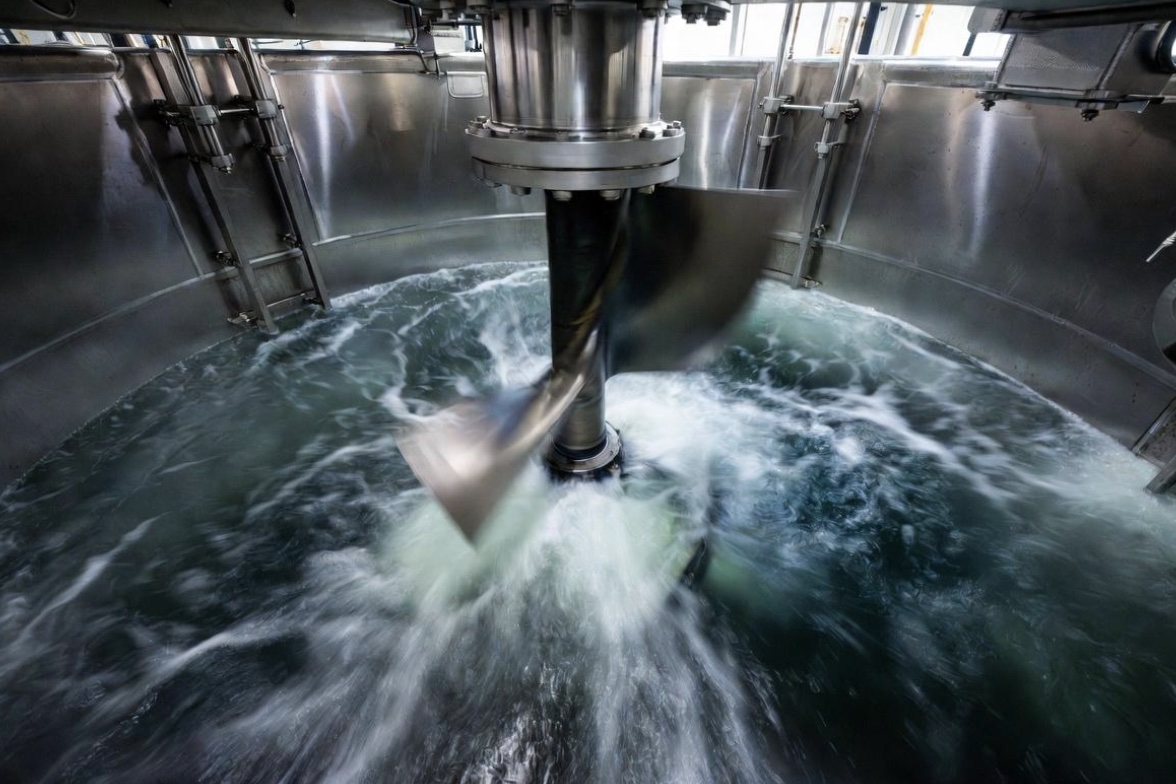
A paddle impeller uses broad, relatively simple blades. Flat paddles tend to create more radial and tangential movement, while pitched paddles add an axial component. They are often used for basic blending, temperature uniformity, and moderate-viscosity duties.
Paddles can provide a robust and practical solution, but blade area, angle, speed, and tank diameter still matter. A small paddle running too slowly may only move fluid near the shaft. An oversized design can create unnecessary torque.
For heat-transfer service, the supplier should evaluate how effectively liquid moves past the tank wall, jacket, or internal coils.
Turbine Impellers for Dispersion and High-Shear Applications
Turbine impellers have several blades mounted around a hub or disc. Flat-blade turbines mainly create radial flow and higher local shear. Pitched-blade turbines combine axial and radial movement.
A turbine impeller may suit liquid-liquid dispersion, gas dispersion, chemical reaction, powder wetting, or processes needing more local energy than simple blending. Tall vessels may use multiple turbine stages for better coverage.
Higher shear also increases attention to motor power, shaft strength, seals, bearings, and heat generation. The supplier should match blade geometry and speed to the product rather than selecting a turbine only because it appears more powerful.
Pitched-Blade Impellers for Circulation and Solids Suspension
A pitched blade impeller uses blades installed at an angle to the horizontal plane. The angle creates axial flow while retaining some radial action. This makes the design useful for blending, solids suspension, heat transfer, and selected gas-liquid duties.
For solids handling, the required result must be defined. “No settling” may mean particles move across the bottom, remain fully suspended, or distribute uniformly throughout the vessel.
Particle size, density, concentration, liquid viscosity, bottom shape, and impeller clearance all affect selection. The design should also consider startup after settled material has accumulated.
How Fluid Viscosity Affects Impeller Selection
Viscosity is a fluid’s resistance to flow. As viscosity increases, momentum travels a shorter distance from the impeller, so dead zones become more likely unless the design changes.
Low-viscosity fluids often suit propellers or pitched-blade impellers. Medium-viscosity products may require larger diameters, lower speeds, or multiple stages. Highly viscous or non-Newtonian materials can require close-clearance anchors, gates, or helical ribbons.
Buyers should provide viscosity at minimum and maximum operating temperatures. For shear-thinning or shear-thickening products, they should also describe how viscosity changes during startup, heating, cooling, or concentration.
The Relationship Between Impeller Diameter, Speed, and Motor Power
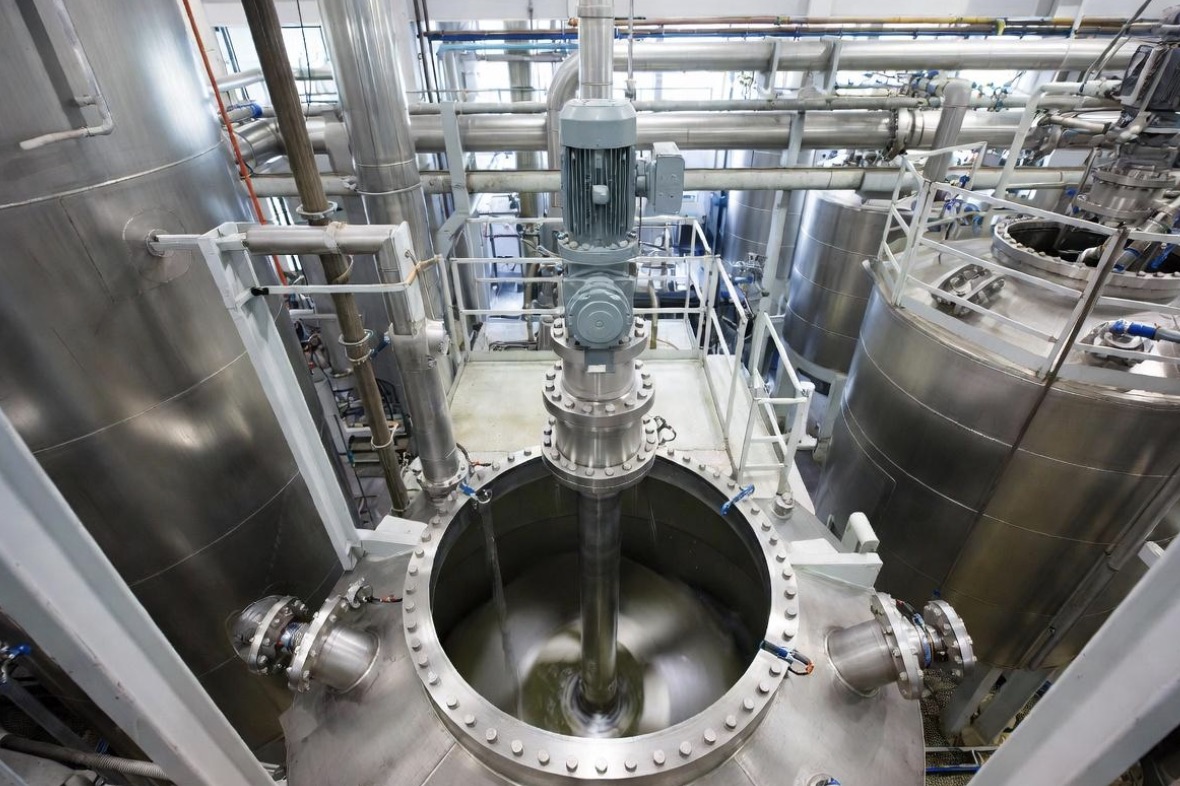
Impeller diameter and speed work together. Increasing either can raise circulation and shear, but it also changes torque and power demand. A small impeller at high speed creates a different process from a large impeller at low speed, even with similar motor ratings.
Tank agitator sizing should consider the complete drive train: motor, gearbox, coupling, shaft, bearings, and support structure. Motor power should follow the mixing calculation and the most demanding operating condition.
Oversizing can increase purchase and energy costs. Undersizing may prevent startup or overload the drive. Variable-frequency control can add flexibility, but the acceptable speed range still requires engineering review.
Choosing Impeller Materials for Corrosive and Abrasive Media
The impeller material must tolerate the process fluid, temperature, cleaning chemicals, and mechanical wear. Common options include carbon steel, coated steel, and several stainless-steel grades. Aggressive service may require special alloys, linings, or nonmetallic materials.
Corrosion and abrasion are different risks. A material with good chemical resistance may still wear quickly in a slurry containing hard particles. Coatings can protect a base metal, but damaged edges or weld areas may expose it.
Buyers should provide chemical composition, concentration, temperature, solids, and cleaning methods. They should also confirm material records, weld quality, balancing, and inspection requirements.
How to Match an Impeller to the Mixing Objective
Impeller selection should begin with the required process outcome rather than a preferred blade name. The table below shows common starting points. Final selection still requires review of the tank, fluid, duty cycle, and installation.
| Mixing objective | Common starting point | Typical flow | Key buyer data |
| General blending | Propeller or pitched blade | Mainly axial | Viscosity, blend time, liquid level |
| Solids suspension | Pitched-blade or axial-flow design | Axial | Particle size, density, concentration |
| Gas dispersion | Radial turbine or mixed-flow turbine | Radial or mixed | Gas rate, pressure, mass-transfer goal |
| Heat transfer | Propeller, pitched blade, or paddle | Axial or mixed | Jacket or coil layout, temperature range |
| High-shear dispersion | Flat-blade turbine | Radial | Droplet size, powder behavior, shear limit |
| High-viscosity mixing | Anchor, gate, or helical ribbon | Close-clearance | Rheology, temperature, wall clearance |
What Buyers Should Confirm Before Ordering an Agitator Impeller
A complete request for quotation should include tank diameter and height, working volume, liquid levels, bottom shape, baffles, coils, and internal obstructions. It should also state density, viscosity range, temperature, pressure, solids information, corrosion risk, and the required mixing result.
Ask the industrial agitator supplier to confirm:
- Impeller type, diameter, blade angle, and quantity
- Shaft dimensions, material, and connection method
- Operating speed, motor power, and gearbox ratio
- Installation position and required clearances
- Wetted materials, coatings, weld treatment, and balancing
- Drawings, inspection records, manuals, spare parts, and packaging
- Voltage, frequency, motor protection, and hazardous-area needs
Buyers comparing agitator impeller options should request a technical proposal, not only a unit price.
Frequently Asked Questions
- Which impeller is commonly used for low-viscosity blending?
Propeller and pitched-blade impellers are common starting points because they create strong circulation. Final selection still depends on tank geometry, speed, and the required blend time.
- What is the main difference between axial and radial flow?
Axial flow moves mostly parallel to the shaft and promotes top-to-bottom turnover. Radial flow moves outward toward the tank wall and usually creates stronger local shear.
- Can one impeller handle several products?
Possibly, when the products have similar properties and mixing goals. The supplier should review the full viscosity, density, temperature, and solids ranges before confirming one configuration.
- How many impellers does a tank need?
The answer depends on liquid depth, tank diameter, viscosity, internal structures, and required coverage. Tall vessels often need multiple stages to reduce unmixed zones.
- Which material should be used for corrosive liquids?
Material selection depends on chemical composition, concentration, temperature, abrasion, and cleaning conditions. Buyers should request a documented compatibility review instead of choosing by material name alone.
- What should buyers approve before production?
Approve the impeller drawing, dimensions, material, blade angle, shaft connection, balancing method, inspection scope, packing, and all operating data used for the supplier’s selection.
Conclusion
An industrial agitator impeller determines how effectively mechanical power becomes useful flow and shear inside a tank. Propeller, paddle, turbine, and pitched-blade designs serve different process goals, while axial, radial, and tangential flow patterns influence circulation, suspension, dispersion, and heat transfer.
Reliable selection requires accurate fluid properties, tank drawings, operating conditions, and a clear definition of the desired result. Buyers should evaluate the complete system, including the drive, shaft, materials, installation, quality control, and documentation.
For product details, customized impeller configurations, or technical support, buyers can contact KEHENG Mixers with their tank drawing and process data.

