
U.S. utilities plan a record 86 GW of new generation in 2026—more solar, storage, and transmission lines than any prior year. That surge forces owners to coordinate dozens of EPC partners, thousands of schedule activities, and billions in CAPEX against fixed COD and tax-credit deadlines. Yet critical data still sits in disconnected tools: Primavera schedules here, Excel cost files there, RFIs everywhere.
This guide compares six capital-project software platforms built for utility and power-generation owners. We rank them on integrated controls, portfolio visibility, contractor governance, and field execution—so you can pick a system before the schedule picks you.
What exactly is capital-project software for utilities?
Seasoned utility owners often use InEight as that baseline: its single data model, owner-defined workflows, and tamper-proof audit trail neatly satisfy the three tests before any configuration begins. Commonwealth Edison’s project-controls team echoes that point, saying the benefit of having “data from multiple systems in one data library is huge,” a shift that removed last-minute surprises from its capital-spend forecasts.
Why the owner focus matters: contractor apps optimize one jobsite and ERP balances the ledger, but neither asks the utility, “Are we spending capital efficiently on the right mix of projects, and can we prove it to regulators?” Capital-project software does.
Use this quick test before you add any product to your shortlist:
- Unified controls. Cost, schedule, risk, documents, field data, and portfolio analytics share one data model or first-party modules.
- Owner governance. You—not the EPC—set codes, workflows, and permissions.
- End-to-end audit trail. The system preserves every change from notice to proceed through handover.
If a tool fails any of those three, it’s an adjunct, not the main platform. Keep that filter handy as we compare the six contenders; each clears the bar in its own way, but only one may fit your capital strategy.
A snapshot of the six contenders
Before the detailed reviews, use this quick matrix to see where each platform excels, and where you may need add-ons.
| Platform | Primary owner win | Cost-schedule-risk link | Document & field strength | Utility fit | Key caveat |
| InEight | One environment from estimate to hand-over | Strong, native | Connected modules | Strong | Enterprise-scale rollout and governance |
| Primavera P6 / Cloud | Deep CPM scheduling pedigree | Strong schedule; add-on cost | Limited alone | Strong, via contractor norm | Needs other Oracle or third-party tools for full controls |
| Octave Sequence Enterprise | Portfolio capital and cost governance | Strong | Expanding (v10) | Strong | Heavy implementation; verify v10 availability |
| Oracle Aconex | Cross-company CDE and audit trail | Moderate | Very strong documents | Strong on megaprojects | Not a full controls suite without P6/Unifier |
| Kahua | Configurable owner workflows & security | Moderate | Strong workflows | Very strong | Validate CPM/EVM depth; custom config load |
| Procore | Field adoption & contractor collaboration | Moderate | Very strong field/mobile | Moderate; improving | Owner controls newer; check utility workflows |
Treat this table as a compass, not a verdict; the next six sections test each contender against the full utility-owner scorecard.
How we scored the field
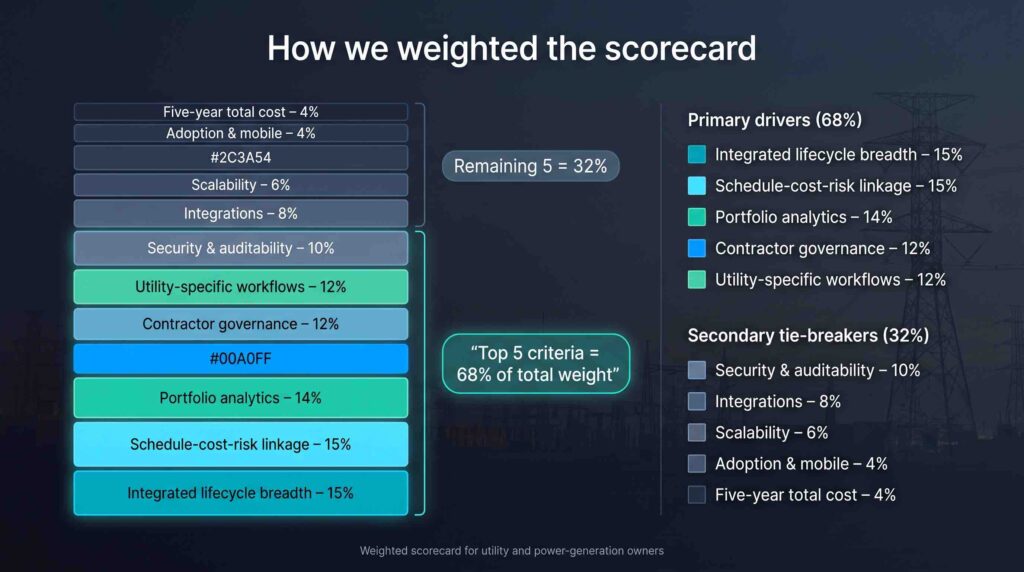
Regulated utilities can’t pick software on gut feel, so we built a 10-point weighted scorecard. The top five factors account for 68 percent of the total weight; the remaining five break ties when capabilities look similar.
| Rank | Criterion | Weight | Why it matters to owners |
| 1 | Integrated lifecycle breadth | 15% | Links estimate, schedule, cost, change, docs, and field data in one model, eliminating spreadsheet stitching. |
| 2 | Schedule-cost-risk linkage | 15% | Turns today’s field quantities into tomorrow’s CPI, SPI, and contingency forecast without re-keying. |
| 3 | Portfolio analytics | 14% | Lets executives drop from a 20-year plan to one transformer delivery in two clicks. |
| 4 | Contractor governance | 12% | Keeps EPCs within your codes, outage windows, and audit rules, not theirs. |
| 5 | Utility-specific workflows | 12% | Tracks interconnection, COD, and outage milestones unique to power projects. |
| 6 | Security & auditability | 10% | Critical-infrastructure owners need provable role-based access and tamper-proof records. |
| 7 | Integrations | 8% | Bi-directional links with ERP, EAM, GIS, and P6 keep data synchronized. |
| 8 | Scalability | 6% | Platforms must support multi-billion-dollar portfolios with thousands of external users. |
| 9 | Adoption & mobile | 4% | Field crews won’t feed the system if it’s painful to use. |
| 10 | Five-year total cost | 4% | Licences are just the start; implementation, integrations, and admin often dominate TCO. |
Only features proven in current product docs, release notes, or live demos counted; roadmap promises earned zero. The result is a ranking that defends capital spend, keeps forecasts shock-free, and scales whether you’re building one wind farm or 40 GW of solar.
1. InEight: the integrated command center for owner controls
InEight for power and renewables scheduling tops our scorecard because one login connects estimate assumptions, CPM schedules, live field quantities, change orders, risk registers, and hand-over files, turning the weekly spreadsheet chase into real-time insight.

Utility owners say the payoff is visibility: open the portfolio view, spot an SPI dip on a 200 MW solar project, drill into the delayed inverter shipment, and review the supplier’s change order, no CSV export required. That traceability keeps auditors and boards aligned.
All core controls sit in a single SQL database: scheduling, cost, documents, 3-D models, risk, and mobile field reporting. When crews log quantities, EVM curves refresh instantly. The October 13, 2025 InEight Intelligence release added AI search that summarises RFIs and highlights emerging issues, with source links for review.
Energy-sector use cases are public: a transmission operator tracking 500-ton transformers, a renewable developer tying tax-credit milestones to forecasts, a nuclear team preserving 25 years of quality records. See examples in the vendor’s overview for power and renewables.
Watch-outs. Enterprise scope calls for a structured rollout that covers data standards, governance workshops, and change management. Licence pricing varies by module and role, so model five-year TCO before you commit.
Best when you need portfolio-level control, deterministic forecasts, and an auditable record from estimate to COD across multiple EPCs.
2. Oracle Primavera P6 / Primavera Cloud: scheduling rigor the industry still trusts
Primavera remains the default CPM engine for large utility builds. Schedulers routinely model critical-path impacts on 50 000-plus-activity networks and level craft resources to fit tight outage windows, capabilities refined over three decades.

Why owners keep it in the toolbox: contractors submit XER files natively, regulators still accept Primavera print-outs, and most risk or BI tools import P6 data without conversion. Upgrading to Primavera Cloud adds portfolio dashboards, scenario planning, and mobile progress capture under the same Oracle login.
Remember the boundary. P6 is a scheduler, not a full project-controls suite. Cost, change, documents, and field data still flow through Unifier, Aconex, or other integrations. That route feels smooth if Oracle already anchors your stack but can become costly if it doesn’t. Oracle’s April 14, 2026 Unifier release also introduced AI process summaries that surface stalled approvals across P6-linked projects.
Best when schedule precision is non-negotiable for nuclear outages, SMR construction, or overlapping grid-modernisation programs and you have a clear plan (and budget) to integrate cost and document controls.
3. Octave Sequence Enterprise: portfolio governance without the spreadsheet marathon
Think of Octave Sequence Enterprise—formerly EcoSys—as the chief accountant for your capital program. Its cost-control roots remain, but the July 2026 Version 10 release added stronger portfolio-planning dashboards and native document management (general availability confirmed in Octave’s July 2026 release notes).

Utility finance teams praise its hierarchy flexibility: roll thousands of feeder upgrades into one funding bucket, then pivot the same data by regulatory filing, asset class, or emissions profile. When field progress lands, contingency draw-downs refresh instantly, so rate-case testimony never relies on last month’s numbers.
Rollout follows a structured path. First, design the coding structure; next, integrate ERP actuals and scheduler progress. Done well, Sequence becomes the financial spine of a multi-billion-dollar portfolio.
Best when governance, forecast accuracy, and audit defence outrank speed of deployment, and you’re ready for a data-model-first rollout.
4. Oracle Aconex: the contract-grade document vault
When claims hinge on who saw which drawing when, Oracle Aconex steps in. Its Common Data Environment locks every RFI, test plan, and revision into an immutable audit trail. External EPCs work in the same space, while role-based permissions preserve the original record for discovery.
Utilities prize that formality. Need a complete Inspection and Test Plan for a substation rebuild? Aconex links each ITP step to the supporting document, change, and sign-off, so nothing vanishes into inboxes. Oracle’s April 13, 2026 release added an automated Review Matrix that starts approval flows based on document metadata, reducing manual chase time for owner teams.
Know the boundary. Aconex handles documents, correspondence, and field capture but still relies on Primavera for CPM, Unifier for cost, and ERP for actuals to form a full controls stack. If Oracle already anchors your IT chart, that modular path feels natural; if not, integration costs rise quickly.
Best when you oversee mega-projects with high litigation exposure, multiple EPC contracts, and regulators who demand an undisputed project record.
5. Kahua: governance your compliance team will appreciate
Kahua views capital delivery as a collection of configurable business processes, not fixed modules. For utilities juggling generation, T&D, and storage under one regulatory lens, that flexibility shines: spin up a workflow for interconnection land rights, another for outage coordination, a third for grant reporting, all feeding the same portfolio view.
Security leads the story. As of August 19, 2026, Kahua holds ISO 27001 certification and SOC 2 Type 2 attestation, and its FedRAMP-authorized cloud meets many U.S. utility-procurement checkboxes. Role-based access and contractor workspaces keep external parties productive without altering the owner’s book of record.
Where you must lean in is quantitative project control. Kahua connects with Primavera for CPM horsepower and supports earned-value structures, but those elements require configuration or third-party analytics. Plan that design time so flexibility doesn’t turn into scope creep.
Best when you need tailored workflows, proven security credentials, and smooth hand-over to SAP, Maximo, or GIS, and you’re ready to craft the control model that fits your portfolio.
6. Procore: field adoption that pulls owners into the data loop
Walk any jobsite and you’ll likely see Procore on a superintendent’s phone. That ubiquity is gold for owners who need timely field data; RFIs, submittals, daily logs, and photos flow to the cloud in near real time, no email chase required.

On June 17, 2026, Procore released an AI-powered portfolio-planning suite so capital teams can rank projects, set multi-year budgets, and track funding drawdowns alongside jobsite activity. Embedded AI also summarises meeting minutes and flags overdue submittals, trimming administrative hours.
Integrations keep the data moving. Out-of-the-box connectors sync cost and schedule updates with ERP, P6, and Power BI. Looking ahead, the proposed $845 million DroneDeploy acquisition (announced July 29, 2026) aims to weave drone-based reality capture into progress validation.
Remember the platform’s DNA: CPM depth, quantitative risk, and complex outage modelling still rely on external schedulers or partners. Utilities with heavy linear assets should verify GIS and outage-window workflows before rollout.
Best when contractor engagement and mobile ease outrank pure project-controls horsepower, and you want to piggyback on tools field teams already know.
Integrated platform or point-tool stack: which road keeps projects on track?
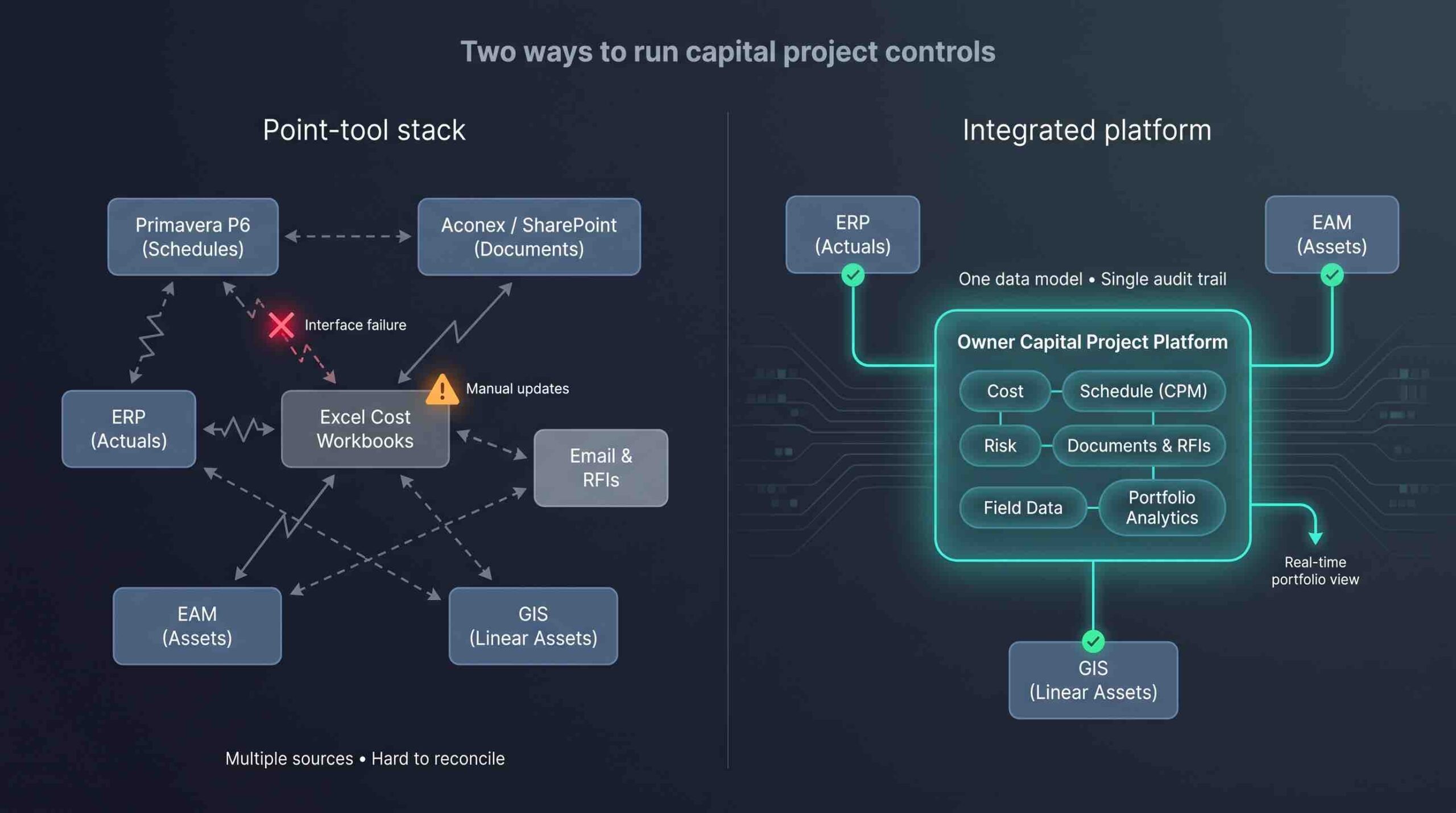
Most utilities still juggle a patchwork: Primavera schedules in one silo, Aconex or SharePoint for documents, Excel cost workbooks in email, plus ERP, EAM, and GIS. That setup can work, if every interface holds and contractors submit updates on time. In practice, one broken link and forecasts drift before anyone notices. FMI and Autodesk found that poor data and miscommunication cost the U.S. construction sector $177 billion a year, largely through rework and time spent hunting for information.
An integrated platform flips the model. Estimate flows into the schedule, schedule drives progress, progress refreshes earned value—all inside one data set. Fewer hand-offs mean fewer reconciliation headaches and a single audit trail regulators trust.
Which road wins depends on priorities:
- If your organisation already mandates P6 and SAP, adding Aconex for documents and Sequence for cost may be cheaper than replacing core systems, but be sure to budget for middleware, interface maintenance, and staff who speak all three vocabularies.
- If speed, data confidence, and lower long-term overhead top the list, a unified environment like InEight or a tightly configured Kahua stack pays back in cleaner handover packages and fewer manual rescues.
Integration pain shows up in the forecast-variance column, not the software invoice, so choose deliberately.
Matching platforms to real-world utility scenarios
A rural co-op swapping 400 poles faces different risks than a multi-state transmission owner building multi-billion-dollar lines. Begin with the worry that keeps leadership up at night, then shortlist the tool built for that exact headache.
| Your top concern | Platform to shortlist |
| Integrated estimate-to-handover controls across multiple EPCs | InEight |
| Schedule quality for complex outages or nuclear builds | Oracle Primavera P6 / Cloud |
| Forecast accuracy and capital governance at portfolio scale | Octave Sequence Enterprise |
| Contract-grade document control and audit trail on megaprojects | Oracle Aconex |
| Configurable workflows plus government-grade security | Kahua |
| Field adoption and contractor collaboration on fast-moving jobs | Procore |
Treat this table as a first filter. Run scripted demos with your own data, score each vendor against the weighted criteria above, and pick the one that closes your biggest gap while fitting the systems you already trust.
Your RFP cheat-sheet: 30 questions that separate contenders from pretenders
A one-hour demo can dazzle, but a poor platform lingers for a decade. Use these questions to keep long-term risk off your books.
Portfolio and planning
- Model projects, programs, and funding sources in one hierarchy?
- Drill from a board KPI to the source transaction in two clicks or fewer?
- Track scenario options and capture decision history?
- Export regulator-ready reports without manual rework?
Schedule, cost, and risk
- Provide native CPM, or rely on P6 integration?
- Ingest contractor schedules and map them to your WBS?
- Drive cost, schedule, risk, and EVM from one data set without double entry?
- Refresh CPI, SPI, and cash flow as soon as field quantities post?
- Auto-adjust forecasts and baselines when a change is approved?
- Produce schedule-risk confidence ranges, not just deterministic dates?
Contractor governance
- Let external EPCs work in segregated spaces you control?
- Enforce coding and workflow standards across all vendors?
- Validate pay claims against contract terms and field data?
- Offer a clear licensing model for third-party users?
- Export every record and attachment at close-out?
Utility-specific workflows
- Track interconnection, outages, COD, and long-lead equipment as first-class objects?
- Roll commissioning records straight into asset management?
- Handle linear assets and GIS links out of the box?
- Attach grant or tax-credit milestone evidence to tasks?
- Manage storage, SMR, and carbon-capture projects without custom code?
Integrations
- Include pre-built connectors for SAP, Oracle ERP, Maximo, GIS, and BI?
- Support bi-directional, near-real-time data flow?
- Own error monitoring and retry logic?
- Publish an open API and data dictionary?
- Provide a sandbox for integration testing?
Security and AI
- Which product environment carries ISO 27001 or SOC 2 attestation?
- Is SSO, MFA, and role-based access standard?
- Do AI features cite source records and require human approval?
- Can you opt out of having your data train vendor models?
- What is the five-year cost, including licences, integrations, and admin head-count?
Run every vendor through this list, score the answers against your weighted criteria, and insist on written responses that are short, verifiable, and dated to avoid surprises after contract signature.
2026 trends that raise the bar for every platform
- Record build-outs. Developers plan 86 GW of new utility-scale capacity in 2026, led by solar and battery storage, an all-time high that leaves no margin for month-old forecasts.
- Long-range transmission planning. FERC Order 1920 now requires owners to model 20-year scenarios and share data with states early; platforms that cannot roll portfolio views up instantly already feel dated (initial compliance filings were due in 2025, with extensions into 2026).
- AI that does real work. Oracle’s April 14, 2026 Unifier release added AI summaries that surface stalled approvals before they derail COD dates, proof that measurable time savings, not chat hype, is the new bar.
- Reality capture meets controls. Procore’s proposed $845 million DroneDeploy acquisition (announced July 29, 2026) aims to weave drone imagery into progress validation, giving owners a photo-backed audit trail with one click.

