
For a very long time, the building sector all over the world has been one of the main reasons for nature breaking down. Among the causes, materials and chemicals used in the sector become major emitters of carbon. Nevertheless, as the planet is increasingly calling for measures to halt global warming, the construction industry goes greener day by day. The employment of low-carbon chemicals is singled out as the most significant progress towards green building. Such substances are instrumental in achieving a less environmental impact of a project. This write-up considers how the supply of low-carbon chemicals is revolutionizing the building industry and how it contributes to ecological infrastructure progress.
The Need for Sustainability in Construction
The construction industry in general is responsible for almost 40% of the carbon emissions worldwide where the processes of manufacturing and using materials like cement, steel, and asphalt are the major causes behind this. In addition, the necessity for operations that are heavy on energy such as concrete mixing, curing and transportation, further the industry’s carbon footprint. These city extensions together with a continuously growing demand for infrastructure require that the environmental impact of the construction sector be reduced in a way that does not compromise the quality, durability and functionality of the buildings.
Sustainable construction refers to the use of green building methods, energy-efficient designs and the use of eco-friendly materials with the primary aim of reducing the negative environmental impact. One of the outcomes of the innovations is that low-carbon chemicals are increasingly being recognized as the groundbreaking solution. These chemicals are intended to reduce the release of greenhouse gases that contribute to global warming during the construction process and for that reason, they are utilized in everything from concrete formulations to corrosion and sealants.
Understanding Low-Carbon Chemicals
Low-carbon chemicals refer to chemical substances that ease the reduction of carbon emission in the fewest possible ways such as improving the performance of construction materials, encouraging the use of renewable resources and cutting the need for energy-intensive processes. Usually, these chemicals are part of a bigger plan of making construction materials more environmentally friendly, which means not only the reduction of emissions but also improving energy efficiency, durability, and recyclability.
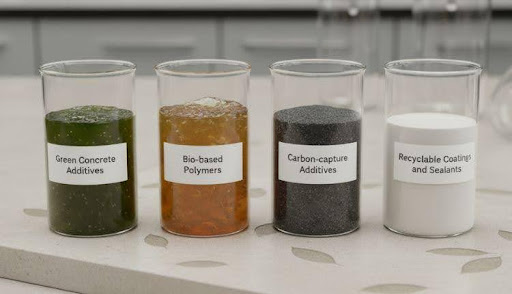
The low-carbon chemicals range broadly in the construction sector some of which are:
- Green Concrete Additives: These chemicals not only make the concrete more durable, easier to handle and shorten its curing time but also reduce the carbon footprint of the mixture. One of the major compounds is a superplasticizer, which can improve both fluidity and uniformity of the concrete mixture. At the same time, an accelerator that does not keep the toughness at a normal level can hardly speed up the curing process. Coupled with this, by means of partial replacement of traditional cement with alternative materials like fly ash or slag, these additives do not merely reduce the emissions of CO2 but also enhance concrete’s resistance to ecological threats, thus making the lifespan of structural engineering longer.
- Bio-based Polymers: Bio-based polymers are made from easily replenishable resources such as soy, corn and linseed that are more eco-friendly than petroleum-based products made of the same nature. They are applied in paints, coatings and sealants and promise a huge reduction in toxic emissions and carbon emissions during production. At the same time they are mostly biodegradable, so they are not very harmful to the environment if thrown away, thus enabling the construction industry to become more sustainable.
- Carbon-capture Additives: They are chemical compounds that enable carbon capture during the curing process of construction materials like concrete, thus less CO2 is released to the atmosphere. Carbon-capturing agents form bonds with carbon dioxide and subsequently keep it within the material, thus avoiding its release. Through that operation, concrete can be made to absorb approximately one-fourth of the CO2 released as a result of its own curing process, thus construction becomes a carbon-negative branch.
- Recyclable Coatings and Sealants: These are the environmentally friendly, low-carbon finishing choices for building materials. Being made of non-toxic, renewable resources, they are low in volatile organic compound (VOC) emissions, which promote the quality of indoor air. Besides, they can be easily reused at the end of their lifespan, thus the amount of discarded materials will be decreased and the overall environmental impact of the building industry will be further reduced.
If these chemicals are not constantly researched and developed the construction industry would take forever to be able to accomplish its goal of net-zero emissions by the middle of the century.
Innovations in Low-Carbon Chemicals for Sustainable Infrastructure
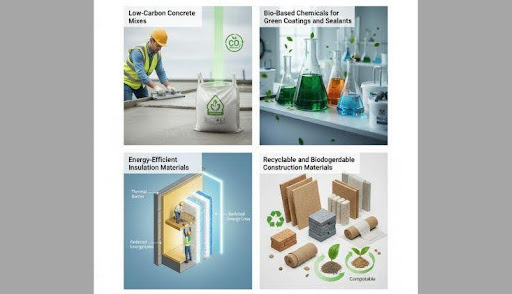
The carbon-lowering chemical innovations have been a major factor in the changes in construction practices towards sustainability. These innovations, as their stated goal, deal with improving the performance of materials, energy-saving measures and waste reduction to the point that they also contribute to environmental requirements, which are getting stricter and are followed more and more by the construction sector.
1. Low-Carbon Concrete Mixes
Concrete is the primary building material used worldwide, but its manufacture is the main cause of the construction industry’s carbon emissions. The production of Portland cement, which is the major contributor to making concrete, emits carbon dioxide (CO2) to the atmosphere. Nevertheless, low carbon concrete mixes have become part of the steel issue resolution.
- Alternative Cementitious Materials (ACMs): These components are the parts of the cementitious system, which cover the supplementary cementitious materials like fly ash, slag and natural pozzolans that can be used to partially replace traditional cement in concrete mixtures. In addition to reducing CO2 emissions, the use of ACMs also improves the durability and performance of concrete.
- Geopolymer Concrete: One of the revolutionary substitutes for common concrete and geopolymer concrete depends on the use of waste products of industries, for example, fly ash or slag as a source of the binder. Its carbon footprint is very much lower than that of regular concrete, with the numbers going as low as 90% less CO2 emissions according to the latest research.
- Carbon Capture in Concrete: Some companies are engaged in the invention of a new group of chemicals that, when mixed with concrete, become capable of capturing and storing carbon dioxide from the atmosphere during the process of hardening.
Such breakthroughs are slowly but surely finding their way into the market of construction chemicals, where developers, contractors and regulatory bodies are showing increasing interest in them as viable options for sustainability.
2. Bio-Based Chemicals for Green Coatings and Sealants
Paints and coatings production along with sealants have been the main contributors of volatile organic compounds (VOCs) that cause air pollution and global warming. The sector is being transformed by the innovations in bio-based chemicals that offer renewable resource-based alternatives.
- Plant-Based Resins and Polymers: These biologically sourced resins are the polymeric matrices used to replace the traditional synthetic resins and are derived from such natural materials as soy, corn and linseed. While biodegradable these materials also release less carbon dioxide and have less toxic emissions during their production.
- Low-VOC Coatings: New formulations of paints and coatings have significantly reduced the VOC content making them more environmentally friendly and less harmful to human health. Also, these coatings have higher wear resistance, thus less frequent reapplication is required and the infrastructure lifecycle gets prolonged.
One of the most demanded bio-based chemical uses is for building construction such as coatings and sealants and this trend will probably be kept as the industry is gradually going to more eco-friendly solutions.
3. Energy-Efficient Insulation Materials
Insulation materials are essential for an energy-efficient building. However, conventionally, the insulation materials like fiberglass and foam are associated with high carbon emissions. The advent of low-carbon alternatives in the insulation industry is a big part of the source reduction narrative for the building sector.
- Bio-Based Insulation: One of the most common examples of bio-based insulation is hempcrete. Other sources such as cork and wool are also being used as insulators. These materials are carbon neutral or even carbon negative, are usually made from sustainable sources, and have excellent thermal insulation properties.
- Aerogels: This highly porous material, often called “frozen smoke”, “silica aerogel”, or simply “aerogel”, is one of the lightest and most effective insulation materials available. The development of low-carbon production methods for the chemicals used in aerogel is resulting in unprecedented thermal resistance capability and energy usage savings for buildings.
- Phase Change Materials (PCMs): PCMs are substances that can absorb or release heat depending upon their phase change from solid to liquid or vice versa. These materials are being added to building insulation for increased energy storage and further efficiency improvement of buildings.
The use of these low-carbon insulation materials in building projects means that less energy is needed for heating and cooling which thus results in lower carbon emissions over the building’s life cycle.
4. Recyclable and Biodegradable Construction Materials
Besides emission reduction, sustainable construction materials need to be recyclable or biodegradable as well to reduce waste and facilitate the implementation of circular economy principles. Low-carbon chemicals are absolutely necessary in the process of making such materials.
- Biodegradable Polymers for Concrete: A group of scientists is working on a polymer that is obtained from a renewable resource and can make concrete stronger and at the same time the concrete is biodegradable after its life cycle.
- Recycled Aggregates: There is an increasing number of construction-related chemical products that are used to bind recycled aggregates. These recycled aggregates are made from materials like crushed concrete, glass and plastic.
These developments are leading to less emission and less waste of materials from the construction of buildings and infrastructure.
Challenges and Barriers to Adoption
Even though low-carbon chemicals come with beneficial aspects, the extensive utilization of such innovations is confronted with challenges. The construction industry has been resistant to change over time which is attributed to a combination of reasons such as cost issues, the presence of a technical barrier and a deficiency in both awareness and knowledge of eco-friendly alternatives.
- Cost Considerations: In general, many low-carbon chemicals, particularly those that rely on alternative materials or are based on advanced technologies may be more costly at the start than their traditional counterparts. Although the environmental benefits and savings in the long run are quite obvious, the initial cost can be a hindrance to some companies.
- Limited Supply Chains: The limited availability of raw materials for low-carbon chemicals, for example, recycled materials and bio-based feedstocks, is one of the challenges. It will be very important to widen these supply chains not only to be able to produce more and cheaper low-carbon construction solutions but also to make them accessible in different places.
- Technical Performance Concerns: Some low carbon chemicals may not have the same performance level as their traditional counterparts yet. Indeed, the research is still going on but some builders may be reluctant to use new materials until they get the assurance that they meet the required standards in the industry.
The Role of the Construction Chemicals Market
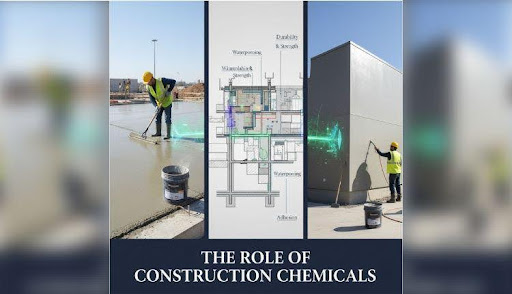
It is an age of demand for eco-friendly building materials and procedures that has resulted in a rise in the market for construction chemicals. The worldwide construction chemicals market is set to grow exponentially as the construction industry turns to environmentally friendly, sustainable alternatives, according to market intelligence by Pristine Market Insights. In fact, a large part of this growth will be attributed to low-carbon chemicals as developers, contractors, and regulatory agencies seek ways to minimize the construction industry’s environmental impact. Besides, these innovative low-carbon chemical solutions are also changing the standards and regulations of industries through a paradigm shift. As a consequence of these alterations authorities worldwide are setting higher ecological requirements for construction works, hence, they are facilitating the spreading of low-carbon materials and products.
The incorporation of low-carbon chemicals into the construction chemicals market is a necessary move to make infrastructure more sustainable and to lessen the environmental impact of the construction process. The facility of using green concrete, bio-based coatings, energy-efficient insulation, and recyclable materials is changing the method of building not only their structure but also their functionality. With the expansion of the construction chemicals market, it is anticipated that low-carbon chemicals will be instrumental in the sustainable construction of the future. By taking up these innovations, the construction industry can become a part of the solution to global climate change, the reduction of waste, and the circular economy.
Authors Bio:-
Sandhya Jadhav is a research analyst with a keen interest in sustainable technologies and green innovations. She focuses on emerging trends in low-carbon materials and their impact on global industries. Her insights aim to promote sustainable infrastructure and environmentally responsible growth across the construction sector.

