
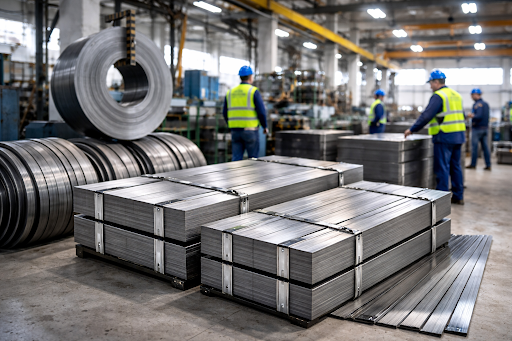
Transformers may look like simple industrial equipment from the outside. But inside, the core plays a major role in how efficiently and reliably the transformer works.
At the center of that design is the silicon steel core transformer, a modern standard for reducing energy losses, improving efficiency, and delivering reliable long-term operation. In today’s world, where power demand is rising and utilities are pressured to cut waste, core quality is no longer a “nice-to-have.” It’s essential.
The article analyzes the essential role of silicon steel cores, which determine operational performance and dependability, together with the increasing popularity of CRGO-based core assemblies in contemporary transformer production.
The Transformer Core: Where Performance Begins
A transformer works by transferring energy between windings through a magnetic field. The core serves as the magnetic flux route and its material characteristics plus construction methods determine:
- No-load losses (core losses)
- Efficiency under real operating conditions
- Noise and vibration
- Long-term reliability and heat behavior
The selection process of transformer core materials ranks among the most important engineering choices that engineers make during transformer development.
The utility and industrial sectors need their transformers to function at full efficiency throughout all operating periods.
Why Electrical Steel Is the Industry Standard
In transformer manufacturing, electrical steel functions as the primary material because it provides superior magnetic permeability together with reduced hysteresis loss when compared to standard steel. The performance of electrical steel varies based on its specific type. The most advanced designs require steel engineered specifically for magnetic performance.
According to IMARC Group, India’s electrical steel market was USD 1.3 billion in 2024 and is projected to reach USD 2.6 billion by 2033 (8.06% CAGR).
Grain Oriented Silicon Steel: A Major Efficiency Upgrade
A big leap in transformer performance came from grain oriented silicon steel, a specialized steel where the crystal grain structure is aligned in a preferred direction.
This alignment helps magnetic flux travel with less resistance.
The result?
- The system experiences decreased core losses
- The system achieves better magnetic flux performance
- The system attains improved total efficiency
- The system achieves better performance during extended operational periods
Transformers operate at lower temperatures while using less energy and producing steadier power output throughout their operational life.
The Role of CRGO Core Assemblies in Modern Transformers
Cold Rolled Grain Oriented steel serves as the foundational material for CRGO. CRGO slit coils serve as electrical steel materials, which transformer manufacturers prefer because they possess:
- High-grade magnetic performance
- Consistency in lamination quality
- Excellent flux density capability
- Reduced no-load losses
A CRGO Core Assembly consists of thin CRGO sheets, which designers created to maximize magnetic flux transmission while limiting air space between the sheets. That air-gap reduction matters because even small gaps increase losses and reduce overall efficiency.
This is why modern transformer manufacturers often partner with a specialized CRGO Core Assembly Supplier because precision assembly is just as important as raw material quality.
Transformer Core Lamination: Why Thin Sheets Matter
One of the biggest design improvements in the silicon steel core transformer is the use of transformer core lamination instead of a solid steel block.
A laminated core reduces eddy current losses by interrupting circulating currents inside the core. Each thin layer is insulated from the next, forcing eddy currents to shrink dramatically.
Benefits of lamination include:
- Lower energy loss
- Reduced heat generation
- Higher efficiency at idle operation
- Longer service life
In large-scale power distribution, even a small improvement in core loss translates to major annual savings.
Why Precision Manufacturing Makes a Real Difference
Core performance isn’t just about the steel grade. It’s also about how accurately the core is cut, stacked, and assembled.
High-end CRGO core assembly manufacturing often includes:
- Precision cutting services for magnetic core coils
- Slit coil widths tailored to customer needs
- Advanced CNC slitting lines with carbide cutters
- Maximum 10-micron burr control on slit coil edges
That burr limit matters because burrs can damage insulation, create unwanted electrical paths, and increase localized losses. A well-built core assembly also helps improve mechanical stability and reduce vibration, one of the major sources of transformer hum.
Performance Advantages of a High-Quality Silicon Steel Core
A properly engineered silicon steel core transformer offers benefits that go beyond efficiency numbers on paper.
- Improved Efficiency and Lower Core Losses: The implementation of CRGO-based cores leads to decreased core losses, which result in enhanced transformer efficiency through reduced wasteful power consumption.
- Higher Flux Density: The use of high-grade magnetic silicon steel enables designers to achieve increased flux density, which results in superior electrical performance for their compact systems.
- Noise Level Reduction: The combination of precision stacking techniques with advanced design methods enables us to decrease magnetostriction-based noise, which results in quieter transformer operation.
- Durability and Long-Term Reliability: The combination of high-grade materials guarantees extended operational life, particularly during times of continuous duty cycles.
- Energy Savings Over the Transformer’s Life: The process of decreasing no-load loss even at minimal levels generates substantial energy savings that continue throughout the entire operational life of the system.
Steplap Design: Small Change, Big Impact
The steplap design stands as one of the most important design elements that premium CRGO cores use.
Instead of stacking laminations with a single straight joint, steplap construction staggers the joints across layers. This improves building factors and productivity while also reducing flux leakage at joints.
The result is:
- Reduced losses at the core corners
- Better magnetic continuity
- Lower noise
- Improved efficiency
Steplap construction is a strong indicator of a modern, performance-focused core assembly.
Quality Checks That Matter in Core Assembly
High-performing core assemblies often go through critical testing and inspection steps such as:
- No-load loss testing
- Megar test
- Accuracy in core diameter
- Accurate total stack and individual stack verification
- Good quality insulation inspection
These checks help ensure that the final core assembly performs consistently and safely once installed in a transformer.
How Silicon Steel Cores Fit into Power Transformer Components
A transformer isn’t just a core; it’s a complete system of power transformer components, including:
- Core assembly
- Windings
- Insulation system
- Tank and cooling system
- Bushings and terminals
- Tap changer (in many designs)
But the core remains the primary driver of no-load efficiency. Even if everything else is built perfectly, a weak core design creates losses the transformer can never “recover” from. Manufacturers prefer to use high-quality CRGO materials together with precise lamination assembly methods to produce their current transformers.
Conclusion
Current efficiency standards represent the primary success factors that define modern transformer systems, together with their ability to withstand time and minimize power consumption. The core functions as the primary element that sustains all operational activities.
The silicon steel core transformer achieves better performance through its CRGO lamination system, which uses precise slitting techniques and maintains tight control over burrs while implementing advanced stacking methods that include step-lap design.
The steel cores that use silicon technology represent a vital element in transformer operation because they serve as the fundamental base for contemporary transformer systems.
Mangals provides manufacturers with dependable CRGO core assembly solutions that guarantee accurate performance results and extended equipment life.

