
Fluid power systems—hydraulic and pneumatic—are foundational to modern industrial equipment. From manufacturing lines and material handling systems to energy and process industries, these systems rely on precise control of fluids under pressure to deliver power, motion, and repeatability. As operating demands increase, so does exposure to heat, friction, and aggressive environments, making material selection a critical design consideration.
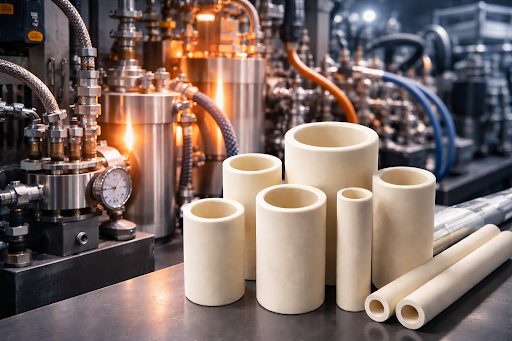
While seals, fluids, and control logic receive significant attention, structural and guiding components within fluid power systems are equally influential in long-term performance. In applications involving sustained thermal loads, designers are increasingly evaluating alternatives to conventional metals, including high-temperature ceramic tubing used to stabilize fluid power systems under continuous thermal load that help maintain dimensional stability and reduce performance drift over time.
As a result, material comparison is no longer limited to strength and cost—it now encompasses thermal behavior, wear characteristics, and lifecycle predictability.
Why Temperature Matters in Fluid Power Performance
Heat is an unavoidable byproduct of fluid power operation. Compression losses, friction, throttling, and continuous duty cycles all contribute to temperature rise within components and surrounding structures. When materials expand unevenly or degrade under heat, system efficiency and reliability can suffer.
Metallic components, while strong and familiar, often exhibit higher thermal expansion and susceptibility to oxidation or softening at elevated temperatures. Over extended service periods, this can lead to misalignment, seal wear, and inconsistent pressure control—issues that may not be immediately visible but gradually erode system performance.
For engineers and maintenance teams, mitigating these effects is essential to sustaining accuracy and uptime.
Evaluating Material Options for High-Temperature Applications
When comparing materials for fluid power components exposed to heat, several criteria come into focus:
- Thermal expansion behavior and dimensional stability
- Resistance to wear and abrasion under fluid flow
- Chemical compatibility with hydraulic oils or compressed gases
- Electrical insulation, where relevant to sensing or control
Advanced ceramics, particularly alumina-based materials, perform well across many of these dimensions. Their low thermal expansion and resistance to oxidation allow them to retain geometry where metals may gradually deform.
In guiding, spacing, or protective roles, precision alumina ceramic rods applied in wear-resistant hydraulic and pneumatic components can help preserve alignment and reduce friction-related wear, contributing to more predictable system behavior.
Metals vs. Ceramics: Functional Trade-Offs
It is important to note that ceramics are not universal replacements for metals. Metals continue to offer advantages in toughness, impact resistance, and ease of fabrication. However, in fluid power systems where thermal stability and wear resistance are primary concerns, ceramics offer complementary strengths.
Rather than substituting entire assemblies, designers often integrate ceramic components selectively—targeting zones where heat exposure or wear has historically limited performance. This hybrid approach allows systems to benefit from ceramic properties without compromising overall structural robustness.
Such targeted material integration reflects a growing emphasis on function-driven design rather than material tradition.
Lifecycle Cost and Reliability Considerations
From a lifecycle perspective, material durability directly affects maintenance frequency, downtime, and total cost of ownership. Components that maintain performance consistency under heat reduce the need for recalibration, replacement, or unplanned service interruptions.
In industrial environments where fluid power systems operate continuously or are difficult to access, these benefits can outweigh higher upfront material costs. Reliability, in this context, becomes a measurable economic advantage rather than an abstract engineering goal.
Looking Forward: Smarter Material Choices in Fluid Power Design
As industrial equipment evolves toward higher efficiency and longer service intervals, material selection will continue to play a strategic role in fluid power system design. Advances in manufacturing and materials science are expanding the practical use of ceramics beyond niche applications into mainstream engineering solutions.
For engineers, procurement teams, and equipment designers, understanding the trade-offs between metals and advanced ceramics enables more informed decisions—ones that align material behavior with operational demands.
Ultimately, high-performing fluid power systems are built not only on precise control and robust mechanics, but also on materials chosen to perform reliably under the realities of heat, pressure, and time.

