
Quick Summary
|
AI in branding helps industrial businesses build a stronger, more consistent brand faster. It sharpens your positioning, scales content, and keeps your messaging consistent. This makes your brand easier for buyers and their tools to trust.
In the past, industrial companies competed mainly on specs, price, and lead times. Today, buyers research suppliers before reaching out to sales. Your brand is what shapes their first impression.
Deloitte’s 2025 manufacturing survey found that 29% of manufacturers use AI or machine learning. Another 24% have adopted generative AI. The same technology can also strengthen your brand.
Table of Contents
What AI in Branding Means for Industrial Businesses
How AI Strengthens Your Industrial Brand
- Sharpen Your Brand Strategy and Positioning
- Create Consistent Brand Visuals and Assets
- Scale a Consistent Brand Voice Across Technical Content
Make Your Industrial Brand Machine-Readable for AI-Driven Procurement
Where AI Falls Short: Keep Humans in the Loop
Frequently Asked Questions
Conclusion
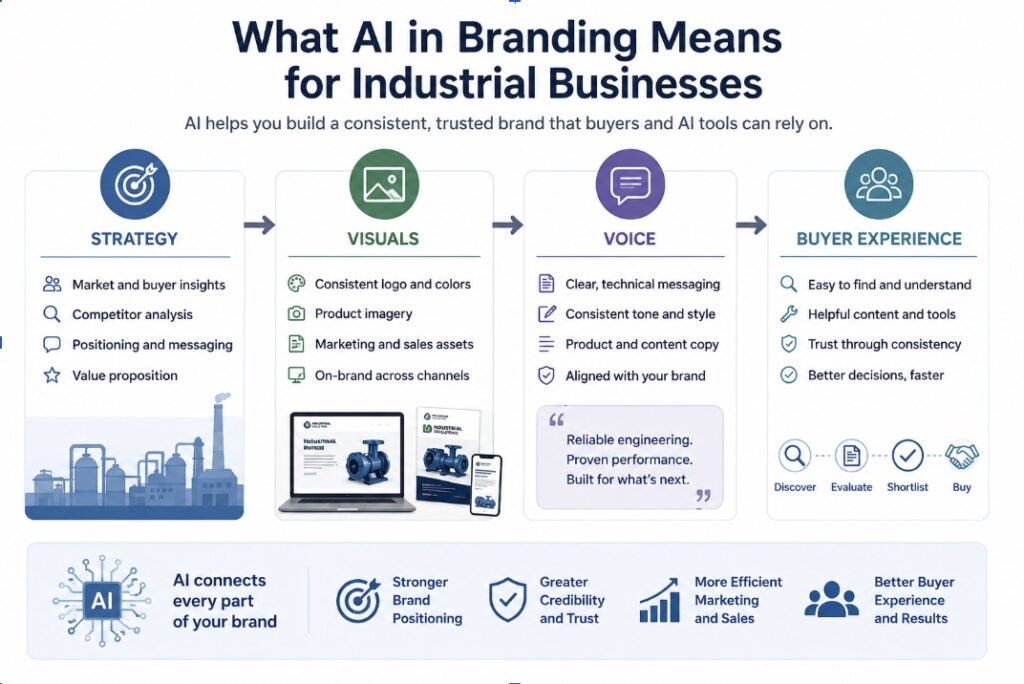
What AI in Branding Means for Industrial Businesses
AI in branding means using artificial intelligence to build, manage, and scale a consistent brand. It covers everything from strategy and visuals to voice and buyer experience.
Image via Linquip
For an industrial business, that means using AI to research your market and produce on-brand assets. It also keeps every touchpoint aligned, without needing a large marketing team.
It matters because trust is now won or lost online. A 2025 Gartner survey found that 69% of B2B buyers see inconsistencies between a company’s website and its salespeople. That gap can put deals at risk.
A consistent brand looks more credible to buyers who’re comparing you against top US manufacturers.
AI helps you close that gap while building a brand that holds together across every page and product line.
| Takeaway: AI in branding helps you deliver consistency at scale. That consistency builds trust with risk-averse industrial buyers. |
How AI Strengthens Your Industrial Brand
AI strengthens your brand by improving your strategy, visuals, and messaging. Together, these three areas help buyers recognize and trust your business.
1. Sharpen Your Brand Strategy and Positioning
Use AI to understand your market faster than manual research. It analyzes buyer questions, competitor messaging, and search trends. This helps you position your brand around what engineers, plant managers, and procurement teams care about.
McKinsey’s 2025 research found that 71% of organizations regularly use generative AI in at least one business function. Marketing and sales lead adoption. Put it to work on:
- Audience Insight: Summarize buyer pain points from reviews, RFQs, and support tickets
- Competitor Gaps: Compare rival messaging and spot missed opportunities
- Positioning Tests: Draft and refine value propositions before investing in campaigns
This supports the same buyer-first approach behind broader digital transformation in industrial marketing.
2. Create Consistent Brand Visuals and Assets
AI creates consistent brand visuals by creating consistent visuals across every product line. Logos, product images, spec sheets, and social posts all share the same look.
For industrial companies, consistency matters more than volume. With AI image tools, you can apply the same colors, fonts, and style across every asset.
Plus, tools like Adobe’s AI Text Effects can style headlines and product labels faster for a clean brand look.
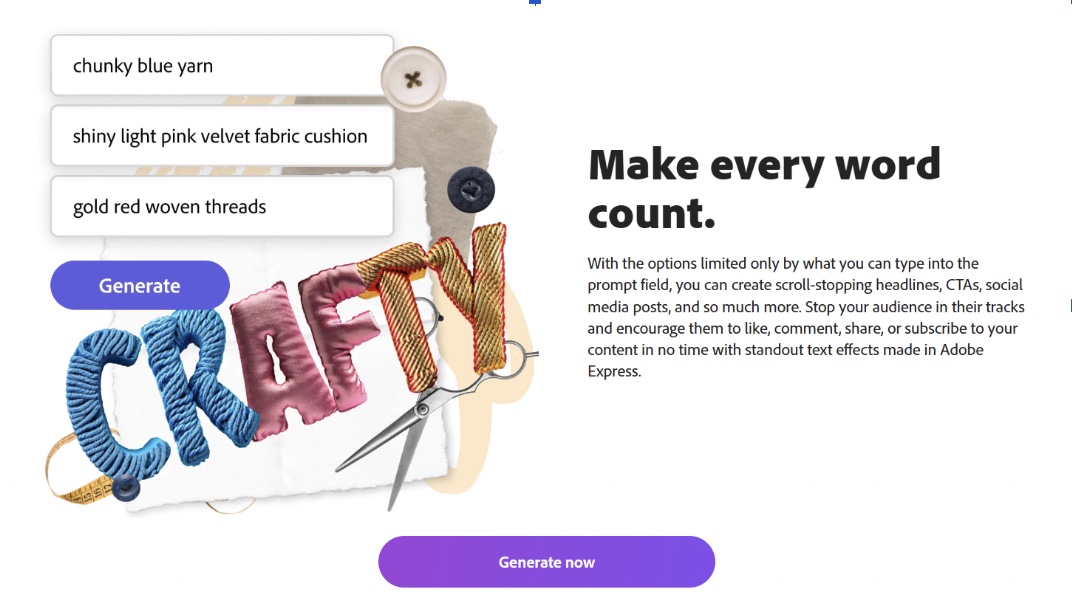
Use AI for:
- Brand Kits: Lock colors, fonts, and logo rules across every asset
- Product Visuals: Generate clean, consistent images across your catalog
- Sales Materials: Produce banners, one-pagers, and trade-show graphics that match your website
This is a great way for a small team to keep a large catalog visually consistent. It makes your business look established and trustworthy.
3. Scale a Consistent Brand Voice Across Technical Content
Use AI to turn technical information into clear, consistent marketing content at scale. Feed it your spec sheets, manuals, and product data, along with a short brand-voice guide.
It can then draft descriptions that sound the same across hundreds of SKUs and distributor materials. Consistency here is a sales issue, not just a style one.
The previously cited Gartner survey found that 73% of B2B buyers avoid suppliers that send irrelevant or off-brand outreach. AI helps you stay relevant and on-message everywhere:
- Product Copy: Create consistent descriptions from technical documents
- Distributor Kits: Keep the same brand voice across partner materials
- Personalized Outreach: Tailor messages without losing your brand identity
Always review AI-generated technical claims before publishing. Human oversight can ensure accuracy.
Takeaway: AI strengthens your brand by:
|
Make Your Industrial Brand Machine-Readable for AI-Driven Procurement
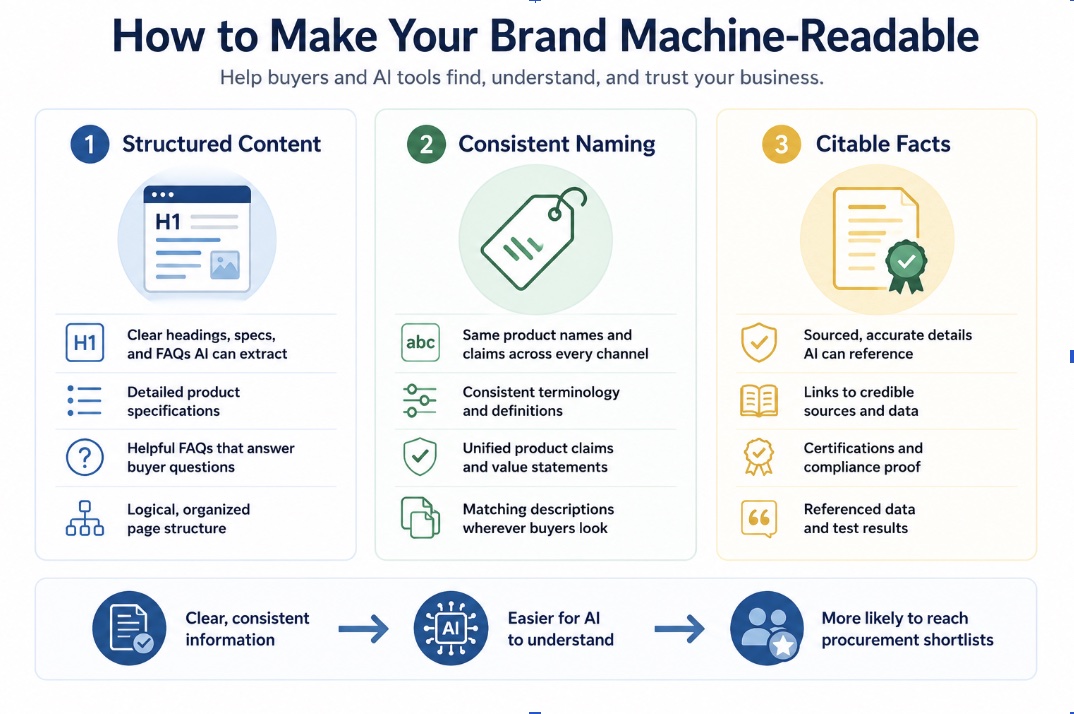
A machine-readable brand uses clear, structured, consistent content that AI tools can easily parse and quote. This matters because buyers and their AI tools now research and shortlist suppliers before any human contact.
The buying journey has moved. As Gartner’s 2026 survey found, 67% of B2B buyers prefer a rep-free buying experience.
Your brand does the early selling, and search and AI tools decide whether you make the list. That makes your website a key part of your B2B/industrial brand strategy.
Make your brand machine-readable through:
- Structured Content: Have clear headings, product specifications, and FAQs that AI can extract
- Consistent Naming: Use the same product names, terms, and claims across every channel
- Citable Facts: Support technical claims with accurate, sourced information that AI can reference
Trust also comes from evidence. This could be proof of your quality or examples of welding innovations that show you keep up with changes in industrial fabrication.
| Takeaway: A machine-readable brand is easier for buyers and AI tools to evaluate. Clear, consistent content improves your chances of making the shortlist. |
Where AI Falls Short: Keep Humans in the Loop
AI can speed up your work, but it can’t replace your brand judgment. Rely on it too much, and you risk three common problems:
- Inaccuracy: Incorrect technical details can quickly damage trust
- Lost Voice: Unedited copy drifts away from how your brand actually sounds
- Sameness: Generic AI output makes your brand look like every competitor
The fix is simple. Treat AI as a fast first draft. Then, have someone review every technical claim, key message, and final asset before publishing.
| Takeaway: Use AI to move faster, but let people make the calls on accuracy and AI brand voice. |
Frequently Asked Questions
What is AI in branding?
AI in branding is the use of artificial intelligence to build and manage a consistent brand. It supports your AI brand strategy, including research, visuals, messaging, and buyer experience. It also helps teams create on-brand content faster.
In short, AI in branding means using AI to build and manage a consistent brand across strategy, visuals, and voice.
How can industrial or manufacturing businesses use AI for branding?
Industrial businesses can use AI to improve positioning, create consistent visuals, and scale technical content. Strengthen AI to ensure brand consistency, so buyers and AI tools can better understand your business.
AI helps industrial brands stay consistent, visible, and easier to trust.
Will AI replace designers or branding agencies?
No. AI can speed up routine work, but people are still responsible for strategy, creativity, and final decisions. The best results come when designers and marketers use generative AI branding tools together.
Essentially, AI works best as a tool for branding teams, not as a replacement.
How do I keep brand consistency when using multiple AI tools?
Give every AI tool the same brand kit and brand guidelines. Include your colors, fonts, logo rules, and use a tool to design logos consistently across platforms, along with terminology and tone. Then, have a person review outputs before publishing.
The bottom line is that shared brand guidelines and human review keep AI outputs consistent.
What are the risks of relying too much on AI for brand content?
The biggest risks are generic content, factual mistakes, and a drifting brand voice. For industrial businesses, inaccurate technical claims can quickly damage trust. Always review AI-generated content before publishing.
Human review protects accuracy, trust, and brand consistency.
Conclusion
AI in branding helps industrial businesses build a stronger, more consistent brand with less effort. It supports your strategy, visuals, content, and buyer experience, while helping buyers and AI tools trust your business.
Start with one area that needs the most attention.
Improve your visuals, product content, or messaging first. Then build from there. Let AI handle the heavy lifting, but keep people responsible for accuracy and final decisions.
Have a question about using AI in branding for your industrial business? Drop it in the comments.

