
For delivery fleets, courier stations, and local logistics operators, battery charging is not only a technical issue. It is an operating issue. Every hour a vehicle spends waiting for power is an hour that cannot be used for deliveries, route coverage, or rider productivity.
This challenge is especially clear in two-wheel electric mobility. Electric motorcycles and scooters are widely used for food delivery, parcel delivery, community services, and short-distance logistics. However, when batteries must be charged one by one, fleet managers often face long charging cycles, safety concerns, uneven battery availability, and limited visibility into battery status.
Why Traditional Charging Creates Operational Pressure
Traditional charging can work well for individual riders, but it becomes more difficult when a business manages dozens or hundreds of vehicles. A lithium battery may take several hours to charge fully, and that delay directly affects daily output.
Charging also creates space and safety challenges. Scattered chargers, temporary wiring, and unmanaged battery storage can increase electrical risk, especially in dense delivery stations, residential areas, and small logistics hubs.
For fleet operators, the bigger problem is predictability. They need to know which batteries are charged, which ones are in use, and whether each station has enough capacity for peak demand.
What a Battery Swapping Cabinet Does
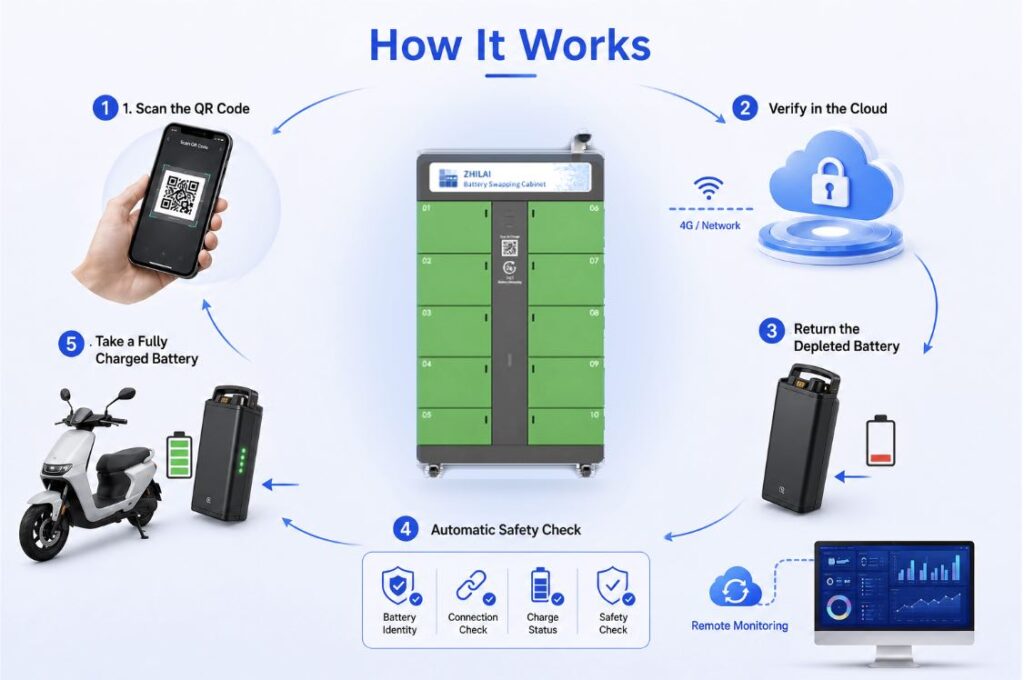
A battery swapping cabinet is designed to replace long charging waits with a faster swap-and-go process. Instead of parking a vehicle and waiting for the battery to charge, a rider returns a depleted battery to the cabinet and collects a charged one from another compartment.
A 2025 review article, “Electric Vehicle Battery Swap Stations: An Overview and Critical Review,” published in the Journal of Umm Al-Qura University for Engineering and Architecture, describes battery swap stations as an alternative to plug-in charging for reducing long recharging time, range anxiety, and battery degradation concerns.
This model separates vehicle use from battery charging. The vehicle can continue operating while the returned battery is charged and monitored inside the cabinet. Batteries are no longer spread across different chargers and locations. They are stored, charged, monitored, and protected in a controlled system.
Safety Features Matter in Real Deployments
When choosing equipment for battery swapping, safety should be one of the first evaluation points. The system is handling lithium batteries, electrical charging, and frequent user interaction, often in busy public or semi-public environments.
Important safety features include protection against overvoltage, undervoltage, overcurrent, short circuit, leakage, and overload. These protections help reduce electrical risk during charging and operation.
Fire response design is also important. ZHILAI battery swapping solutions include aerosol fire suppression in the cabinet and water-based fire suppression in battery compartments, depending on the cabinet configuration. Temperature sensing, and charging status indication can further support safer operation.
These details may not be visible to riders during a normal swap, but they are critical for fleet managers, property owners, and station operators.
Intelligent Charging and Battery Management
A cabinet with battery management and communication functions can monitor charging status, battery information, and operating conditions in real time. In ZHILAI solutions, the cabinet can work with battery management systems and cloud-based software to support real-time device monitoring and remote operation.
At the device level, this means the cabinet should be able to read and manage basic charging data such as battery status, voltage, charging condition, cabinet operation, and warning signals. Communication with the BMS helps operators confirm that batteries are matched with the correct charging process, while cloud connectivity allows station status to be checked without sending staff to the site for every routine issue.
This gives operators a clearer picture of daily performance. They can check cabinet usage, battery availability, warning information, and station status through a centralized platform. For multi-site operators, cloud-based monitoring helps manage stations as one network rather than as isolated equipment.
Choosing the Right Cabinet for Fleet Operations
When evaluating a battery swapping system, businesses should begin with the real operating scenario. A small community station and a high-density delivery hub will not need the same configuration.
Key factors include fleet size, expected daily swaps, battery voltage, battery dimensions, BMS communication protocol, power supply, available installation space, and local safety requirements. ZHILAI’s battery swapping cabinet product line includes 5-door and 10-door cabinet options, with compatibility for 36 V, 48 V, 60 V, and 72 V battery systems according to project requirements.
Operators should also check compartment clearance, cabinet material, IP rating, standby and maximum power, operating temperature range, fire protection design, and whether the system can continue operating during short power interruptions. These details affect whether the cabinet can run reliably in a real station environment.
Site preparation is also important. Operators should consider foundation leveling, network access, maintenance space, ventilation, electrical capacity, and fire safety rules before deployment.
Common Application Scenarios
Battery swapping cabinets are most useful in places where vehicles must stay active and riders cannot afford long charging breaks. Typical scenarios include food delivery stations, courier service stations, logistics transit stations, community service stations, parking lots, industrial parks, and centralized charging points for electric motorcycles.
For delivery platforms and logistics businesses, the value is not only faster charging. The value is better control over energy assets with less manual work.
Conclusion
As two-wheel electric fleets continue to support last-mile delivery and local logistics, energy management will become a more important part of daily operations. Battery swapping cabinets offer a more structured approach by helping operators reduce waiting time, improve battery availability, centralize charging control, and add safety features designed for repeated commercial use.
For businesses planning delivery fleet expansion, community energy stations, or logistics service points, the right battery swapping cabinet is more than a storage unit. It is a practical infrastructure tool for keeping electric mobility moving.

