
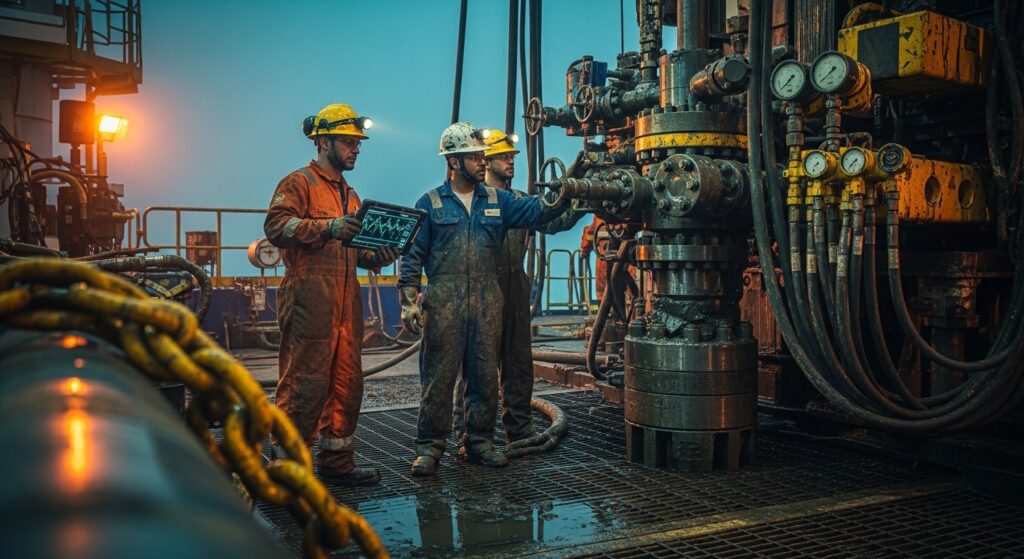
Drilling crews pull volatile hydrocarbons from deep underground, working against extreme physical forces every single shift. Even with AI-assisted drilling and better automation, blowouts keep happening. They’re not freak accidents; they’re the result of mechanical failures, wellbore pressure imbalances, and the unforgiving laws of thermodynamics.
The Mechanics of Wellbore Pressure Imbalances
There’s a constant tug-of-war happening inside every wellbore. On one side, you’ve got formation pressure (the natural pressure of fluids trapped in rock). On the other hand, hydrostatic pressure (the downward force exerted by drilling mud). When hydrostatic pressure drops below formation pressure, that’s called a kick. Essentially, formation fluids rush into the wellbore uninvited.
If crews don’t get a kick under control fast, those fluids travel upward and set the stage for a full-blown blowout. The margin is razor-thin, and things can go sideways in seconds.
Mud Weight Management
Drilling mud is the first line of defense against uncontrolled fluid influx. Get the mud weight wrong, and you’re looking at either a wellbore collapse or a surface blowout. Research on stress sensitivity in deep gas reservoirs shows how even minor changes in effective stress and pore compaction during drilling can drastically alter seepage capacity.
These tiny structural shifts make pressure management incredibly volatile. So what does that mean for drill teams on the ground? Constant real-time monitoring isn’t optional; it’s survival.
Here’s a quick breakdown of the three primary wellbore pressure states:
| Pressure State | Definition | Operational Outcome | Risk Level
|
|---|---|---|---|
| Overbalanced | Hydrostatic > formation | Fluid loss into the formation | Moderate |
| Underbalanced | Hydrostatic < formation | Fluid influx (kick) | High (blowout risk) |
| Balanced | Hydrostatic = formation | Stable drilling | Low |
Operational Limits of Blowout Preventers and Shear Rams
A Blowout Preventer (BOP) is the fail-safe mechanism designed to seal the wellbore during a kick. These massive mechanical valves sit directly above the wellhead, built to withstand extreme pressure surges. If the drilling mud can’t hold back formation pressure, the BOP physically closes off the well to keep hydrocarbons from escaping.
Sounds reliable, right? Not always. BOPs have strict operational limits, and when those limits are exceeded, the consequences can be catastrophic.
Why Shear Rams Fail During Critical Operations
Blind shear rams are the last line of defense. They’re designed to cut through the drill pipe and completely seal the wellbore. The problem? Sudden gas expansion can rapidly warp or freeze these mechanical parts through extreme thermodynamic forces.
When this kind of heavy industrial equipment fails, the human toll hits immediately. Between January 2015 and July 2022, 2,101 severe work-related injuries occurred in the U.S. oil and gas extraction industry. Contract workers accounted for 70.1% of those severe incidents, which says a lot about the risks well-servicing crews face every day.
Shear rams typically fail under extreme conditions for a few specific reasons:
- Pipe centralization issues: The drill pipe gets pushed off-center, preventing the blades from achieving a clean cut.
- Tool joint interference: Rams try to cut through the thickest part of the pipe connections, exceeding the rams’ hydraulic capacity.
- Hydraulic pressure loss: Dead batteries or control pod malfunctions keep the accumulators from delivering enough driving force.
- Debris accumulation: Mud, rock cuttings, or cement solidify inside the ram cavities and physically block closure.
The Thermodynamic Consequences of Sudden Gas Expansion
When a gas kick travels up the wellbore toward the surface, it accelerates violently. Boyle’s Law explains why: as ambient pressure decreases, trapped gas expands rapidly. That expanding gas displaces drilling mud at an exponential rate, supercharging the blowout.
A midstream pipeline blowout in St. Helena Parish in early 2026 illustrated this force perfectly. Extreme pressure buildup caused a rupture that shook the ground miles away, a vivid reminder of how much kinetic energy uncontrolled hydrocarbon expansion can generate.
The Industrial and Human Cost
Oil and gas extraction remains one of the most hazardous work environments on the planet. Period. When mechanical systems fail, the results for frontline workers are devastating. In 2023, the U.S. private mining, quarrying, and oil and gas extraction industry recorded 113 fatalities. Historical BLS data puts fatal injury rates at 14.2 deaths per 100,000 full-time workers.
When redundant safety systems, such as shear rams and mud-monitoring arrays, both fail, tragedy follows. Understanding the engineering breakdowns behind these events is a critical step in addressing oil rig worker death rates, helping families and investigators hold operators accountable for deferred maintenance or systemic negligence.
Fortifying Future Safety Protocols
Preventing wellbore blowouts comes down to rigorous thermodynamic monitoring and mechanical integrity. As the industry pushes into deeper, more complex formations in 2026, operators need to respect the physical limits of hydrostatic pressure and the mechanical thresholds of their BOPs. There’s no margin for shortcuts here.
Pushing beyond calculated parameters doesn’t just risk equipment; it risks lives. Safety across the industrial supply chain starts with precision engineering and zero-compromise maintenance.

