
Artificial intelligence has evolved from a promising technology into an essential business asset. Whether you’re a startup founder, enterprise executive, software developer, marketer, or researcher, AI platforms can automate repetitive tasks, improve decision-making, generate high-quality content, analyze massive datasets, and accelerate innovation.
However, choosing the right AI platform has become increasingly difficult. Hundreds of AI tools now compete across different categories, each claiming to offer the smartest models, the fastest responses, or the most advanced automation.
The reality is that no single AI platform is perfect for every user. Some excel at conversational AI, while others focus on workflow automation, coding assistance, document analysis, image generation, or enterprise-grade security.
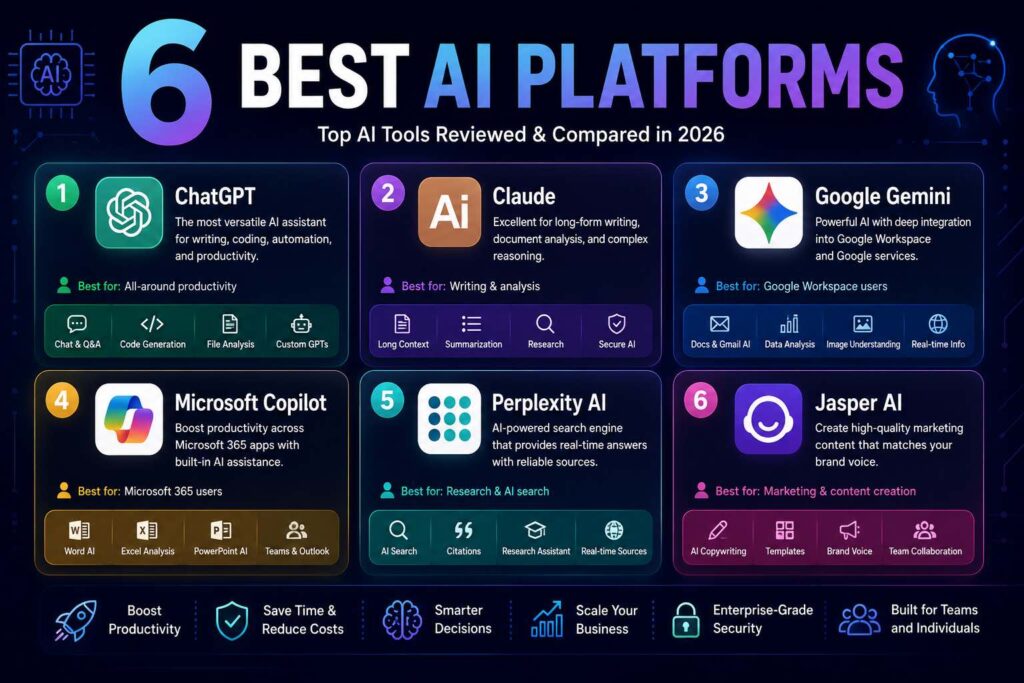
In this guide, we’ve reviewed the 6 best AI platforms in 2026, comparing their core capabilities, pricing, strengths, limitations, and ideal use cases. Our goal is to help you identify the platform that best matches your business needs, technical requirements, and budget.
Quick Comparison of the Best AI Platforms
| AI Platform | Best For | Free Plan | Starting Price |
|---|---|---|---|
| ChatGPT | General AI & Productivity | ✅ | $20/month |
| Claude | Long-form Writing & Analysis | ✅ | $20/month |
| Google Gemini | Google Workspace Users | ✅ | $20/month |
| Microsoft Copilot | Microsoft 365 Productivity | Limited | $30/month |
| Perplexity AI | AI Search & Research | ✅ | $20/month |
| Jasper AI | Marketing Teams | Trial | $49/month |
How We Evaluated These AI Platforms
Our rankings are based on extensive research and real-world usage rather than marketing claims. Each platform was evaluated using a consistent methodology focused on practical business value.
The evaluation criteria include:
- AI model quality
- Response accuracy
- Ease of use
- Automation capabilities
- Integration ecosystem
- Pricing and value
- Enterprise readiness
- Security and privacy
- Collaboration features
- Overall return on investment
Rather than focusing solely on benchmark performance, we prioritized platforms that consistently improve productivity and solve real business problems.
1. ChatGPT — Best Overall AI Platform
Artificial intelligence has become mainstream largely because of ChatGPT. Developed by OpenAI, the platform continues to set the benchmark for conversational AI, coding assistance, content generation, brainstorming, research, and workflow automation.
The latest versions combine advanced reasoning capabilities with multimodal understanding, allowing users to work with text, images, files, spreadsheets, and even voice interactions from a single interface.
Businesses increasingly rely on ChatGPT for customer support, document drafting, software development, market research, training materials, and internal knowledge management.
Unlike many AI tools designed for one specific purpose, ChatGPT serves as an all-in-one productivity assistant capable of adapting to countless professional workflows.
Key Features
- Natural language conversations
- Advanced reasoning models
- Code generation and debugging
- Image understanding
- Data analysis
- Custom GPTs
- File uploads
- API integrations
- Voice conversations
- Team collaboration
Pros
✔ Excellent response quality
✔ Strong coding capabilities
✔ Massive plugin ecosystem
✔ User-friendly interface
✔ Supports multiple file formats
✔ Regular feature updates
Cons
- Advanced features require a paid subscription.
- Responses may still require fact-checking for highly specialized topics.
Pricing
- Free Plan
- Plus: $20/month
- Team Plan
- Enterprise Pricing Available
Best For
- Professionals
- Students
- Developers
- Marketing teams
- Small businesses
- Enterprise organizations
2. Claude — Best AI Platform for Long-Form Writing and Document Analysis
When it comes to processing lengthy documents and producing well-structured written content, Claude has established itself as one of the strongest alternatives in today’s AI landscape. Built by Anthropic, the platform is designed with a strong emphasis on helpfulness, clarity, and responsible AI behavior, making it particularly valuable for professionals who regularly work with complex information.
One of Claude’s biggest advantages is its ability to understand extremely large context windows. Instead of breaking long reports into multiple sections, users can upload entire research papers, contracts, technical manuals, or financial reports and ask detailed questions about their contents. This significantly reduces the time spent reviewing documents manually.
For writers, consultants, researchers, and legal professionals, Claude delivers responses that are often more structured and nuanced than many competing AI assistants. It performs especially well when summarizing lengthy materials, rewriting technical content into simpler language, or drafting polished articles, reports, and business documentation.
Key Features
- Large context window for long documents
- Advanced document summarization
- High-quality long-form writing
- Research assistance
- File upload support
- Natural conversational interface
- Coding assistance
- Enterprise-grade security options
Pros
✔ Excellent at analyzing large documents
✔ Produces natural, human-like writing
✔ Strong reasoning and contextual understanding
✔ Clean and intuitive user experience
✔ Reliable for research-heavy tasks
Cons
- Fewer third-party integrations than some competitors.
- Limited availability of certain advanced features depending on the subscription tier.
Pricing
- Free Plan
- Pro: Starting at $20/month
- Team and Enterprise plans available
Best For
- Content writers
- Researchers
- Legal professionals
- Consultants
- Business analysts
- Knowledge workers
3. Google Gemini — Best AI Platform for Google Workspace Users
Google Gemini has rapidly become one of the most capable AI platforms for businesses and professionals who rely on the Google ecosystem. Instead of functioning as a standalone chatbot, Gemini integrates deeply with services such as Gmail, Google Docs, Sheets, Drive, Meet, and Calendar, helping users complete everyday tasks more efficiently.
One of Gemini’s strongest advantages is its ability to understand multiple types of information simultaneously. Users can analyze documents, generate presentations, summarize emails, interpret images, write code, and answer complex questions without switching between several applications.
Organizations that already use Google Workspace often find Gemini to be a natural extension of their existing workflow. The platform reduces repetitive work, improves collaboration, and helps teams create content faster while keeping information organized across Google’s cloud services.
Key Features
- Native integration with Google Workspace
- AI assistance for Gmail and Google Docs
- Spreadsheet analysis
- Image understanding
- Code generation
- Research assistance
- Multimodal AI capabilities
- Enterprise security controls
Pros
✔ Excellent integration with Google products
✔ Fast and accurate information retrieval
✔ Strong multimodal capabilities
✔ Useful for collaborative teams
✔ Easy to adopt for existing Workspace users
Cons
- Delivers the greatest value within Google’s ecosystem.
- Some advanced features require paid Workspace subscriptions.
Pricing
- Free plan available
- Google AI Pro
- Enterprise plans through Google Workspace
Best For
- Google Workspace users
- Marketing teams
- Business professionals
- Students
- Project managers
- Small and medium-sized businesses
4. Microsoft Copilot — Best AI Platform for Microsoft 365 Productivity
Microsoft Copilot has transformed how organizations use familiar productivity software. Rather than introducing an entirely new workspace, Copilot embeds AI directly into applications such as Word, Excel, PowerPoint, Outlook, and Teams, allowing employees to complete tasks without changing their daily workflow.
For enterprise users, Copilot is particularly valuable because it can access organizational data stored across Microsoft 365 (subject to company permissions). This enables it to summarize meetings, draft reports, create presentations, analyze spreadsheets, and answer questions using internal business documents.
The platform is especially effective for reducing administrative work. Employees can spend less time formatting documents, writing repetitive emails, or manually analyzing datasets, allowing them to focus on higher-value tasks.
Key Features
- Microsoft Word AI assistant
- Excel data analysis
- PowerPoint presentation generation
- Outlook email drafting
- Teams meeting summaries
- Enterprise knowledge search
- Secure Microsoft 365 integration
- Coding support through GitHub Copilot integration
Pros
✔ Outstanding productivity features
✔ Excellent enterprise security
✔ Deep Microsoft ecosystem integration
✔ Powerful spreadsheet analysis
✔ Saves significant administrative time
Cons
- Best suited for organizations already using Microsoft 365.
- Premium functionality requires a business subscription.
Pricing
- Microsoft Copilot Free
- Microsoft 365 Copilot subscription
- Enterprise licensing available
Best For
- Enterprise organizations
- Corporate teams
- Financial analysts
- HR departments
- Project managers
- Microsoft 365 users
5. Perplexity AI — Best AI Platform for Research and AI Search
Unlike traditional AI chatbots, Perplexity AI positions itself as an AI-powered answer engine. Instead of generating responses from a language model alone, it combines conversational AI with real-time web search and source citations, making it particularly valuable for users who need reliable, up-to-date information.
One of its biggest strengths is transparency. Rather than asking users to trust its answers blindly, Perplexity typically provides references to the sources used, allowing readers to verify facts and explore topics further. This approach makes it especially useful for journalists, researchers, consultants, students, and business professionals who rely on accurate information.
The platform also supports follow-up questions in a conversational format, enabling users to explore complex topics without starting a new search each time. For anyone conducting market research, competitive analysis, or industry monitoring, this significantly improves efficiency.
Key Features
- AI-powered search engine
- Real-time web search
- Source citations
- Research summaries
- Follow-up conversations
- Document analysis
- Academic research assistance
- Fast information retrieval
Pros
✔ Provides source-backed answers
✔ Excellent for research
✔ Real-time information
✔ Easy-to-use interface
✔ Strong fact-checking capabilities
Cons
- Less focused on creative writing than some competitors.
- Advanced search features require a Pro subscription.
Pricing
- Free plan
- Pro subscription
- Enterprise plans available
Best For
- Researchers
- Journalists
- Consultants
- Students
- Business analysts
- Competitive intelligence teams
6. Jasper AI — Best AI Platform for Marketing Teams
Jasper AI has established itself as one of the leading AI platforms for businesses that prioritize content marketing, brand consistency, and scalable copy creation. While many AI assistants are designed for general-purpose tasks, Jasper focuses specifically on helping marketing teams produce high-quality content more efficiently.
The platform includes specialized templates for blog posts, product descriptions, email campaigns, landing pages, social media content, digital advertising, and SEO copy. Its Brand Voice feature allows organizations to train the AI on their preferred tone, messaging, and style guidelines, helping maintain consistency across every piece of content.
Jasper also integrates with popular marketing tools, making it easier for teams to move from content creation to publishing without unnecessary manual work. For agencies and growing businesses managing multiple campaigns, this can significantly improve productivity and collaboration.
Key Features
- AI copywriting
- Brand Voice customization
- SEO content creation
- Marketing templates
- Campaign generation
- Team collaboration
- Workflow automation
- Integrations with popular marketing platforms
Pros
✔ Built specifically for marketers
✔ Excellent content templates
✔ Strong brand consistency tools
✔ Easy collaboration for teams
✔ Supports large-scale content production
Cons
- More expensive than general-purpose AI assistants.
- Less suitable for technical tasks such as coding or data analysis.
Pricing
- Creator plan
- Pro plan
- Business plan with custom pricing
Best For
- Marketing agencies
- Ecommerce businesses
- Content teams
- Copywriters
- SEO professionals
- Brand managers
How to Choose the Right AI Platform
Selecting an AI platform isn’t simply about choosing the most popular option. The best solution depends on your business goals, workflow, technical requirements, and budget. Before investing in a subscription or enterprise deployment, consider the following factors.
1. Define Your Primary Use Case
Start by identifying what you want AI to accomplish.
For example:
- Content creation and copywriting
- Customer support automation
- Software development
- Data analysis
- Research
- Document management
- Marketing automation
- Business intelligence
A platform that excels at coding may not be the best choice for marketing, while a research-focused AI assistant may lack advanced automation capabilities.
2. Evaluate Integration Capabilities
Modern businesses rely on multiple software platforms every day. Your AI solution should integrate smoothly with your existing tools rather than creating additional work.
Look for compatibility with platforms such as:
- Google Workspace
- Microsoft 365
- Slack
- Salesforce
- HubSpot
- Notion
- GitHub
- Zapier
- CRM and ERP systems
The more naturally AI fits into your workflow, the greater the productivity gains.
3. Consider Security and Privacy
If your organization handles sensitive customer information, financial records, or proprietary business data, security should be a top priority.
Important features include:
- Data encryption
- Access controls
- Enterprise authentication
- Compliance certifications
- Data retention policies
- Private AI deployments
Many enterprise platforms also provide administrative controls that allow organizations to manage permissions and protect confidential information.
4. Compare Pricing Against Value
The least expensive platform isn’t always the most cost-effective.
Instead of comparing subscription prices alone, evaluate:
- Productivity improvements
- Time savings
- Collaboration features
- Scalability
- Automation capabilities
- Customer support
A premium platform that saves several hours each week may provide a much higher return on investment than a cheaper alternative.
5. Test Before You Commit
Most leading AI platforms offer free plans or trial periods. Take advantage of these opportunities to compare response quality, usability, and performance using your own real-world tasks.
Running the same prompts across multiple platforms can quickly reveal which one aligns best with your expectations.
Comparison: Which AI Platform Is Right for You?
| If You Need… | Recommended Platform |
|---|---|
| Everyday productivity | ChatGPT |
| Long document analysis | Claude |
| Google Workspace integration | Google Gemini |
| Microsoft 365 automation | Microsoft Copilot |
| AI-powered research | Perplexity AI |
| Marketing content creation | Jasper AI |
Remember that many professionals use more than one AI platform. For example, a marketing team might rely on ChatGPT for brainstorming, Jasper for branded content, and Perplexity AI for research. Choosing complementary tools can often deliver better results than depending on a single platform for every task.
Frequently Asked Questions
What is the best AI platform in 2026?
For most users, ChatGPT remains the best all-around AI platform thanks to its versatility, ease of use, advanced reasoning capabilities, and growing ecosystem of tools. However, the ideal choice depends on your specific needs. Claude is excellent for document analysis, while Perplexity AI stands out for research and source-backed answers.
Which AI platform is best for businesses?
Businesses should prioritize platforms that integrate with their existing workflows. Microsoft Copilot is an excellent option for organizations using Microsoft 365, while Google Gemini is a natural fit for companies built around Google Workspace. Marketing teams may benefit from Jasper AI, and businesses looking for a flexible AI assistant often choose ChatGPT.
Are free AI platforms good enough?
Yes, many free AI plans are suitable for everyday tasks such as writing, brainstorming, summarizing, and answering questions. However, paid plans typically offer faster performance, higher usage limits, advanced models, larger context windows, enhanced collaboration, and enterprise-grade security features.
Which AI platform is best for content creation?
For general writing tasks, ChatGPT and Claude consistently produce high-quality content. Businesses focused on marketing campaigns, SEO, and brand consistency may find Jasper AI to be a better fit due to its specialized marketing features and brand voice capabilities.
Which AI platform is best for research?
Perplexity AI is one of the strongest choices for research because it combines conversational AI with real-time web search and source citations. This makes it easier to verify information and explore topics in greater depth.
Can businesses use multiple AI platforms?
Absolutely. Many organizations combine several AI tools to address different needs. For instance, a company might use ChatGPT for brainstorming, Claude for analyzing lengthy documents, Perplexity AI for market research, and Microsoft Copilot to streamline daily office tasks.
Final Thoughts
Artificial intelligence is no longer a niche technology reserved for large enterprises or research labs. In 2026, AI platforms have become indispensable tools that help businesses improve efficiency, automate repetitive work, enhance decision-making, and accelerate innovation.
The best platform for your organization depends on how you plan to use AI. If you’re looking for a versatile assistant capable of handling a wide range of tasks, ChatGPT remains one of the strongest options available. For professionals working with lengthy reports or technical documents, Claude offers exceptional context handling. Organizations already invested in Google Workspace or Microsoft 365 will benefit from the seamless integrations provided by Google Gemini and Microsoft Copilot, while Perplexity AI excels at research and Jasper AI continues to lead in AI-powered marketing.
Rather than searching for a single “perfect” platform, focus on identifying the solution—or combination of solutions—that aligns with your workflow, budget, and long-term business goals.
As AI technology continues to evolve, staying informed about new features, pricing updates, and emerging capabilities will help you maximize your investment and remain competitive in an increasingly AI-driven world.

