
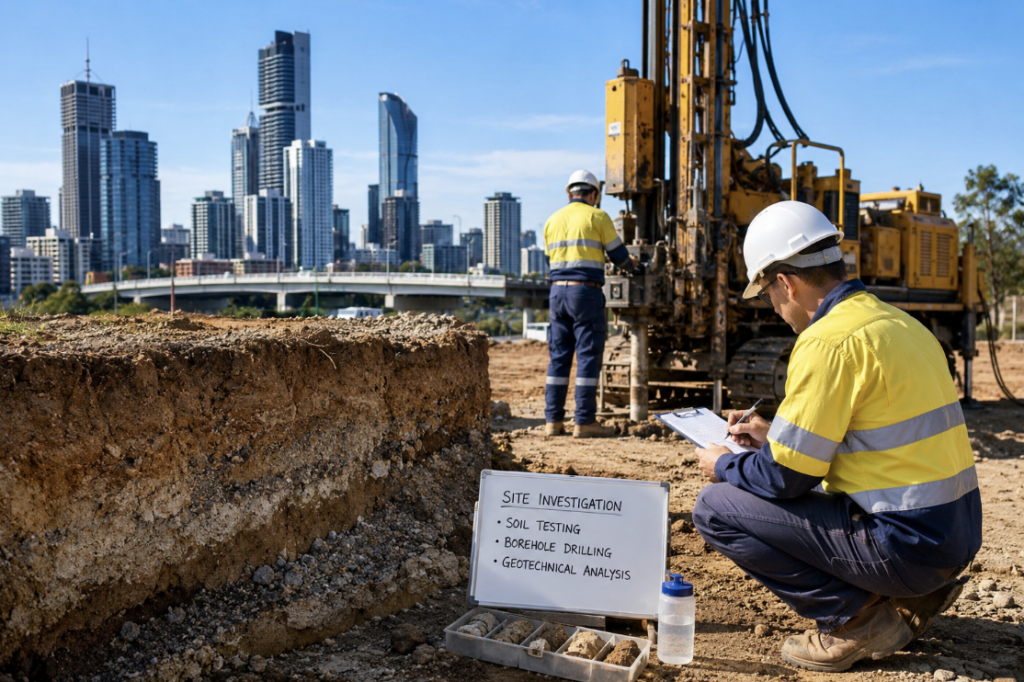
Most building projects begin in a similar fashion. Someone envisions a new home, a commercial project, or even an improvement in the infrastructure of the area. Designs are made. Approvals are requested. The building firm is contacted. But within that sequence of events, a vital question tends to be posed too late into the process and by too few individuals: What exactly lies beneath the surface of the ground?
When it comes to geotechnical engineering Brisbane developers and builders rely on experienced specialists to assess soil conditions and ground stability before construction begins.
This guide discusses everything you need to know about geotechnical engineering, why it is important, and how to select the proper ground engineering company.
What Geotechnical Engineering Actually Means
Geotechnical engineering is a field of study under civil engineering which revolves around the behavior of soils, rocks, and water bodies and how such behavior affects the designs of structures above or below the ground. This field encompasses all activities related to ground condition analyses starting from the initial stage of soil analyses and ending at implementing stabilization techniques, slope stability measures, retaining walls and erosion control methods among others. That which distinguishes geotechnical engineering from other fields of study is the fact that it deals with the ground itself, which serves as the basis for all works carried out thereon. No matter how sound the design may be, improper analysis and understanding of the underlying ground may compromise a structure before construction even starts. Practically speaking, geotechnical engineering works include assessment of slope stability in hilly residential areas, design of retaining walls for commercial and civil engineering projects, protection against rockfall and erosion among other specialized ground problems.
Why Brisbane Presents Unique Ground Engineering Challenges
Brisbane cannot be regarded simply as an urban center from a geotechnical standpoint. Its varied topographical profile consists of areas ranging from level land on the floodplains of the Brisbane River and other waterways, hilly locations in the inner city area and surrounding suburbs, to rock escarpments and densely vegetated hillsides throughout the entire Southeast Queensland area. Each such environment poses specific challenges in terms of geotechnical construction. The former involves potentially problematic soil conditions including those that might pose difficulties in terms of compaction and the possibility of flooding; the latter involves the issue of slope stability and erosion. Then, the climate of the Brisbane area is characterized by heavy rainfalls which impact the stability of slopes by raising erosion rates and posing additional stress on any retaining structures which may be necessary for addressing dramatic elevation differences within the landscape. These facts help explain the rise in demand for specialized Brisbane geotechnical engineering services over the last decade.
Key Geotechnical Engineering Services for Brisbane Projects
The various soil conditions and projects demand a different approach. This is a general guide that outlines the different kinds of services that are needed depending on the type of soil and projects.
Ground Stabilisation
The ground stabilisation process is employed when there is an instability in the soil or rock at a particular site that cannot effectively sustain buildings or structures. The methods used for this vary according to the kind of instability present, ranging from soil nailing or anchoring to grouting and geotextiles. A specific example in which slope stabilisation would be required is in Brisbane’s hilly areas, where development occurs on slopes.
Retaining Wall Systems
One of the most commonly sought out geotechnical engineering solutions in Brisbane involves the building of retaining walls that may serve a wide array of functions ranging from residential gardening projects to more complex commercial and civil construction projects. The goal is pretty simple: retaining walls are supposed to be capable of holding soil back and dealing with the changes in ground levels effectively and in a way that would ensure durability and stability of the structure. It should go without saying that retaining wall engineering can prove rather challenging as the wall must be designed in such a way that it would be able to resist the soil lateral pressure, handle drainage issues and perform well under any weather conditions. The wrong choice of materials or the lack of proper engineering knowledge in regard to retaining walls may easily cause the project to fail.
Rockfall Protection
Wherever there is an existence of rock faces, escarpments or slopes irrespective of whether they occur naturally or have been created as a result of digging operations, in Brisbane and South East Queensland, then rockfall mitigation techniques become essential. Various ways of protecting against rock fall include the use of nets or mesh attached to the surface of the rock, or the creation of fences to trap falling material. It all depends on the extent of the risk involved, the character of the rock and the impacts that may arise as a result of a rock fall incident.
Shotcrete Application
The shotcrete concrete application process is the spraying of concrete under high pressure using a large hose. Shotcrete is widely employed in Brisbane to stabilize the ground, protect rocky faces, construct retaining walls, tunneling, and shoring projects. The major strength of shotcrete is its capability to spray concrete on irregular, vertical, and overhead surfaces where other concrete application methods cannot be applied. This technology can efficiently handle various stabilization and protection applications in hilly areas of Brisbane with restricted access and steep slopes.
Erosion Control
The high rainfall intensity of Brisbane results in a high potential for erosion on unprotected slopes and disturbed soil. Apart from the damage caused by the erosion process itself, the sediment that is formed as a result also affects the surrounding environment. Erosion control engineering includes the identification of erosion risks and the implementation of measures to minimize these risks. Measures include everything from revegetation to sophisticated drainage and other types of surface protection mechanisms.
Difficult Access Solutions
It is always not the case where any geotechnical issue could always find its place in an accessible position. Such places with inaccessible areas are characterized by steep areas, restricted zones, risky areas, and remote zones. All of these areas require special skills like rope access, working at heights, and working in dangerous conditions.
When Should You Engage a Geotechnical Engineer in Brisbane
The most honest response to this question is: sooner than most people think. Geotechnical recommendations are most useful prior to any design or construction occurring, when plans are still being developed, before any development application has been lodged and prior to the start of construction. Assessing geological conditions early in a project ensures that the effects can be accounted for throughout the project process, rather than finding issues during construction and having fewer available options at hand. For residential developments in Brisbane, you would do well to seek geotechnical assistance on your property if there is significant site slope, erosion issues, a rocky outcrop or escarpment nearby, unique soil conditions or any previous ground disturbance which may impact stability. In terms of commercial and infrastructure projects, geotechnical input will generally already be a required step in the project planning and development process due to the high stakes involved.
What to Look for in a Brisbane Geotechnical Engineering Team
Selecting the appropriate ground engineering firm for any Brisbane-based undertaking requires looking at certain criteria that really matter. Local experience is essential when dealing with the geotechnical challenges in Brisbane because the area’s geological features and climate dictate that ground engineering experts with extensive local expertise will be rewarded. In other words, it does not help to have general technical proficiency when working in Brisbane; one must also have practical expertise with the geotechnical challenges unique to the area.
Frequently Asked Questions
What is the difference between geotechnical engineering and civil engineering?
Civil engineering is the general term for several infrastructures and construction specialties. Geotechnical engineering is a speciality of civil engineering which deals exclusively with the properties of soil, rock, and water beneath the earth’s surface.
Do I need a geotechnical engineer for a residential project in Brisbane?
A geotechnical engineer is not required for every housing development, but any housing development that involves sloping terrain, rocky terrain, or terrain with unknown conditions will benefit greatly from the professional’s expertise. Also, many councils within Brisbane insist upon a geotechnical report being completed as part of a development application.
How long does a geotechnical assessment take in Brisbane?
It will differ widely based on the extent of investigation that needs to be conducted. An initial site assessment could take a couple of days, but more extensive investigations like soil testing and lab analysis may take several weeks.
What causes slope instability in Brisbane?
Common triggers may include excessive rainfall that saturates the soil, deforestation which provides support to roots, building activities which alter stress or water drainage conditions, and natural erosion of rock and soil material.
Is shotcrete suitable for residential projects in Brisbane?
Indeed. Although shotcrete is mainly employed in major commercial or industrial constructions, its application is expanding to residential areas, especially the hilly regions of Brisbane, where shotcrete is applied in slope stabilization, retaining walls, and erosion prevention when regular concrete casting is unfeasible.
Final Thoughts
It is easy to overlook the ground that supports any development because it is typically out of sight, taken for granted as being firm and stable and rarely uppermost in anyone’s mind while concentrating on design and construction. However, it is crucial to the whole project. In a diverse landscape such as that of Brisbane, where rainfall can be heavy, knowing what is happening under the ground – and making sure there is a strategy to deal with whatever is encountered – cannot be overlooked.

