
INDUSTRIAL MATERIAL SELECTION GUIDE
How to Choose Prepainted Steel Coils for Industrial and Building Applications
Introduction
Choosing prepainted steel coils is not simply a matter of comparing color and price. For an OEM, distributor, building-product manufacturer, or project contractor, the specification affects corrosion resistance, forming performance, appearance, maintenance needs, and total landed cost. A coil that works well for an indoor appliance panel may fail early on a coastal roof, while an unnecessarily high-performance coating can make a controlled indoor application more expensive than required.
International buyers should therefore connect every technical choice to the final environment and fabrication process. The key variables include the steel substrate, metallic coating, paint chemistry, coating thickness, coil dimensions, hardness, surface finish, tolerances, and packing method. This guide explains how to evaluate those variables, compare quotations on the same basis, and prepare a clearer request for quotation.
Understanding Prepainted Steel Coils and How They Are Manufactured
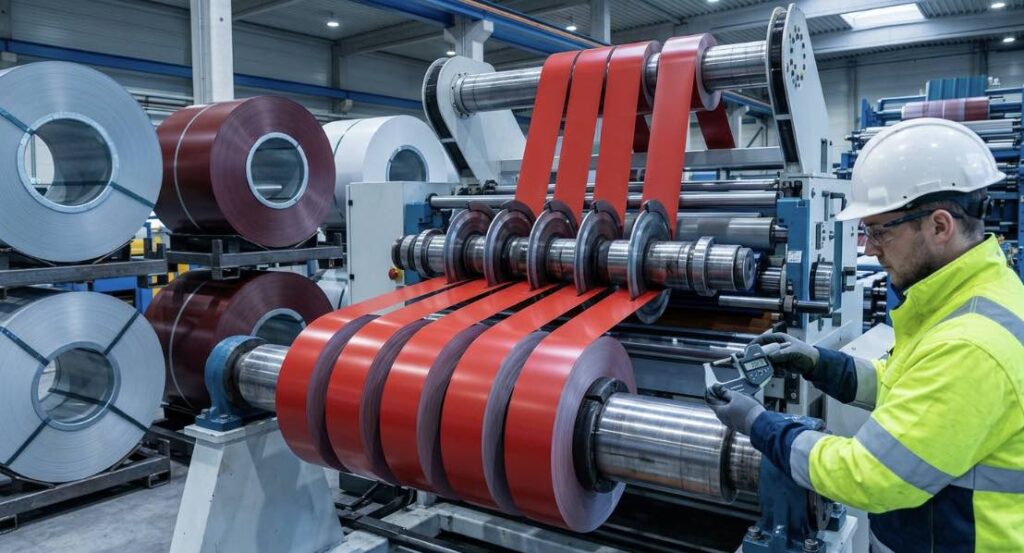
A prepainted steel coil is flat steel that receives a protective metallic layer and factory-applied organic coatings before it is cut, roll-formed, stamped, or assembled. A continuous coil-coating line normally cleans and pretreats the substrate, applies primer and topcoat, cures each layer, cools the strip, and recoils it. Controlled application helps deliver more consistent color, gloss, film thickness, and adhesion than painting individual parts after fabrication.
The final product is a coating system rather than a single material. Performance depends on how the substrate, pretreatment, primer, topcoat, and back coat work together. Buyers should request a layer-by-layer specification and avoid evaluating a quotation from the paint name alone.
- Typical supply forms include master coil, slit coil, cut-to-length sheet, and profiled roofing or wall panels.
- Common related terms include color-coated steel coil, coil-coated steel, PPGI, PPGL, and pre-coated metal.
Why Material Selection Matters for Industrial and Building Projects
Industrial panels and building envelopes face different risks. Factory cabinets may be exposed to cleaning chemicals, abrasion, oil, or repeated forming. Roofs and cladding experience ultraviolet radiation, rain, condensation, temperature cycling, airborne pollutants, and cut-edge exposure. The same nominal color can perform very differently when its coating system is changed.
Start by defining the service environment, expected life, fabrication method, visible surface, and maintenance access. Linquip’s overview of galvanization in difficult industries provides useful background on why zinc protection helps and where environmental exposure still requires careful material selection.
Choosing the Right Base Metal and Substrate
Most prepainted products use cold-rolled steel with a zinc or aluminum-zinc metallic coating. The base grade influences yield strength, elongation, hardness, flatness, and formability. A structural profile may require higher strength, while a deep-drawn or tightly formed component needs sufficient ductility to prevent cracking at bends.
Specify the applicable grade or required mechanical-property range instead of writing only “steel coil.” If your production includes roll forming, stamping, lock forming, or tight-radius bending, tell the supplier the process and minimum bend radius. Samples or trial coils can reduce risk when appearance and formability are both critical.
PPGI vs. PPGL: Understanding the Key Differences
PPGI uses a galvanized, zinc-coated substrate beneath the paint. PPGL uses an aluminum-zinc coated substrate, often called galvalume or aluzinc, beneath the paint. Both are widely used, but neither is automatically correct for every project.
PPGI is commonly selected for general construction products, indoor and outdoor panels, appliances, doors, and applications that value practical forming behavior. PPGL is often considered for roofing and cladding where atmospheric corrosion resistance and heat reflectivity matter. However, actual performance depends on coating mass, paint system, detailing, cut edges, local climate, and installation quality—not the acronym alone.
Buyers comparing outdoor specifications can review dedicated PPGL steel coil options and confirm whether the substrate, AZ coating, paint type, and available dimensions match the intended profile and exposure.
Selecting the Appropriate Metallic Coating Weight
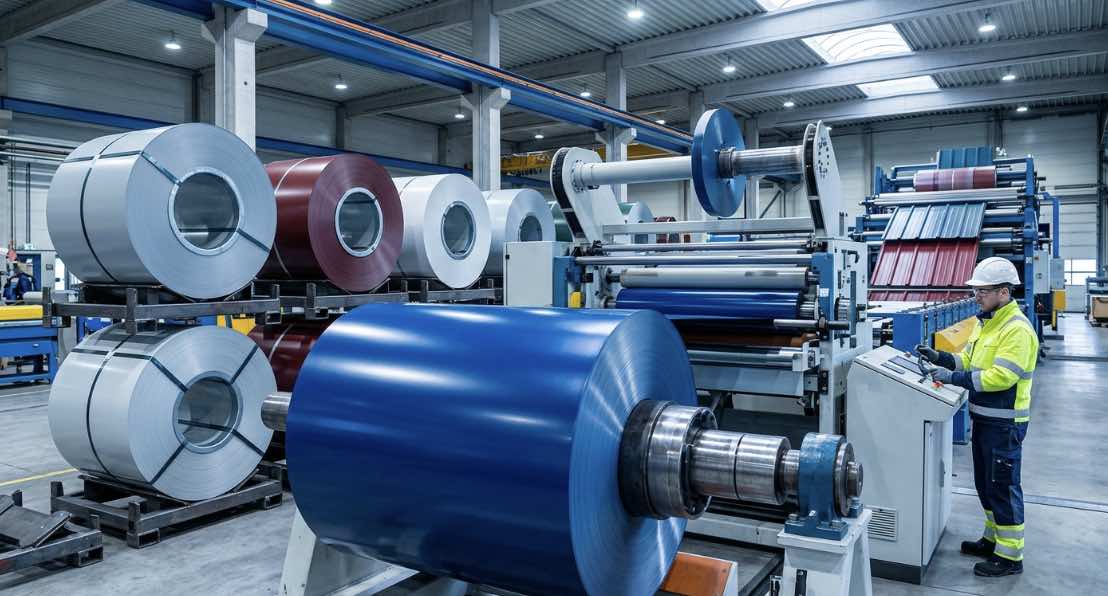
Metallic coating weight is an important corrosion-protection variable. It is generally expressed as total coating mass across both sides, such as a Z designation for zinc or an AZ designation for aluminum-zinc. A higher value usually provides a larger protective reserve, but the correct level must reflect the environment, forming demand, design life, and governing standard.
Do not compare Z and AZ designations as though they were identical. Their compositions and corrosion mechanisms differ. Ask suppliers to state the coating type, nominal mass, test method, and acceptance tolerance. For severe humidity, coastal exposure, or chemically aggressive sites, involve the project engineer and consider edges, fasteners, drainage, and compatible accessories as part of the whole system.
Comparing Polyester, SMP, HDP and PVDF Paint Systems
The topcoat controls much of the visible appearance and weathering behavior. Regular polyester, often abbreviated PE, is widely used for cost-conscious general applications. Silicone-modified polyester (SMP) can improve hardness and weather resistance. High-durability polyester (HDP) is positioned between general polyester and higher-performance exterior systems. PVDF is commonly considered for demanding architectural exposure where long-term color and chalk resistance are priorities.
Names alone do not create an equivalent specification. Resin formulation, pigment selection, primer compatibility, film thickness, curing, and supplier test data all matter. Ask for the coating manufacturer or system designation when required, plus stated performance for gloss retention, color change, adhesion, chemical resistance, and relevant warranty conditions.
Matching Coil Thickness and Width to the Final Application
Nominal thickness affects weight, stiffness, forming load, profile geometry, and cost. Width affects material utilization and whether the coil fits the buyer’s line. Procurement teams should clarify whether quoted thickness includes or excludes metallic and paint coatings and should define acceptable tolerances using an agreed standard.
A complete dimensional request normally includes:
- Base metal or total coated thickness and tolerance.
- Coil width, slit width, width tolerance, and edge condition.
- Coil inside diameter, maximum outside diameter, and acceptable coil weight.
- Maximum line capacity and any limits for telescoping, burr, or camber.
Evaluating Color, Gloss and Surface Finish Requirements
Color should be controlled through an agreed reference, such as a RAL code, physical sample, or signed color panel. A code alone may not capture gloss, texture, metallic effect, viewing angle, or batch-to-batch expectations. For OEM panels and visible architectural surfaces, buyers should approve a physical sample under representative lighting before mass production.
Define the acceptable color-difference method and limit, gloss range, surface texture, protective film, and which side is the critical face. Matte, wrinkle, embossed, printed, and metallic finishes may require different processing controls. If adjacent panels will be installed together, discuss batch planning to reduce visible variation.
Considering Formability, Adhesion and Processing Performance
A visually correct coil can still create production problems if its hardness, elongation, adhesion, or surface lubrication does not suit the forming line. Tight bends may stretch the paint and expose the metallic layer. Poor tooling, excessive pressure, dirty rollers, or incompatible protective film can scratch the surface.
Share drawings, bend radii, forming speed, profile type, and critical surfaces with the supplier. Request relevant bend, impact, adhesion, pencil-hardness, and solvent-rub test information. For a new finish or difficult profile, conduct a sample-forming test before confirming the full order.
Assessing Corrosion Resistance and Expected Service Life
Service life cannot be predicted responsibly from one number. Climate, time of wetness, salt, industrial pollutants, roof pitch, condensation, cut edges, installation damage, and maintenance all influence corrosion. Paint degradation and substrate corrosion should also be evaluated separately.
Use the project exposure category and applicable standards to build the specification. Linquip’s discussion of steel in durable industrial equipment reinforces the broader principle that material performance must match operating conditions. Buyers should request relevant salt-spray, humidity, UV-weathering, or chemical-resistance data, while understanding that accelerated tests are comparison tools rather than exact service-life forecasts.
Selecting Prepainted Steel for Industrial Applications
Industrial uses include equipment housings, electrical cabinets, cold-room skins, cleanroom panels, shelving, partitions, doors, transportation components, and appliance bodies. Selection depends on whether the panel is visible, formed, insulated, cleaned frequently, exposed to food or chemicals, or installed indoors or outdoors.
For appliance and equipment panels, color consistency, surface cleanliness, formability, scratch resistance, and compatibility with foaming or bonding processes may be decisive. For cold rooms and controlled environments, buyers may also need washable surfaces and predictable adhesion to the panel core. Provide the supplier with the application rather than requesting a generic coil.
Selecting Prepainted Steel for Roofing, Cladding and Building Panels
For roofing and wall systems, review climate, building location, roof slope, drainage, insulation, condensation, fasteners, sealants, and contact with other metals. Outdoor panels require a coating system designed for UV exposure and local corrosion conditions. Roof sheets may also need a different back-coat specification from wall cladding or sandwich-panel skins.
A specialized PPGI coil manufacturer should be able to discuss substrate, zinc coating, paint system, RAL color, slitting, cut-to-length supply, samples, and export packing against a defined application. Buyers should still verify every agreed value in the purchase specification and pre-shipment documents.
Quality Tests, Certifications and Standards Buyers Should Verify
Quality control should connect the signed specification to measurable acceptance criteria. Relevant standards vary by market and product, so the purchase order should cite the required ASTM, EN, JIS, GB, or other standard by its correct designation and edition where necessary. Do not assume that a general quality-management certificate proves product conformity.
The following table can help buyers structure a pre-shipment inspection plan.
| Inspection area | What to verify | Common method | Buyer concern addressed |
| Dimensions | Thickness, width, ID, coil weight, tolerances | Calibrated gauges and scales | Line fit and material yield |
| Metallic coating | Type and coating mass | Approved coating-mass test | Corrosion protection |
| Organic coating | Primer, topcoat and back-coat thickness | Dry-film thickness testing | Durability and appearance |
| Appearance | Color, gloss, texture, surface defects | Instrument and approved sample | Visual consistency |
| Mechanical performance | Hardness, bend, impact and adhesion | Standardized laboratory tests | Cracking during fabrication |
| Packing and traceability | Labels, batch number, edge protection, moisture barrier | Packing checklist and photographs | Export damage and claim handling |
How to Evaluate a Reliable Prepainted Steel Coil Supplier
A reliable supplier should turn an application into a clear, traceable specification—not simply quote the lowest price per ton. Evaluate technical communication, sample handling, tolerance control, inspection records, production planning, export packing, documentation, and response to nonconformities. Ask which steps are performed in-house and which are outsourced.
Before placing a larger order, consider these checks:
- Send one RFQ sheet to every candidate so quotations are directly comparable.
- Request a technical data sheet, representative sample, and proposed inspection plan.
- Confirm MOQ, trial-order options, production lead time, Incoterm, port, payment terms, and document package.
- Ask how colors and raw-material batches are controlled across repeat orders.
- Agree on claim evidence, notification time, and corrective-action process before shipment.
Price differences may come from substrate grade, coating mass, paint chemistry, film thickness, tolerances, packing, coil weight, or testing scope. Procurement teams should normalize those variables before choosing a supplier. The lowest initial price can become expensive if poor yield, surface defects, damaged edges, or inconsistent batches interrupt production.
Conclusion
Choosing prepainted steel coils requires a system-level decision. Buyers should match the substrate, metallic coating, paint system, dimensions, mechanical properties, finish, quality tests, and packing method to the real application. A complete RFQ and agreed inspection plan make supplier comparisons clearer and reduce avoidable disputes.
If your team is evaluating PPGI or PPGL for industrial panels, appliances, roofing, cladding, or other building products, prepare the application details, target dimensions, coating requirements, finish reference, annual demand, and destination port. Everesteel can review the specification and provide product details, quotation support, customization options, sample discussion, and technical coordination for your sourcing project.

